Saturday, February 27, 2016

He comes to us as One unknown

When I neglect the Music Box as I have now for more than a month, it is hard to return. Where can I start? What shall I say? The blank page lies before me, and still (as it has been these weeks) there is so little time, just what I can spare this day over my lunch.

I played a noontime recital at the Congregational Church on Wednesday; the Liszt “Weinen, Klagen” (of which I wrote when I played it in 2012 – here and here), plus a last-minute addition, the Preludio “Sine nomine” by Howells, to stretch the program a little closer to its appointed half-hour. I have recordings of both, which I should post on YouTube. But that is part of what has paralyzed me; I have quite a few sound files ready to be posted, but no time to do it. Thinking that I would write a Music Box essay once I had a link or two to include, I have done neither.

There was no Blaue Blume for the Liszt this time, for I did not play it as well as I did in 2012: Too many note mistakes, especially in the first pages. But I hope that I communicated something of its spirit. [Edit, the next day: Upon listening to the recording a second time and allowing a few days' space, I see that it is not so bad after all. Yes, there were note mistakes, one of them (at a stop change) grievous, but I should be content with it on the whole.]

The work was complicated by a large funeral on Monday, the wife of our previous rector, herself a priest well-known and respected across the diocese and beyond. Expecting a big crowd and knowing that some would arrive early, I poked my head in the room at 10:10. Finding it already more than half full (for an 11:00 funeral), I sighed, and sat down to play. I had expected this, so I had enough music at hand, though some of it was sketchily prepared, most of all the opening piece, the Bach prelude O Lamm Gottes unschuldig, which I had played through once that morning to have more or less ready if needed.

I am pleased to say that it fulfilled its function. When I began, the crowd was in party spirit, jabbering away at full volume with plenty of laughter and high spirits. The Bach begins quietly; I played for several pages and was probably attended to by no one in the room. But it grows stronger as it goes, and gradually got their attention. By the end (nine minutes later), the mood of the room had changed. Bach (and I would say the Holy Ghost) had begun to gather them for worship.

Monday funeral; Wednesday recital, with choral rehearsals afterwards. With the Youth Choir, I again spent too long with Lent Madness. If you don’t know about this, you should visit their website: Lent Madness. It is a good-natured parody on the “March Madness” college basketball doings that often coincide with Lent, complete with brackets, daily “color commentary” and much more. I have been posting the coming week’s matchups on the board and (with Nora, our Christian Formation director) talking about them.

The adult choir later on was an excellent rehearsal, with the St. Simeon’s group (which joins us for the First Sunday Choral Evensongs) alongside the regular choir. We did good work on the Howells St. John’s Cambridge canticles and an anthem by Kenton Coe, “My heart is glad.” After the break, when the St. Simeon’s singers had been dismissed, we continued with our work, finishing with about ten minutes on the first part of Handel’s “Worthy is the Lamb/Blessing and Honor.” That is the Second Lesson for Easter III, April 10, and we hope to sing it that day, with the Youth Choir alongside the adults. In a final sing-through to the beginning of the Amen, there was some Real Music in the air.

Thursday was a day for grocering, errands, tax preparation (the work of many days, on which I must nibble away as possible).

And so: Friday. With the Bach Vater unser for Sunday’s voluntaries, the large setting as prelude and the small as postlude. I have played it before (see here, when I played it six years ago on this same Sunday, the Third in Lent), but it is one of the most challenging pieces in the organ works of Bach. It needs more than the two days’ preparation available for it.

I gave the large setting about six hours; slow, frustrating work. The frustration was solely because of the short window for preparation, and stands as a warning. I should allow myself more time for such things. Keeping what at times are five contrapuntal lines going through thickets of accidentals is a considerable mental challenge – I constantly lose track of where I am, what clef my left hand is in, what key I am in, which notes are sharped, which are naturaled, the two-against-three that is one of the glories of this work. I worked steadily until I had to leave for an evening choir dinner; I worked longer than I should, making me about twenty minutes late.

Saturday. I overslept, worn out from the week’s work. After Matins, I did the choir room setup, and saw that I needed to update the Lent Madness bracket for the youth choir bulletin board, since they are singing tomorrow and will see it. We are almost through the first round, headed for the Saintly Sixteen. I noted that four of the remaining contenders for the Golden Halo are (among other things) writers, so I thought to post some quotations on my door: Julian of Norwich, Dietrich Bonhoeffer, John Mason Neale, Albert Schweitzer. I did this, and on my way upstairs to practice, thought that I should add pictures; that would give a better chance of drawing the children’s attention. So, I did: an icon of Julian, her book in hand and cat at her side, photographs of the others. For Schweitzer, I needed two: one of him at his African hospital, holding a baby, and another at the organ.

About that time, one of the street guys came in. Our discussion tended in a direction for which the Bonhoeffer quote was ideal, so I read it to him. He asked for two copies to share with his friends. Here is the quote:
To be called to a life of extraordinary quality, to live up to it, and yet to be unconscious of it is indeed a narrow way.
To confess and testify to the truth as it is in Jesus, and at the same time to love the enemies of that truth, his enemies and ours, and to love them with the infinite love of Jesus Christ, is indeed a narrow way.

To believe the promise of Jesus that his followers shall possess the earth, and at the same time to face our enemies unarmed and defenceless, preferring to incur injustice rather than to do wrong ourselves, is indeed a narrow way.

To see the weakness and wrong in others, and at the same time refrain from judging them; to deliver the gospel message without casting pearls before swine, is indeed a narrow way.

The way is unutterably hard, and at every moment we are in danger of straying from it. If we regard this way as one we follow in obedience to an external command, if we are afraid of ourselves all the time, it is indeed an impossible way.

But if we behold Jesus Christ going on before step by step, we shall not go astray.
By now, it was 11:45. On Saturday. With the Vater unser nowhere near ready. I changed my shoes, sat at the console, said my prayer (“Jesu, juva,” just like Bach used to write on his scores) and looked at the score, bristling with its cross-rhythms and accidentals.

And the thought came to me of Schweitzer sitting at the organ, in that photo on my door. I thought of him playing the Vater unser, which he certainly did, for he played the complete organ works of Bach in concert from memory (“from heart” might be the better term), having learned some of them in a WW I prison camp in Africa (where he was a missionary of German descent in French territory, and thus rounded up), “playing” on a tabletop with paper drawings of a keyboard and organ pedals

And I knew that he would approve of the way that I had spent the morning. I asked him to intercede for me.

It is now 3:00. My dinner is finished, I have lingered beyond it to finish this essay, and I must attend to my work. I hope for one more playthrough of the Vater unser, but I must also run the hymns, set the hymn boards – and not neglect the youth choir’s anthem: the choral song “He that is down need fear no fall” by Vaughan Williams. It has the potential to be Real Music, if they (and I) get it right.

As we discussed at the youth choir rehearsal, among his other works, Schweitzer was a bit of a theologian, most noted for his book “The Quest for the Historical Jesus.” In my opinion, the book opened a can of worms, leading to such abominations as the so-called “Jesus Seminar.” Some of the young people had heard bits and pieces of such discussions at home and in sermons, about how (so the scholars say, some of them) much of the Gospel accounts were written down so long after the fact that the things they describe are not true, not in a historical sense. So how can we know the “Real” Jesus?

That was Schweitzer’s question, too. One of the reasons I respect him is that he did not need this question to be answered in order to follow and serve Jesus as his Lord. I posted this quotation, mostly for the twelve-year-old who went on at length about these things, for it is the only real answer to it: Schweitzer puts this as the final paragraph of his book.
He comes to us as One unknown, without a name, as of old, by the lakeside, He came to those men who knew Him not. He speaks to us the same words: “Follow thou me!” and sets us to the tasks which He has to fulfill for our time. He commands. And to those who obey Him, whether they be wise or simple, He will reveal himself in the toils, the conflicts, the sufferings which they shall pass through in His fellowship, and, as an ineffable mystery, they shall learn in their own experience who He is.


Sunday, January 24, 2016

Almost heaven, West Virginia...

The first time that I heard this song, it was sung by John Denver. Live, in concert.
I was in college, far from home. I almost never went to non-classical concerts, but there I was. The show was simply him and a couple of other musicians sitting on stools, playing guitars and singing. No special effects, no fancy lighting, no larger-than-life overamplification – just the music, most of it songs that he had written.

At the end, he started in on this, which would become one of his most famous songs:
Almost heaven, West Virginia,
Blue Ridge Mountains, Shenandoah River…
Sitting beside me was my friend M., who grew up in the next county over from me. West Virginia was (and is) a place that gets almost no positive notice. Few people have anything nice to say about it.

But anyone who grew up there always wants to go back.
Country roads, take me home
To the place I belong,
West Virginia, mountain mama
Take me home, country roads.
I will never forget looking at her, the two of us amazed and delighted that someone was singing a song about home.

That was a long time ago, and both of us are even farther from home nowadays, a thousand miles and more in opposite directions.
All my memories gather round her,
Miner’s lady, stranger to blue water.
Dark and dusty, painted on the sky,
Misty taste of moonshine, teardrops in my eye.
I have not forgotten the Mountain State. None of us ever will.

*************
Tonight, three of my young friends, singing as the Skipperlings, made their first appearance at the Mill, one of the leading music venues in our community; they were the opening act for an evening of music, singing to an appreciative full house.

And they finished with this song.
I hear her voice in the morning hours she calls me,
Radio reminds me of my home far away…
When I consider how I was one of the people who helped teach these girls to sing, it gives me goosebumps. I do believe that I will remember this night as long as I remember that John Denver concert, and with equal affection.

Dear Skipperlings -- should you see this, thank you for singing that song tonight. You could not have given me a greater gift. I hope you always remember that Music can do such things for people. It can take them home, no matter how many years and thousands of miles it may be.

Tuesday, January 19, 2016

Doing my part

On my honor, I will do my best to do my duty to God and my country… (from the Scout Oath)
In 2004, I gave too much money to the campaign of Sen. John Kerry. Never again.

In 2007-08, I gave too much time to the campaign of Gov. Bill Richardson. His local headquarters was across the street from our church (in a different part of the same building as this year’s Clinton headquarters), and it was too easy to go over there for an hour or two of volunteer work after my day’s work at the church. That quickly became two or three hours into the evenings, and half-days on Saturdays and sometimes Sunday afternoons. My involvement grew and grew, until it was dominating my life in the final weeks before the Iowa Caucus.

I am glad that I did what I could, and I have some good memories (and a few bad ones, and lasting resentment against the Obama people). But never again.

This time, I was determined to stay out of it. I would show up on caucus night and stand up for Sen. Bernie Sanders (as I wrote here), but that would be it. I am eight years older, and no longer have the energy to do much.

But “Bernie” is one of the few politicians I admire. Alone among the candidates on both sides, he will take on the billionaires and use anti-trust legislation to dismantle the “Too Big to Fail” banks – which are much larger and more powerful now than when they caused the 2008-09 financial crisis. He alone will work toward a sensible single-payer national health care plan – something Obama promised and did not deliver.

As summer moved into fall, and then winter, I was increasingly guilty about doing nothing. “I am too busy,” I told myself. There was Advent, then Christmas. I came to realize how badly I would feel if he loses the caucus (which is very possible, even likely) and I had done nothing – the one presidential candidate in all these years since Jimmy Carter for whom my support is absolute.

Last Friday afternoon, I walked down to the local Sanders headquarters. I signed up so that they would have my name in the list for their planning – I remember from the Richardson campaign how important that is for them, and how difficult it was to get people to actually commit. And I volunteered to give them three full days: the Monday and Tuesday before the caucus, and the Caucus Day itself, Monday, February 1.

Three days. I can at least do that much for my country.

Sunday, January 3, 2016

Speak the Language

[This is an essay I have submitted for our AGO chapter's newsletter. Much of the ground has been covered in various posts here at the Music Box, but I consider it worth posting here as a summary. For further reading, use the "Labels" function in the sidebar, looking for articles tagged with "improvisation." There are currently thirty-five of them.]


****************

Speak the Language

The first step toward improvisation is to Know the Tune.
The second step: Speak the Language.

This, in turn, has two parts: Grammar and Syntax.
And Grammar likewise falls into two divisions: Harmony and Counterpoint.

Harmony:
The best place to start is by harmonizing the scale. Both Dupré and Hancock in their books on improvisation begin with this [Marcel Dupré: “Complete Course in Organ Improvisation” (A. Leduc) and Gerre Hancock: “Improvisation” (Oxford)]. Following Dupré, I recommend starting with C major, in whole notes up and down, and a written harmonization. Do this carefully, with good voice leading. Play it at the organ or piano; memorize it. Transpose it into other keys – this will aid in the memorization. Sometimes, put the scale (still in the soprano) on a solo stop so that your accompanying voices are in the left hand and pedal.

When you can do this in all major keys, do it again, this time with the scale in the bass line, sometimes in the bottom voice of the left hand, and sometimes in the pedal. Again, all major keys. As time passes, begin to vary your harmonization. Become comfortable harmonizing the scale with a variety of chords, a variety of bass lines, differing numbers of voices.

Then, play the scale en taille, in the tenor. Play it with the left hand on a solo stop, accompanied by two higher voices on another manual and a bass line in the pedal. All major keys. This is important, for when you are in full improvisatory flight and you suddenly find yourself in B major, you will not panic, for you are as comfortable with five sharps as with one.

Then, the whole process repeats with the minor scale. To be thorough, work with all keys in both the natural and melodic minor forms, and with the scale in all three positions: soprano, tenor, bass. It is profitable to do some work in the modes as well, especially Dorian and Phrygian. Be patient, for this will probably take a long time to become comfortable. I was stuck at this stage for most of a year.

Hancock abbreviates this process quite a bit, and adds the suggestion of doing your harmonizations in a variety of styles, and with the scale varied rhythmically. Once you have developed a degree of facility with the basic slow scale, this is a good idea and will help you retain your sanity.

You need not avoid other improvisatory work; keep “Knowing the Tunes” and using the skills you already have to improvise on them, and of course keep playing literature and hymns and anthem accompaniments. The harmonizations of scales should run in parallel with your other organ work, and over time you will find that you are playing more comfortably, both in your improvisations and your written repertoire.

This work is never done. When you sit down to work on improvisation and find yourself devoid of ideas, harmonize scales. It will get your creativity started. Even in a “real” improvisation in a church service or concert, if you are stuck, throw in a scale passage. It will be something that is so comfortable for you that it will allow you to regain your bearings.

Beyond Scales:
The next step is to harmonize melodies. After all the work with scales, this will be straightforward. Again, experiment with the melody in the tenor and bass as well as the soprano, and work in a variety of keys. Dupré gives many sample melodies, mostly from plainsong, but you can find plenty of material in any hymnal. It is well to begin with melodies that are mostly stepwise, and to have just the melody before you, not a hymnal harmonization. If need be, write the melody on staff paper.

Another time-honored approach is Figured Bass. This will teach you to work from the “bottom up” as well as “top down,” and you can experiment with improvising melodies over the bass, staying in the harmonic structure indicated by the figures. Or, given a melody (let’s say, a vocal recitative with figured bass), make countermelodies or figurations that complement the melody.

This leads us to the other approach:

Counterpoint:
Most people begin with Harmony. Counterpoint would be an equally good place to start, for wherever you begin, one eventually leads to the other.

The best primer that I have seen for a contrapuntal approach to improvisation is a little book by Jan Bender, now out of print: “Organ Improvisation for Beginners” (Concordia, 1975), but you can do much of this work without Bender’s book. Start with a hymn tune in the soprano and play around with little “answers” to it in a lower voice. Maybe just little fillers at cadences, or something that imitates the tune, or maybe a bass line. “Play” is the operative word: do be playful in this work. Don’t worry if it is not up to the standard of JSB, and (at first) don’t worry about parallel fifths and suchlike; let your ear tell you what works and what doesn’t. And don’t, don’t, don’t add a third part! Not yet. Just melody and counterpoint.

Bender takes the student from here to the improvisation of a two-part chorale-based invention. If you are brave, see if you can imitate the Bach inventions, or the little Duets toward the end of the Clavierübung, or passages of two-part writing in the chorale preludes. Again, don’t feel that you must live up to his standard or create a full-scale piece – but do think about how he is working, how he is creating a second line that imitates the first, and note his economy of material. See if you can do that on a smaller scale, perhaps an eight-measure beginning for an invention, or if you will, the exposition of a two-voice fugue. For that is where you can take it, if you have the will and the time. Two voices, then three, four, five…

If you walk this path, you will soon find that you need a more structured approach, and for that, there is no better guide than the “Gradus ad Parnassum,” the famous text on Species Counterpoint by the master J. J. Fux. This (in its 1725 Latin edition) was the only theoretical book found in the library of J. S. Bach at his death. It was the book which Joseph Haydn used to teach himself composition, carefully working out every exercise, and then he used the book with his student Beethoven. An English translation by Alfred Mann (W. W. Norton, 1965) is readily available as an inexpensive paperback; the original Latin is freely available as a PDF at several places on the Internet. You can and should do the exercises in writing – but for our purposes, you should then go to the keyboard and see if you can improvise them. There is another book that takes this approach: “Organ,” by Arthur Wills (Schirmer Books), wherein the latter part of the book comprises a short course in improvisation, beginning with the Species Counterpoint. Inexpensive used copies appear to be readily available online.

I will confess that I never got beyond two-voice counterpoint – but I will also confess that this work was of great value to me.

Syntax:
Harmony and Counterpoint are the building blocks, the grammar. Syntax, or Musical Form, is the manner in which they are assembled into a coherent musical statement. Both Dupré and Hancock provide excellent leadership into this realm, with Dupré’s second volume preparing the student to improvise in the symphonic forms after the manner of Widor and Vierne.

One of Hancock’s suggestions is the imitation of what others have done. When you encounter a particularly fine piece of music, select a phrase from it and see if you can imitate it. As a beginning, you might simply transpose it so that you are no longer bound to the printed notes. Or you might take an eight-bar phrase and see if you can continue it into a sixteen-bar period, different from what the composer has written but continuing in the same style. It is better to create a short section of what could become a full composition and work with it, rather than immediately launching into a larger form – for example, see if you can extend your eight or sixteen bar fragment into the A section of a ternary (A-B-A) form.

Or you might take another approach: determine the formal structure, and make a piece of your own in exactly the same structure, down to the same phrase-lengths. If the original is chorale-based, see if you can create your piece by using a different (but similar) chorale or hymn tune but otherwise adhering closely to the original.

There are dozens of fine books on musical form and analysis. I will limit myself to one recommendation, another little paperback: “Fundamentals of Musical Composition” by Arnold Schoenberg (Faber and Faber, 1999).

Conclusion:
This is your music. I have suggested some ideas; if you do not find them helpful, try something else. You may be temperamentally unsuited to months of scale harmonization. Or you might not have the slightest interest in counterpoint, or patience for species counterpoint exercises. Or you might find that counterpoint is of supreme interest to you, and harmony – not so much. Try different approaches; when you find a path that is promising, follow it.

But a caution is in order, which is also a word of hope: the time will come when you are stuck. You have been improvising for a while, perhaps years, and you have been pleased with your work. But after a while, it has begun to all sound the same, and you may feel that you are trapped in a style that has become your style, but in which you have nothing more to say. Your dissatisfaction is an important and hopeful point in your musical career, for it will force you into a new path. And it may lead you back to basic work with harmony and form, or counterpoint. The tools will be there when you need them.

Friday, January 1, 2016

Books from 2015

After reading this post at Fr. Tim's website:
Books I read or re-read in 2015

it seems good to me to post a similar list. Like Fr. Tim's list, this is in the order in which I read them.

- The Apocrypha (I had never read all of it at one go, and some of the murkier parts that are not in the Daily Office Lectionary never at all. Until this year.)

- Bernstein, Wm. J.: Rational Expectations (there are four finance/investing books on my list, because I must deal with such things in terms of retirement savings, but more so because I find the subject fascinating. This was the most immediately practical of the four, though Graham [see below] is a greater and more important book in the long term, as Bernstein himself would probably admit.)

- Anderson, Poul: The Psychotechnic League Trilogy
----- The Psychotechnic League
----- Cold Victory
----- Starship
(These three paperbacks have languished on my shelf for decades. It is a "future history" that Anderson wrote in the late 1950's, beginning with a back-story where President Eisenhower died on the operating table following his 1955 heart attack, and the new President Nixon "pushed the button," launching a pre-emptive strike against the USSR and all but destroying the world. Not Anderson's best, but enjoyable.)

- Shiller, Robert J.: Irrational Exuberance (another financial book, from a Nobel laureate, describing the investment "bubbles" of our time. He pretty much thinks that we are in another one. I use his cyclically adjusted price/earnings ratio, or CAPE, as a primary market indicator.)

- Dawn, Marva J.: Unfettered Hope: a Call to Faithful Living in an Affluent Society (She is an author to whom I always attend, ever since her book "Reaching Out without Dumbing Down." This is another fine book, mostly about how a Christian life of simplicity, peacemaking, and love is a Witness, a Hope in our affluent society.)

- Mason, Bernard S.: Woodcraft (this was from my mother's house, and came to me when we cleared out its contents. As I wrote elsewhere, my mother started what may have been the first Girl Scout troop in her state as a young schoolteacher around 1935. This book, much underlined and annotated, is from that period of her life. Although I grew up with it on the bookshelf at home, I never read it. I wish I had.)

- Brown, Rita May: Animal Magnetism (a gift to my wife, who reads Brown's "Sneaky Pie Brown" mysteries. This book is nonfiction, an autobiography of Brown's lifelong relations with animals of all sorts, especially horses and dogs, and the lessons she has learned from them.)

- Collins, Suzanne: The Mockingjay (I had read the previous volumes in the "Hunger Games" trilogy, and wrote of them in the Music Box; I did not get around to this one until now. I find it less compelling -- it is as if Collins were writing a movie novelization. Almost every scene seems as if it were written with an eye as to how it would appear on screen, a failing which at times afflicts the latter volumes of the Harry Potter series in my opinion. But the first book of Collins' trilogy, "Hunger Games," is outstanding.)

- Bailey, Albert Edward: The Gospel in Hymns (this was one of my Big Projects for the year. It was formerly one of the standard American texts on hymnody, and remains both important and often inspirational. Like many of my music-related books, this came from my old friend Mary Landrum, whom I mentioned in the previous post. This volume especially will be a reminder of her, for the bookplate in the front identifies it as belonging to her mother.)

- Graham, Benjamin: The Intelligent Investor (in my opinion, the classic investment book. This was a second reading; there will likely be a third and fourth should I live sufficiently long.)

- Edleson, Michael: Value Investing (recommended in the Bernstein book mentioned above. Edleson is another Nobel laureate. I modified my investment plan somewhat based on Bernstein and Edleson.)

- Williamson, Jack: two from the "Legion of Space" series
------- The Legion of Space
------- The Cometeers
(again, a science fiction volume that has gathered dust for decades. Williamson was one of the Grand Masters of the early days of science fiction, and this is pure "space opera" adventure from the 1930's. One can see where George Lucas stole some of his ideas for the Star Wars universe; there is even what amounts to a "Death Star." Williamson does it much better than Lucas, in my opinion.)

- Chesterton, G. K.
----- Heretics
----- Orthodoxy (a second reading)
----- The Ballad of the White Horse (a fourth or fifth reading; I try to get around to this every year on or after the Feast of St. Alfred the Great)

- Campbell, Patricia: Songs in their Heads: Music and its Meaning in Children's Lives (a "music-ed" book that, again, has languished on the shelf for years. Some intriguing and useful ideas here which are applicable to my work with the youth choir)

- Carter, Jimmy: A Full Life. (Carter is one my my heroes. I have his first book, "Why not the best," written as a campaign biography during his presidential run, and now what may be his last book. Knowing of his fight with cancer, I wept several times while reading this account of his "full life." I should write more fully of it elsewhere, but it it worth noting here that in this book, he considers among the important accomplishments of his presidency such things as sharing the Gospel of Jesus Christ with several world leaders who came to him and asked for it, when they were in positions where they could not publicly acknowledge any interest in such things, and his encouragement of Deng Xiaoping to loosen restrictions on Christianity in response to the normalization of relations with the U.S., toward which Carter had done much.)

- Boswell, James: The Life of Samuel Johnson (This was my other Big Project for the year; a gigantic work about a gigantic character.)

- Williams, Peter and Barbara Owen: The Organ (a second reading. This was mostly drawn from the New Grove Dictionary of Musical Instruments, and published as its own volume. It is colored largely by the anti-Romantic views of the authors, viewing the nineteenth and early twentieth centuries in organbuilding as an unfortunate aberration. I do not like this book at all, but there is information here that would be hard to find elsewhere.)

and finally:
- Wills, Arthur: Organ (of which I wrote the other day).

Some of these were e-books; I have had a Nook bookreader for a couple of years now, and enjoy it, especially for reading on the transit bus where the lighting is not the best. But this list reminds me that one of the pleasures of Real Books is that they have a history, such as the books from my mother's life as an idealistic young schoolteacher, and Mrs. Landrum, both of them departed this life. E-books do not carry that sort of weight.

I am currently reading "This Day," which is a book of Sabbath poems by Wendell Berry, and "God in Search of Man: A Philosophy of Judaism" by Abraham Joshua Heschel. Both are excellent.

Wednesday, December 30, 2015

"Organ," by Arthur Wills (book review)

I write of this book primarily for its material on improvisation, for which read on.

The book has been on my shelf for fifteen or twenty years, since it was given to me (along with several bags of other musical books) by Mary Landrum, of blessed memory. I have finally read it, with delight; I wish that I had read it immediately, for it would have saved me some wrong turns along my path.

Wills was the Organist of Ely Cathedral from 1958 to 1990. In one volume, he sought to fulfill at least three purposes: a historical outline of the organ’s physical and tonal development, a historical survey of the music for the organ, and a course of study for learning to play the instrument.

It is this last which is of interest for today, though I recommend the book for its other contents as well, particularly for its emphasis on English music for the organ with suggested repertoire, a topic often neglected in books about organ music.

Wills begins this section (“Acquiring the Skills,” Part IV of the book) with an eight-page syllabus for three years of study, taking the beginner (granted, with the considerable piano fluency that he [and I] consider a prerequisite) from the easiest slow movements of the Mendelssohn sonatas to such works as the Messiaen Messe de la Pentecôte, the Bach Clavierübung Part III, the Liszt Ad nos (of which I wrote longingly a few weeks ago). I would add that it would be a student with unusual diligence and not insignificant talent who would attain this level (and learn all of this repertoire!) in three years. But the works that he lists are indeed the core repertoire that a student should learn, arranged in a good pedagogical order.

He devotes the rest of Part IV (pp. 186-242) to Organ Improvisation. And here, buried in the back of a volume where one might not expect such a topic, is a Treasure. Wills is the first author I have encountered who begins with what amounts to Species Counterpoint, leading to work modeled on French Classic examples such as the Titelouze hymn settings – which, one comes to realize, are not far removed from Species work, with the chant tune in long notes in the pedal, the other parts moving contrapuntally above it. From there, the student moves to chorale improvisation modeled on Buxtehude and Bach; then free improvisation, starting with two-part textures as one would find in the Voluntaries of John Stanley and his contemporaries, and on to binary and ternary forms, and the sonata form, using Haydn and Mozart as examples for all of this (minuets, slow movements, sonata-allegro movements). The final “exercise” in the book is the improvisation of a four-movement symphonic form using what has been studied: first movement in sonata form, slow movement in ternary form, scherzo in rondo form, finale consisting of introduction, fugue and toccata.

All this is to be accomplished in the three-year course of study, alongside all of that repertoire. And not to forget: choral accompaniment, to which he had earlier devoted a few pages, noting such works as the Stanford Magnificat in A major and the Duruflé Requiem as especially profitable for study.

I suspect that Wills expected this sort of discipline from his students at the Royal College of Music, and it is surely his work as a teacher that lies behind this volume. I conclude with a quotation from one of his students, Stephen Cleobury, the current Director of Music at Kings College, Cambridge:
Notwithstanding the possible disadvantages of ranging over too wide a field, many organists have displayed great versatility in carrying out many differing tasks assigned to them – solo performance, improvisation and accompaniment, choir-training and conducting, teaching and adjudicating, arranging and composing. Such is the daily round of the English cathedral organist, and there are many musicians now at work in all branches of the profession who have reason to be grateful to this tradition and its guardians for their early training. I shall always value the insights that I gained as a pupil of Dr. Wills… (from the Foreward: p. 9)

I see from Amazon that the most recent edition of the book is 2001. My copy is the 1985 edition; I suspect that any edition would be suitable, and that older copies may be found at minimal expense on used-book sites.

Organ, by Arthur Wills (Yehudi Menuhin Music Guides)
Schirmer Books, 1985
ISBN 0-02-872850-5
(paperback: 256 pages)

Sunday, December 27, 2015

Kenton Coe

For tonight, I have a new upload to YouTube: my prelude from the Midnight Mass [the link is further down this page]. It is a suite of six Christmas Carol settings by the Tennessee composer Kenton Coe. His website is here. I recommend that you visit it, if only to see the portrait of him and read his “random thoughts” on the homepage. Here is one:
I only trust a music that is a language between the composer and the listener: sharing an intellectual and spiritual experience. That music can be as simple as the simplest mountain carol, or as complicated as a piece by Elliot Carter. The only way to appreciate music is to listen to it, and listen to it, and listen to it. If it is in an unfamiliar style, keep listening. I had to play the recording of the Ives’ Concord Sonata fourteen times to begin to understand what it was about, and it was worth the effort!
This is something I am proud to put on the Net. It is about twenty-five minutes of music, and well worth the time to listen to it. I have played these pieces for twenty years and more, and they remain my favorite settings of these carols, by far.

Mr. Coe is one of the small number of Real Composers whom I have met. For many years, we lived in neighboring cities. He is very gracious, and has always encouraged me in my work with choirs and the organ.

I exchanged e-mails with Mr. Coe earlier this fall (our choir will be doing one of his anthems in 2016), and I told him that upon reflection, he is one of the main influences on my musical style. I can offer a composer no higher compliment, other than to perform his music.

Kenton Coe: Six Organ Preludes, Book II (Christmas Carols)
(composed in 1988)

Joy to the world
Puer nobis nascitur
Venite adoremus
Rosa mystica
Silent night
God rest ye merry, gentlemen

Artwork:
Angels appearing before the Shepherds (Henry Ossawa Tanner, 1911)
The Nativity (Lucas Cranach the Elder, c. 1520)
The Adoration of the Kings (Peter Breughel the Elder, c. 1556)
Virgin and Child (Madonna of Humility) – Andrea Mantegna, 1490

Saturday, December 26, 2015

Boxing Day

I almost did not practice the hymns for tomorrow.

Preparations for Christmas Eve dominated the week. Somehow, the idea lodged in my head that there were two days to prepare for Sunday.

Well, yes, if one counts Christmas Day. But that morning was devoted to the Mass for the day, wherein Ting Davidson played violin. I wrote of this last year; it was a delight to work with her again in similar manner. Someday soon, her collegiate studies will end and it is unknowable whether she will make it home for Christmas after that, or at least not with enough time or energy to play for a church service. That makes a day like yesterday all the more precious to me. She is a terrific musician.

I could have stayed through the afternoon and practiced. But my wife was at home, with a day off after too many days of “big box” retail work, too much overtime.

It was not until this morning that I realized that this day is Saturday, not Friday, and this day is all that I have.

Our service tomorrow is Christmas Lessons and Carols, “so that no one has to work very hard,” as one of the clergy said. Right: prelude, ten hymns, postlude. Not much work for anyone.

I had the church to myself all day except for the noontime Al-Anon group; it is Boxing Day, and no one is working unless they must. I was feeling more than a little resentful at the clergy, taking a day off and spending time with their families. “No one has to work very hard.” I worked about three hours on the voluntaries, glad that I had spent two hours on them Thursday morning when that evening’s services were more pressing.

I looked at the hymnal, bristling with the tape flags for tomorrow’s hymns. “Just leave it. You have some time tomorrow morning. If you can’t play 'While shepherds watched' and ‘Joy to the world’ by now, you might as well hang up your shoes.”

It was that close. Yes, I could play these hymns and carols without practice. The service would probably go just fine with what I call “plain vanilla” hymnody – straight-up hymn playing without creativity, without thought or any more than a minimum of preparation.

And, by just a tiny amount, the Kingdom of God would be degraded. The people would go home and go on with their lives. When next year rolls around, they might stay at home rather than coming out for the First Sunday after Christmas Day.

What it boils down to is that by not practicing, not doing my best, I would be Bearing False Witness. I would be acting as if the Nativity of Our Lord were not important. I wrote of this in another connection here:
In the morning, I woke and prayed and knew what had to be done. Yes, I could have decided not to do it. Who would have known? Would it have made a difference to anyone in the world that I had felt a sense of incompleteness about a painting? ...

But it would have made me a whore to leave it incomplete. It would have made it easier to leave future work incomplete. It would have made it more and more difficult to draw upon that additional aching surge of effort that is always the difference between integrity and deceit in a created work. (Chaim Potok, “My Name is Asher Lev,” p. 328, quoted in the linked Music Box essay.)
I sighed, opened the hymnal, and started in on the first hymn, “Once in royal David’s city.” And, what do you know, once I got going, it was Good Work. It was clear whose voice that had been, telling me to “just leave it.” It was clear, also, what manner of spirit lay behind my resentment against the clergy for taking a day off. They have worked hard this week too, often dealing with thorny interpersonal issues that drain the life out of one's soul. That is the bread and butter of parish pastoral ministry, and it is much harder than sitting in a quiet church at the organ, practicing hymns. We must work together, and the Adversary (Hebrew: "ha-Satan") ever seeks to sow discord and resentment between us.

And if I think even for a moment that I have a tough job, I could trade places with my wife, who had an eight-hour shift at Customer Service and Returns on the day after Christmas.

Two and a half hours sufficed to work through the ten hymns. I am not doing anything new or dramatic, but I am using the stanza layouts that I have prepared in the past, and I could not have done so in tomorrow’s service without this day’s work.

The final hymn is one that summarizes the story: “The first Nowell.” I saw my notes that the Willcocks harmonization from the green “Carols for Choirs” is good for the final stanza, so I went downstairs and got it out of the stack from the other night’s music. It is good indeed, and needed about fifteen minutes of work to get the cobwebs brushed off, for I have not used it for several years. It will be a better ending for tomorrow’s service than a plain vanilla play-through, much better.
Then let us all with one accord
Sing praises to our heavenly Lord;
that hath made heaven and earth of nought,
and with his blood mankind hath bought.
Nowell, Nowell!
Born is the King of Israel.

Tuesday, December 22, 2015

Three for Advent

Most of the world has moved on to Christmas – they got there the day after Halloween, for the most part. But we are not there yet.

Here are three pieces from the Fourth Sunday of Advent, all based in various ways on the Visitation of the Blessed Virgin Mary to her cousin Elizabeth:

Improvisation on “Veni Emmanuel” and “Picardy”

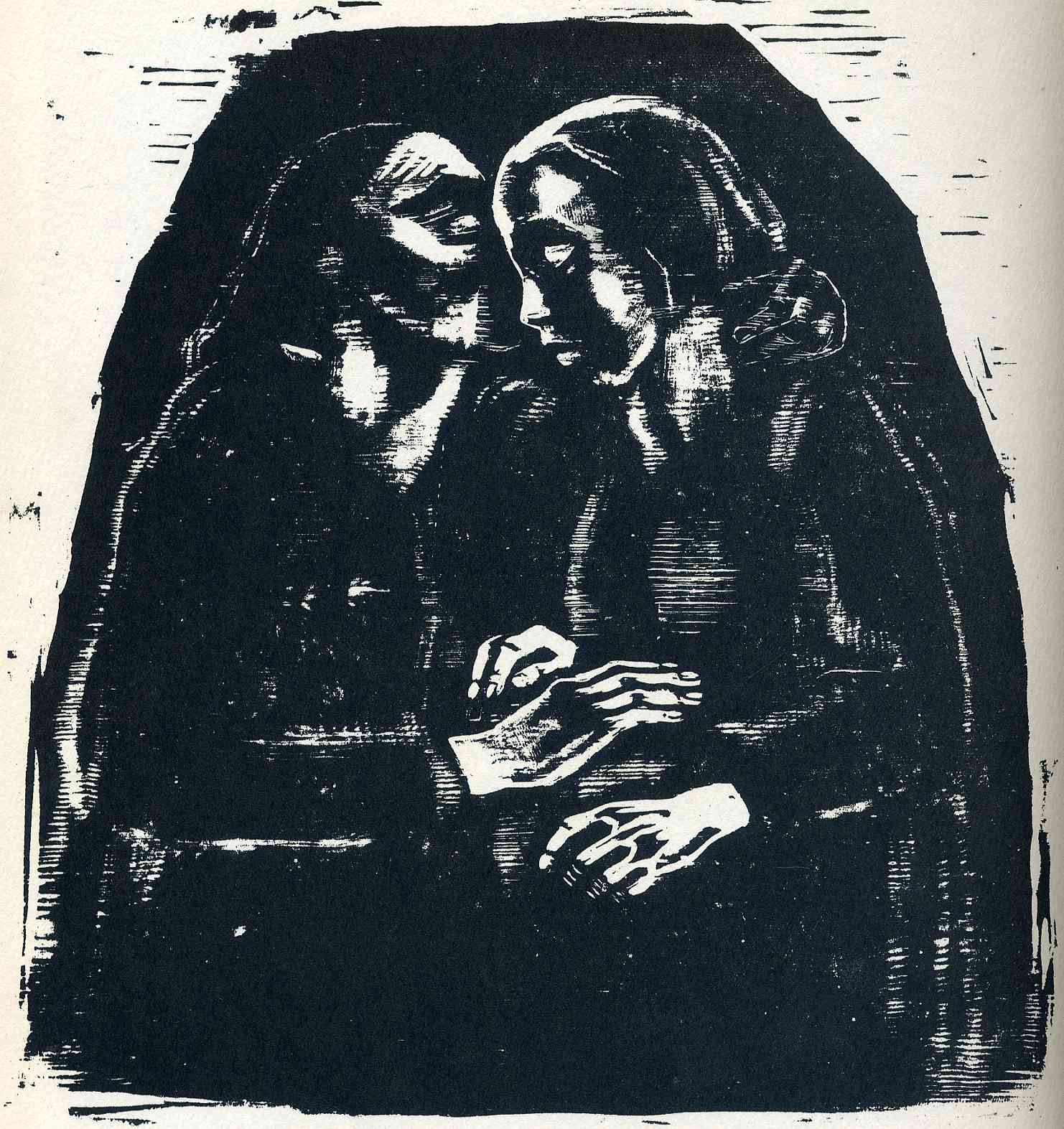
Artwork: “Mary and Elizabeth” by Kathe Kollwitz (1867-1945)

This improvisation came out rather dark in tone, and I hope that the Kollwitz print is a good match to it. I made another attempt at Sonata Form, with the exposition of the two tunes in A minor and C minor, a development mixing the two, and a rather abrupt return to the tonic for recapitulation. I remind myself that the only way I can become thoroughly comfortable with a form is by frequent use of it.

Kollwitz was born in East Prussia, and worked in Germany through two wars. The younger of her two sons died in World War I, greatly influencing the direction of her art for the rest of her life. A committed pacifist and socialist, the Nazi government forced her to resign her teaching position in 1933. All of her work was removed from German museums and she and her husband were threatened by the Gestapo. She continued to work through the later 1930’s, creating a major cycle of lithographs on “Death.” Her Berlin house was destroyed in a bombing raid in 1943, along with much of her work. Two hundred and seventy five etchings, woodcuts, and lithographs survive, enough to secure her reputation as one of the leading artists of twentieth century Germany.

************

J. S. Bach: Two settings of Meine Seele erhebt den Herren (My soul doth magnify the Lord)
from the Schübler Chorales (BWV 648)
Fugue on the Magnificat (BWV 733)

These settings are a textbook for working with minimal material, for the tune is essentially no more than a psalm tone, two phrases. From this, Bach creates masterpieces.

In the first, Bach weaves an ostinato (first presented as a solo in the pedals) around the tune, creating a quiet, intense setting. The artwork is by Rembrandt; I love the quiet grace of the two women in the center of the painting, the light radiating from them.

Artwork: “The Visitation” by Rembrandt (1640)

For the second setting, Bach takes the first phrase of the psalm tone and makes it the subject for a fugue on full organ, organo pleno and bursting with energy. It is for manuals only until the tune finally appears in the pedals at a most profound climax of intensity.

Here, I have included a painting by Henry Ossawa Tanner, who has become one of my favorite twentieth-century American artists. Mary walks in the door, and Elizabeth, sitting at her kitchen table, recognizes that the world has changed forever: “He hath put down the mighty from their seat, and hath exalted the humble and meek.”

Artwork: “The Visitation” by Henry Ossawa Tanner (1910)

*******************
I will not post again before the Twelve Days; thus, I wish for all of you a most joyful and holy Christmas. The world has indeed changed forever.

The Lord be with you

I do not intend to see the new Star Wars movie.
But I saw the first one many years ago. In those days (and often since then), people would use a movie line as a good wish: "May the Force be with you." I have heard it several times in the last week.

I have grown increasingly uncomfortable with the worldview behind that: an impersonal Force, complete with a Dark Side. The Force enables one to perform superhuman exploits, for good or ill - in essence, Magical Thinking, the notion that we can somehow influence Hidden Powers to bend the universe for our personal benefit. But that is ill-tempered on my part. It is just a movie, though its influence on popular culture has been considerable. I have many young friends who love the Star Wars movies and characters, so I will say no more.

Except for this: We have something greater than any Force -- a Person. So when we say something as common as "The Lord be with you" and respond "And with thy spirit," this is not a trivial wish.

The Lord is not going to bend the universe for our personal benefit, and he is not to be manipulated into anything. But he is our Friend, and he will be with you (and me) in life and death. That is good enough for me, and I wish it for you:

The Lord be with you.