July 12: The Lord's Day
I head into the District, with hopes of attending the 8:00 Mass at Ascension and St. Agnes on New York Avenue. It is a fine Anglo-Catholic parish which I know from a previous visit, easily recognizable by its Episcopal Red door. But today, I can find no place to park.
I move on, aiming to follow US 50 downtown by the monuments to Lincoln and Washington, and across the Potomac into Virginia, but I soon find myself on Massachusetts Ave. NW instead, in the embassy district. Approaching Wisconsin Avenue, I see an imposing pseudo-Gothic building on the right; it proves to be the National Cathedral. “This will do,” I tell myself, and I easily find a parking space on Wisconsin near St. Alban's Church, the parish church that was there long before the Cathedral. I check the sign for service times at St. Alban's and note that I am late for one, early for the next, so I wander over to the Cathedral, intending to look around for a half-hour or so and go back to St. Alban's. I am put off by the notice of a $10 admission fee and almost turn back, but I also see that I could make it to their early service without being impossibly late, and I find upon entry that the $10 fee does not apply to Sunday worshippers.
The service is downstairs in the Bethlehem Chapel, a crypt-like room that seats about two hundred and is on this day about half full. To my delight, it is Rite One, with Eastward celebration (that is, the Celebrant joins the people in facing east, toward Jerusalem that is and that shall be). It is a solid and dignified Low Church liturgy with no bells, no kneeling or crossing of oneself. I am glad that I am here, rather than upstairs in the main church for the 10:00 service. As I depart (going through the upstairs nave) I listen briefly to the visiting choir and organist who are completing their preparations.
The authorities have supplanted the handsome high altar, barely visible in the distance, with a nondescript (but large) table on what looks to be a platform extending out into the crossing. Behind the table (which I prefer not to dignify by calling it an altar), the choir is seated on risers which run horizontally in front of the choir screen, mostly obscuring what is beyond. The real Altar and divided Choir are blocked off. Perhaps they open it up during the week for the tourists.
July 13-14: Monday and Tuesday
Having prayed at the graves of my father and mother on Sunday late and Monday early, I head westward for Iowa and what is now my home. It is a road I have often travelled and described on other occasions, a final opportunity for solitude and prayer.
One of my goals for the Camino was to form the habit of praying the Little Offices. I have come to where I do reasonably well with Matins and Evensong and Compline. I silently pray a Little Office upon first waking, before rising from bed; I described it towards the end of this essay.
But I have never managed to say the Noontime office regularly, nor the other Little Hours of the day, Terce and None. I am most often “too busy,” rushing from one task to the next. What a miserable excuse! These offices take five minutes or less, and I easily waste that much time every day. More: I suspect that were I to interpose them between tasks, I would no longer find myself to be rushing.
As a beginning, I determined to make them a part of my routine for the Camino. Whenever I stopped the car for a break, which was every hour or two, I stretched, said the Office with an eight-verse section of Psalm 119, a New Testament verse chosen pretty much at random, and a Collect, then did other things. If it was a fuel stop, I attended to that, moved the car, then stretched and prayed. After a while it did become habit, and I worked all the way through Psalm 119.
Afterword: July 15 and following
I arrived home Tuesday evening. Wednesday was a busy day of grocery shopping, errands, sorting ten days of mail and paying bills, washing the Toyota. And Thursday found me back at the church. I had come home early to begin work on a Beethoven transcription for Saturday's funeral, and it proved that I needed every bit of these three days to prepare it, along with the other music for Saturday and Sunday. But I did not feel like work, nor did I work efficiently – and that dratted time log will indicate it, with too many and too lengthy breaks.
Still, I have managed to continue with the Little Offices on Wednesday and the days back at the church. Every practice break this week, I stretch, use the bathroom, say the Office. Then back to the organ. If I can continue with this, it will be well, even if I do not succeed in carrying the pattern forward into office work (of which I have done little this week). Here too it would do me good to take better breaks – stretch, say the Office – instead of the pattern I fall into when I am stressed, which tends to involve more chocolate than is good for me.
The test will come when I have my next normal Tuesday, with its staff meeting and most often a list of Must Do Right Now tasks coming out of it, tasks that typically take the rest of the day. Can I insert a Little Office between the staff meeting and the first of these tasks? Can they not wait even five minutes?
For the Camino continues. The Toyota has done its part, taking me some 2500 miles, but the Road still lies ahead, its End glimpsed rarely and then only through the mists, dimly. And the Offices are one of the ways in which we catch these glimpses.
Although my time log is ugly, I have on the whole worked the balance of this week and the weekend with a better spirit and a greater awareness of the One who walks with us, telling us of Himself in the Scriptures and the faces of the people we meet. That is not something that can be measured on a sheet of fifteen-minute intervals.
Next up: the RSCM Course. I go to it this year with more worries than usual, or perhaps hopes more than worries, that our new choristers coming to their first Course will prosper, and that my friends back home will find rest from their labors and stresses.
I am grateful that I can entrust these young people, so precious to me, to the likes of Weezer and Michael and Eddie and Caitlin and Jennifer – and now Mike and Jenna. And Debra and Debbie and Kristin. And I am glad that, Lord willing, I will see these my friends tomorrow and sing with them.
Showing posts with label travel. Show all posts
Showing posts with label travel. Show all posts
Sunday, July 19, 2015

the Great Roads, and a Sunken Lane
US 30 is one of the Great Roads, stretching from the boardwalk of Atlantic City to to the mouth of the Columbia River in the west. I drive eastward, the towns ever closer together, the buildings now often in the old Federal style of the early 1800's.
Mansfield, Ohio, about halfway across the state: the first Hill. But I am too busy to admire it, for the road has of a sudden become urban, crowded, and under construction. To my mind, this town of Mansfield marks the uttermost edge of the Midwest; I am entering the Rust Belt, the old industrial heartland centered on Cleveland and Pittsburgh. At Wooster, I leave US 30, dropping south on US 250 through Amish country, and on down a bit of Interstate 79 to the Ohio River, Parkersburg, and US 50. This is another of the Great Roads, from Ocean City and Assateague Island on the Maryland coast through the District of Columbia and westwards, eventually reaching Sacramento, California. I drive it through the forest-clad mountains of West Virginia as far as Clarksburg. Discouraged by traffic and construction (much of it truck traffic obviously related to the fracking industry, about which I will not here write), I turn north again, to Morgantown and Interstate 68.
Few people know the western part of Maryland, tucked between the Potomac River and the Mason-Dixon Line, a land of mountains and long fertile valleys. After two hours of white-knuckle high speed traffic on the Interstates, I look forward to the Maryland Welcome Center, just across the state line from West Virginia. It is early, still two hours until sunset, but seeing that the center is permanently closed due to state budget cuts, I worry about finding a place to lay my head further east. There have been other rest area closings on my journey, all of them appearing to be for lack of money, and the areas that are open have deferred a lot of maintenance.
Here, the rest area remains open; it is just the welcome center building that is boarded up. I stop for the day, claiming a picnic table up the hill behind the parking lot, looking out over the lake and river far below, the mountain ridges hazy and blue, three of them visible from here, one behind the other, all covered with forest. The hot afternoon settles into evening, the storm clouds that have trailed me for two days piling high in the west. I write, and eat a picnic supper. I begin Evensong, watching a curtain of rain approach in the valley. The rain comes while I am saying the Collects, driving me undercover into the Toyota. It proves to be a brief, intense squall; behind it, the clouds scatter, with the promise of a clear evening and a fine cool breeze.
I settle in for the night, listening to a CD of some of my own work, piano improvisations, and looking out over the mountains until they disappear in the darkness. A few stars appear in the sky.
July 8 - Wednesday
The rain returned after midnight, this time steady, settling in for a long stay. At dawn, the valley was entirely shrouded in mist, invisible.
Today is a short travel day, less than two hundred miles. But the temptation to Not Pray is present, as ever: Get Going!!!! Don't waste time here; you have miles to go. Matins is long enough, but the Litany as well?
Yes, the Litany; it is Wednesday.
As always, once I begin the Office, sitting in the Toyota with the rain drumming on the roof, it proves worthwhile. I find this to be more generally true, applying to any endeavor that takes a bit of effort – practicing, exercise, household chores. Starting is often the hardest part.
Matins and Litany completed, breakfast eaten, shaved and cleaned up in the rest area bathroom, I roll out, ending a fifteen-hour stay in this place.
No wonder my wife refuses to travel with me.
10:30 am – Sideling Hill, Maryland, on I-68.
This parallels US 40, the old National Road. It was a child of that most visionary of presidents, Mr. Jefferson. He obtained Congressional authorization for this road, which runs from Baltimore and points east across the Alleghenies to Indianapolis and St. Louis, fulfilling Jefferson's vision of a link between the Thirteen States and the new Louisiana Purchase.
The interstate climbs through an impressive man-made gap in the hill (there is a good photograph in the Wikipedia link), with a rest area near the top. Again, the exhibit center is permanently closed due to a “$280 million budget reduction package.” But the pedestrian bridge across the highway remains. I hike across to the westbound side, where the empty exhibit center remains, gradually crumbling from neglect, for there is something which I must revisit. There it is, down at the end of the parking lot, entirely ignored by the other travellers: the Vietnam Veterans' Memorial for the State of Maryland. It is a large native stone with a plaque, under some shade trees with a black POW/MIA flag and a magnificent view of the valley eastward, noting that this highway, Interstate 68, is dedicated to these Veterans.
It was here, in Vietnam, that we got seriously off-track. Our role in the Second World War, in which both of my parents served, was just, insofar as we can judge such things, and more just perhaps than we knew at the time, for the immensity of what the Nazis were up to did not become clear until the end. And Korea – it seemed equally just, for we were standing alongside a small country struggling to be free and find its own way in the world (as South Korea has in the years since). At first, Vietnam appeared to be another Korea. But it proved more complicated than that.
The Vietnam War ended with the fall of Saigon in 1975, forty years ago. The remaining veterans are old now, and will soon be gone (and I with them, for I am at the very tail end of that generation, the last birth-year of the draft lottery). But so long as I live, I will not forget.
I cannot pass so near without a stop at another place of memory: the Antietam Battlefield. I wrote of it here, on the anniversary of that fearsome day.
Today, I walk the Sunken Road, which was the center of the Confederate line. For a place that is so large in its significance to American history, its small size was surprising. It is an old farm lane sunk down under years of wagon traffic about six or seven feet below the neighboring fields, with a rail fence at the top, similar to an old county road on my farm, and hardly more than one or two hundred yards long. On September 17, 1862, the division of D. H. Hill, between 2000 and 2500 men, many of whom had already suffered from heavy fighting on the left flank of the army that morning, faced a frontal assault by some ten to twelve thousand Federals, all of them fresh and ready for battle.
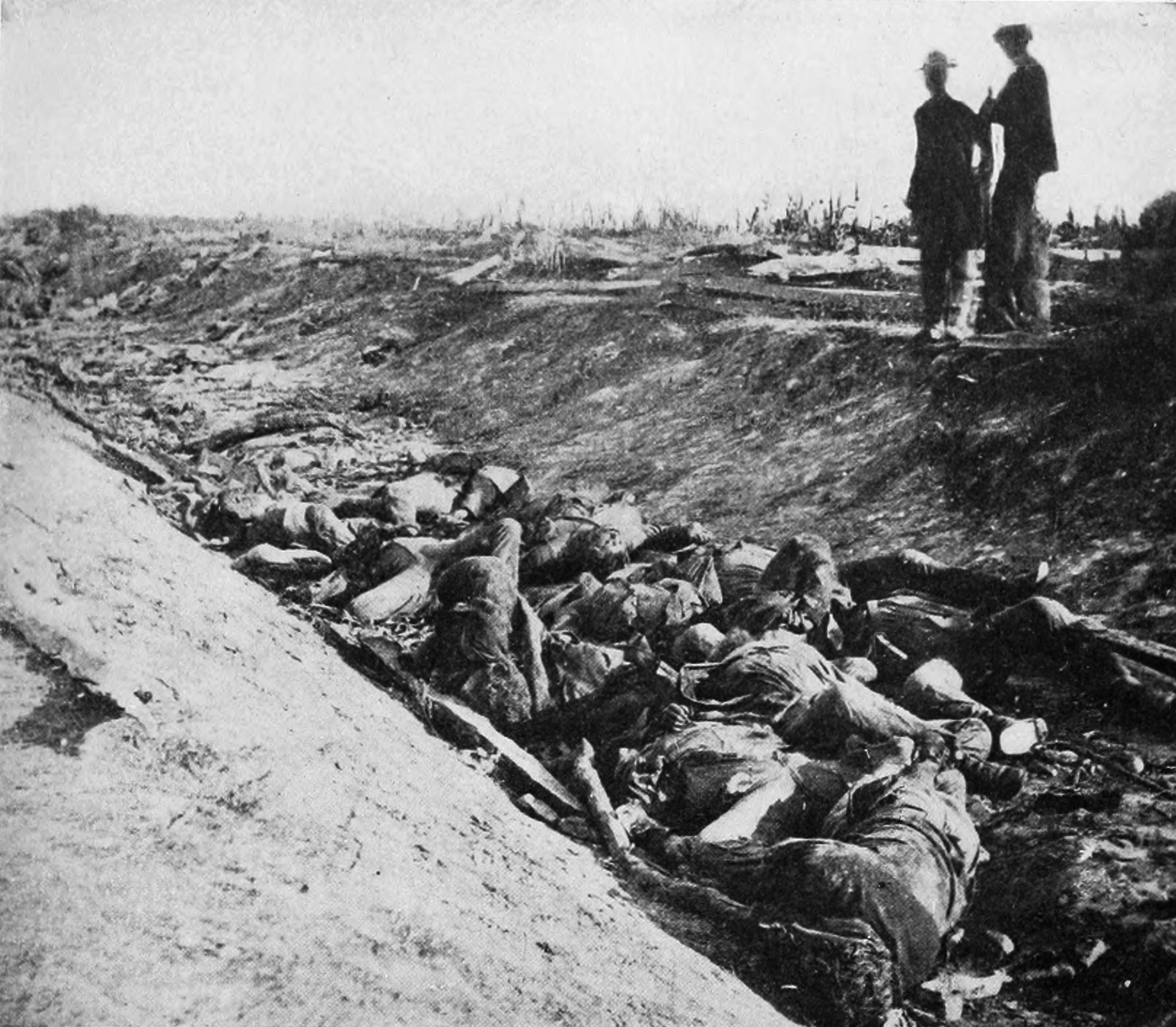
After a terrible three-hour struggle, the Federals managed to gain a foothold at one end of the lane. From there they poured fire down the lane, breaking the Confederate position. Photographs such as this one, a few days later, showed the bodies of the Confederate soldiers “stacked like cordwood” in the lane. “We were shooting them like sheep in a pen,” one of the New York soldiers later wrote.
On this one day, more American soldiers fell than in the Revolution, the War of 1812, and the Mexican War combined.
A middle-aged woman who had been working as a clerk in the U.S. Patent Office, Clara Barton, had just the previous month gained permission to serve as a nurse on the front lines, where women had previously not been allowed. She was there at Antietam that day, and the events and suffering of that time started her on a path that led to the founding of the American Red Cross in 1881. That struggle involved her in arguments against those who maintained that such an organization was not needed because the United States “would never again face a calamity like the Civil War.” She knew better.
July 9-11
My mission for the week is a visit with my sister and her husband in suburban Maryland. I will say little of these days; they were quiet, and a renewal of such family ties as I have.
I had intended a visit to my cousins. All but one of them live within a ten-mile radius in southern West Virginia, an area that also includes my farm. A funeral scheduled for July 18 has lopped two days from the vacation, so I will see neither farm nor cousins.
But there is one other visit in West Virginia that I am not going to cancel.
(to be continued)
Mansfield, Ohio, about halfway across the state: the first Hill. But I am too busy to admire it, for the road has of a sudden become urban, crowded, and under construction. To my mind, this town of Mansfield marks the uttermost edge of the Midwest; I am entering the Rust Belt, the old industrial heartland centered on Cleveland and Pittsburgh. At Wooster, I leave US 30, dropping south on US 250 through Amish country, and on down a bit of Interstate 79 to the Ohio River, Parkersburg, and US 50. This is another of the Great Roads, from Ocean City and Assateague Island on the Maryland coast through the District of Columbia and westwards, eventually reaching Sacramento, California. I drive it through the forest-clad mountains of West Virginia as far as Clarksburg. Discouraged by traffic and construction (much of it truck traffic obviously related to the fracking industry, about which I will not here write), I turn north again, to Morgantown and Interstate 68.
Few people know the western part of Maryland, tucked between the Potomac River and the Mason-Dixon Line, a land of mountains and long fertile valleys. After two hours of white-knuckle high speed traffic on the Interstates, I look forward to the Maryland Welcome Center, just across the state line from West Virginia. It is early, still two hours until sunset, but seeing that the center is permanently closed due to state budget cuts, I worry about finding a place to lay my head further east. There have been other rest area closings on my journey, all of them appearing to be for lack of money, and the areas that are open have deferred a lot of maintenance.
Here, the rest area remains open; it is just the welcome center building that is boarded up. I stop for the day, claiming a picnic table up the hill behind the parking lot, looking out over the lake and river far below, the mountain ridges hazy and blue, three of them visible from here, one behind the other, all covered with forest. The hot afternoon settles into evening, the storm clouds that have trailed me for two days piling high in the west. I write, and eat a picnic supper. I begin Evensong, watching a curtain of rain approach in the valley. The rain comes while I am saying the Collects, driving me undercover into the Toyota. It proves to be a brief, intense squall; behind it, the clouds scatter, with the promise of a clear evening and a fine cool breeze.
I settle in for the night, listening to a CD of some of my own work, piano improvisations, and looking out over the mountains until they disappear in the darkness. A few stars appear in the sky.
July 8 - Wednesday
The rain returned after midnight, this time steady, settling in for a long stay. At dawn, the valley was entirely shrouded in mist, invisible.
Today is a short travel day, less than two hundred miles. But the temptation to Not Pray is present, as ever: Get Going!!!! Don't waste time here; you have miles to go. Matins is long enough, but the Litany as well?
Yes, the Litany; it is Wednesday.
As always, once I begin the Office, sitting in the Toyota with the rain drumming on the roof, it proves worthwhile. I find this to be more generally true, applying to any endeavor that takes a bit of effort – practicing, exercise, household chores. Starting is often the hardest part.
Matins and Litany completed, breakfast eaten, shaved and cleaned up in the rest area bathroom, I roll out, ending a fifteen-hour stay in this place.
No wonder my wife refuses to travel with me.
10:30 am – Sideling Hill, Maryland, on I-68.
This parallels US 40, the old National Road. It was a child of that most visionary of presidents, Mr. Jefferson. He obtained Congressional authorization for this road, which runs from Baltimore and points east across the Alleghenies to Indianapolis and St. Louis, fulfilling Jefferson's vision of a link between the Thirteen States and the new Louisiana Purchase.
The interstate climbs through an impressive man-made gap in the hill (there is a good photograph in the Wikipedia link), with a rest area near the top. Again, the exhibit center is permanently closed due to a “$280 million budget reduction package.” But the pedestrian bridge across the highway remains. I hike across to the westbound side, where the empty exhibit center remains, gradually crumbling from neglect, for there is something which I must revisit. There it is, down at the end of the parking lot, entirely ignored by the other travellers: the Vietnam Veterans' Memorial for the State of Maryland. It is a large native stone with a plaque, under some shade trees with a black POW/MIA flag and a magnificent view of the valley eastward, noting that this highway, Interstate 68, is dedicated to these Veterans.
It was here, in Vietnam, that we got seriously off-track. Our role in the Second World War, in which both of my parents served, was just, insofar as we can judge such things, and more just perhaps than we knew at the time, for the immensity of what the Nazis were up to did not become clear until the end. And Korea – it seemed equally just, for we were standing alongside a small country struggling to be free and find its own way in the world (as South Korea has in the years since). At first, Vietnam appeared to be another Korea. But it proved more complicated than that.
The Vietnam War ended with the fall of Saigon in 1975, forty years ago. The remaining veterans are old now, and will soon be gone (and I with them, for I am at the very tail end of that generation, the last birth-year of the draft lottery). But so long as I live, I will not forget.
I cannot pass so near without a stop at another place of memory: the Antietam Battlefield. I wrote of it here, on the anniversary of that fearsome day.
Today, I walk the Sunken Road, which was the center of the Confederate line. For a place that is so large in its significance to American history, its small size was surprising. It is an old farm lane sunk down under years of wagon traffic about six or seven feet below the neighboring fields, with a rail fence at the top, similar to an old county road on my farm, and hardly more than one or two hundred yards long. On September 17, 1862, the division of D. H. Hill, between 2000 and 2500 men, many of whom had already suffered from heavy fighting on the left flank of the army that morning, faced a frontal assault by some ten to twelve thousand Federals, all of them fresh and ready for battle.
After a terrible three-hour struggle, the Federals managed to gain a foothold at one end of the lane. From there they poured fire down the lane, breaking the Confederate position. Photographs such as this one, a few days later, showed the bodies of the Confederate soldiers “stacked like cordwood” in the lane. “We were shooting them like sheep in a pen,” one of the New York soldiers later wrote.
On this one day, more American soldiers fell than in the Revolution, the War of 1812, and the Mexican War combined.
A middle-aged woman who had been working as a clerk in the U.S. Patent Office, Clara Barton, had just the previous month gained permission to serve as a nurse on the front lines, where women had previously not been allowed. She was there at Antietam that day, and the events and suffering of that time started her on a path that led to the founding of the American Red Cross in 1881. That struggle involved her in arguments against those who maintained that such an organization was not needed because the United States “would never again face a calamity like the Civil War.” She knew better.
July 9-11
My mission for the week is a visit with my sister and her husband in suburban Maryland. I will say little of these days; they were quiet, and a renewal of such family ties as I have.
I had intended a visit to my cousins. All but one of them live within a ten-mile radius in southern West Virginia, an area that also includes my farm. A funeral scheduled for July 18 has lopped two days from the vacation, so I will see neither farm nor cousins.
But there is one other visit in West Virginia that I am not going to cancel.
(to be continued)
Saturday, July 18, 2015
mi Camino (part one)
July 6: Jan Hus, Martyr
2:45 pm – Chenea, Illinois. I am in the town park, which shares its twelve-space parking lot with the Chenea Public Library, a cute little white frame building with black trim which might have been a two-room school or small church back in the day, now well-kept and neat – and on this day, busy. A steady traffic of teenagers and children come and go as I write, all of them on foot in this small town where one can easily walk from one end to the other.
Around here it it flat as far as the eye can see. I am headed due east on US 24, which makes a straight line from the Mississippi River at Burlington, Iowa across Illinois and most of Indiana, almost all the way to Fort Wayne. Often, the two-lane road stretches to the horizon with its utility poles alongside. Straight ahead.
On this, the first day of my vacation, I must let go.
Too much lies on my desk back in Iowa, where I “have left undone those things which [I] ought to have done” (BCP p. 41). “And there is no health in us,” as the old Prayerbook continues. I feel that, for sure.
Through May and June, I worked hard, alongside my dear fellow-laborers in Christ – choristers, staff colleagues. Student recitals, the chamber music festival, Vacation Bible School, to say nothing of the ongoing round of Sunday music, including three Principal Feasts. And now, a governing committee wants a daily accounting of our work for July, itemized in fifteen-minute segments and pigeonholed into assigned categories. Not May, not June. July – when I am taking my first extended vacation in two years, when there are no choral rehearsals (other than RSCM, where I am a chorister and not a director) – and most of all, when I am so worn out that I am not working efficiently. I do not know what the Powers that Be intend with this, but I am certain it is Not Good. I do not fear for myself: I am old, and they are welcome to fire me and see how things go in the aftermath. I do worry about the others, my friends who pour themselves out as an oblation to the LORD and are underpaid for their work as it is.
But I must let go.
One of my friends walked the Camino pilgrimage in France and Spain a few months ago; this is my Camino, this drive through the tidy little Midwestern towns and the vast fields of corn and beans. I breathe my prayer: “Deo... gratias...” mile after mile, the windows of the Toyota rolled down, watching the thunderclouds build in the hot afternoon.
9:15 (now Eastern Time, having left the Central Time Zone a while back). I sing Evensong in the parking lot of a Marathon gas station and truck stop, still on US 24, outside of Wabash, Indiana, standing by the Toyota and watching the sun set into the towering dark clouds to the west.
As the road crosses the Hoosier State, the terrain begins to be not so flat. At least in places, it is now rolling countryside. No genuine hills yet; they are still several hundred miles to the east. But there are now Trees, many more of them, green and beautiful. There are stretches of the road where it is entirely among them, no corn or beans in sight. The towns are closer together, too.
I had thought to stay the night here, but as darkness falls, the lot fills with pickup trucks, most of them old and rusty and all carrying tough-looking young men in their teens and twenties, gathering to hang out and drink.
One of them notices me quietly singing my prayers and reading Scripture, and comes over, asking about my Iowa plates. He proves to be a fine young man, and tells me about places to fish in the area, especially the local state park with its reservoir. Later, I recall camping there, perhaps ten or twelve years ago. I remember the sun rising in a clear sky over the lake, the birds singing.
But I move on.
July 7 – Tuesday
I landed at another Marathon station, this one in Markle, Indiana on US 224. I parked in the back corner of the lot and rested well.
Time was when I carried my tent and camping supplies. But I have learned that I am equally comfortable sleeping in the car, and it is much easier. No campground to find (often well off from the highway, and sometimes with excessive fees), no tent to set up and strike the next day – and carry in the car, often wet and dirty. Just park the car, move to the passenger seat, lean it back all the way, and sleep. There have been two occasions where I felt unsafe and moved on – but there have been campgrounds where I have felt equally unsafe.
At first light, I pray the little Office, get out of the car, and stretch. Behind the lot is a residential neighborhood, so I walk, needing the exercise. In a few blocks I am in the two-block downtown. The old buildings are still mostly well-kept, but many of the storefronts are vacant. A church, a post office, the library tucked into one of the storefronts, a couple of restaurants, a few shops.
At one end of town is the Veteran's Park, on a quarter-acre lot. I salute the flag and say a prayer, thinking of the Indiana farm boys from this and the neighboring township who died far from home, fighting foreign wars that were not of their making.
I honor the Stars and Stripes for the same reason that I honor the Stars and Bars of the Confederate States of America – I remember the men and women who fought under these banners.
By the time I return to the Marathon station, the lot is filling, and I am not a paying customer. I want to sing Matins, but it is clear that I should move on.
Through most of Ohio, US 30 is a fine four-lane divided highway, much less travelled than the busy I-70 which parallels it some ways further south. About 9 am, I stop at one of the full-scale rest areas on this road, near Lima. It proves to be a much better place to wash up and pray Matins, which I do in the back of the little park under a grove of buckeye trees, mixed with oaks. Buckeyes grow in West Virginia – there are some of them on my farm – but I don't recall seeing them further South or West. I am glad to be in their company, and that of an eagle who floats overhead for much of the time, riding the gusty winds of what looks to be an unsettled and possibly stormy day.
I am here for an hour and a half. This is why I travel – the long silences, the wind blowing in my ears, the wide flat fields in the early morning wet with dew, the Offices prayed outdoors for the most part, the times when I sit at a picnic table and write, as I am doing now.
There is a wholesome strength to these farm states of the upper Midwest that has not altogether disappeared. Compared to the South, the farmsteads are tidier, the houses and small towns are not so run down, the people seem to take pride in their communities and their work in a different way than what one sees in the South, or the cities of the Atlantic seaboard. When the United States falls apart someday, this region might be the seed for a new beginning.
It is time to move on.
2:45 pm – Chenea, Illinois. I am in the town park, which shares its twelve-space parking lot with the Chenea Public Library, a cute little white frame building with black trim which might have been a two-room school or small church back in the day, now well-kept and neat – and on this day, busy. A steady traffic of teenagers and children come and go as I write, all of them on foot in this small town where one can easily walk from one end to the other.
Around here it it flat as far as the eye can see. I am headed due east on US 24, which makes a straight line from the Mississippi River at Burlington, Iowa across Illinois and most of Indiana, almost all the way to Fort Wayne. Often, the two-lane road stretches to the horizon with its utility poles alongside. Straight ahead.
On this, the first day of my vacation, I must let go.
Too much lies on my desk back in Iowa, where I “have left undone those things which [I] ought to have done” (BCP p. 41). “And there is no health in us,” as the old Prayerbook continues. I feel that, for sure.
Through May and June, I worked hard, alongside my dear fellow-laborers in Christ – choristers, staff colleagues. Student recitals, the chamber music festival, Vacation Bible School, to say nothing of the ongoing round of Sunday music, including three Principal Feasts. And now, a governing committee wants a daily accounting of our work for July, itemized in fifteen-minute segments and pigeonholed into assigned categories. Not May, not June. July – when I am taking my first extended vacation in two years, when there are no choral rehearsals (other than RSCM, where I am a chorister and not a director) – and most of all, when I am so worn out that I am not working efficiently. I do not know what the Powers that Be intend with this, but I am certain it is Not Good. I do not fear for myself: I am old, and they are welcome to fire me and see how things go in the aftermath. I do worry about the others, my friends who pour themselves out as an oblation to the LORD and are underpaid for their work as it is.
But I must let go.
One of my friends walked the Camino pilgrimage in France and Spain a few months ago; this is my Camino, this drive through the tidy little Midwestern towns and the vast fields of corn and beans. I breathe my prayer: “Deo... gratias...” mile after mile, the windows of the Toyota rolled down, watching the thunderclouds build in the hot afternoon.
9:15 (now Eastern Time, having left the Central Time Zone a while back). I sing Evensong in the parking lot of a Marathon gas station and truck stop, still on US 24, outside of Wabash, Indiana, standing by the Toyota and watching the sun set into the towering dark clouds to the west.
As the road crosses the Hoosier State, the terrain begins to be not so flat. At least in places, it is now rolling countryside. No genuine hills yet; they are still several hundred miles to the east. But there are now Trees, many more of them, green and beautiful. There are stretches of the road where it is entirely among them, no corn or beans in sight. The towns are closer together, too.
I had thought to stay the night here, but as darkness falls, the lot fills with pickup trucks, most of them old and rusty and all carrying tough-looking young men in their teens and twenties, gathering to hang out and drink.
One of them notices me quietly singing my prayers and reading Scripture, and comes over, asking about my Iowa plates. He proves to be a fine young man, and tells me about places to fish in the area, especially the local state park with its reservoir. Later, I recall camping there, perhaps ten or twelve years ago. I remember the sun rising in a clear sky over the lake, the birds singing.
But I move on.
July 7 – Tuesday
I landed at another Marathon station, this one in Markle, Indiana on US 224. I parked in the back corner of the lot and rested well.
Time was when I carried my tent and camping supplies. But I have learned that I am equally comfortable sleeping in the car, and it is much easier. No campground to find (often well off from the highway, and sometimes with excessive fees), no tent to set up and strike the next day – and carry in the car, often wet and dirty. Just park the car, move to the passenger seat, lean it back all the way, and sleep. There have been two occasions where I felt unsafe and moved on – but there have been campgrounds where I have felt equally unsafe.
At first light, I pray the little Office, get out of the car, and stretch. Behind the lot is a residential neighborhood, so I walk, needing the exercise. In a few blocks I am in the two-block downtown. The old buildings are still mostly well-kept, but many of the storefronts are vacant. A church, a post office, the library tucked into one of the storefronts, a couple of restaurants, a few shops.
At one end of town is the Veteran's Park, on a quarter-acre lot. I salute the flag and say a prayer, thinking of the Indiana farm boys from this and the neighboring township who died far from home, fighting foreign wars that were not of their making.
I honor the Stars and Stripes for the same reason that I honor the Stars and Bars of the Confederate States of America – I remember the men and women who fought under these banners.
By the time I return to the Marathon station, the lot is filling, and I am not a paying customer. I want to sing Matins, but it is clear that I should move on.
Through most of Ohio, US 30 is a fine four-lane divided highway, much less travelled than the busy I-70 which parallels it some ways further south. About 9 am, I stop at one of the full-scale rest areas on this road, near Lima. It proves to be a much better place to wash up and pray Matins, which I do in the back of the little park under a grove of buckeye trees, mixed with oaks. Buckeyes grow in West Virginia – there are some of them on my farm – but I don't recall seeing them further South or West. I am glad to be in their company, and that of an eagle who floats overhead for much of the time, riding the gusty winds of what looks to be an unsettled and possibly stormy day.
I am here for an hour and a half. This is why I travel – the long silences, the wind blowing in my ears, the wide flat fields in the early morning wet with dew, the Offices prayed outdoors for the most part, the times when I sit at a picnic table and write, as I am doing now.
There is a wholesome strength to these farm states of the upper Midwest that has not altogether disappeared. Compared to the South, the farmsteads are tidier, the houses and small towns are not so run down, the people seem to take pride in their communities and their work in a different way than what one sees in the South, or the cities of the Atlantic seaboard. When the United States falls apart someday, this region might be the seed for a new beginning.
It is time to move on.
Wednesday, July 31, 2013
On to Richmond
July 13-14: a college, a church, and the battlefields
The annual conference of the Hymn Society was held this year on the campus of the University of Richmond, an elite private institution of higher learning. Its elegant campus sits among the wealthy estates of the River Road area of west Richmond, and I could not help thinking of the Capital and its contrast with the poverty of Districts 11 and 12 in the Hunger Games book. Such thoughts do not, however, keep me from taking two desserts from the lavish display at dinner. I am not sure that I have ever eaten in such luxury, and can well imagine what Katniss and Peeta (and Rue and Thresh and many others from the book) would have thought -- as they loaded their plates and came back for seconds and thirds. Or what some of the people elsewhere in Richmond might think.
Years ago, our church sponsored a family of refugees from the Ukraine, back during the days of Soviet rule. There were two adults and four or five children -- the adults were short and thin, the children emaciated and small. I was with them when they first encountered an American supermarket. They could not believe their eyes -- all this food! I think of them as I marvel at this cafeteria.
I understand why the UR campus is so immaculate, why its dining hall and food are so lavish: they must attract students and their tuition dollars, and many of these students come from families of privilege where they assume such luxury as their entitlement. And this is no different from other elite private colleges and universities across the country, including the one where I received my baccalaureate. But I remain uneasy about it, and aware of the fragility of this manner of life: its manicured lawns, its perfect buildings -- and, I noted, its omnipresent security force.
Sunday morning finds me at St. James' Episcopal Church, its spire the focal point at the east end of Monument Avenue in Richmond. On this summer Sunday, the church is about eighty percent full, a lively congregation of all ages, including plenty of children and teens. I am underdressed in white shirt and tie with dress slacks and shoes; almost all of the men are in suits, the women in dresses.
The liturgy is straightforward Rite Two with five hymns, all well-played and sung with vigor. We kneel at appropriate times, but at no point do I see anyone make the sign of the cross; the overall feel of the liturgy is low-church.
I take an instant dislike to the Rector, whose function this day is Talk Show Host (at the announcements) and Celebrant. He reminds me of other clergy I have known, and it is unfair of me to lump him in with them. At the least, the obvious vigor of the parish reflects well on the parish leadership, and the Rector is always part of that.
I had arrived late, slipping into a back pew during the Collect for Purity, so I am curious whether anyone would greet me at the end. The postlude is buried under an instant din of loud chatter following the dismissal. I stand in place, listening as best I can, until the organist finishes (Buxtehude, played very well), and make my way to the door. There is much friendly conversation -- it is obvious that this congregation cherishes its fellowship -- but not a word for me, not so much as a friendly smile. I might as well be invisible. I am in the line for an assisting priest at one of the three doors; she takes my hand and with an artificial smile worthy of Effie Trinket from the Hunger Games, she says "Welcome. I'm so glad you're here." I walk down the avenue to the statue of "Jeb" Stuart, who was a communicant at St. James and was buried from this parish after his death in battle. The President, Jefferson Davis, and his wife Varina, and Mrs. Lee (and Robert, when possible) attended St. Paul's Episcopal, a few blocks away. We will have a hymn festival at St. Paul's later in the week
The afternoon lies before me, free until the conference officially begins at 5:00. I drive east on Broad Street, past the even more historic St. John's Episcopal Church, site of Patrick Henry's words "Give me liberty, or give me death." I linger at the National Park Service welcome center at the top of the hill on Broad Street, site of the Chimbarazo Hospital, the Confederacy's largest. More than 70,000 patients were here during the four years of its existence, with a lower mortality rate than many modern hospitals. A young park ranger makes up with her friendliness for the clergy of St. James; I am the only visitor, and she spends some fifteen minutes telling me about the site and the other National Park Service battlefield sites around Richmond. It is far too much for one afternoon, and I quickly get lost, seeking US 360 out to the Cold Harbor battlefield. I give up, and drive the length of Broad Street back to the university.
Later in the week I visited the battlefield sites east and southeast of Petersburg, some thirty miles south of Richmond. I linger at The Crater, remembering that horrible day. Those who may have seen the movie "Cold Mountain" a few years ago will remember the battle scene early in the film; that was the Crater. Some Pennsylvania coal miners in the Union army dug a tunnel under the Confederate lines and filled it with gunpowder. The explosion immediately killed some 270 South Carolina soldiers who were in the trenches, making a thirty-foot deep crater still visible today. As was too often the case in this war, the Union soldiers were not effectively led -- their commander, Gen. James H. Ledlie, was well behind the lines, drunk -- and they were soon driven back with heavy casualties in hand-to-hand fighting in and around this crater. A division of United States Colored Troops had been specially trained for this day, and their casualties were the heaviest, the Confederate soldiers killing many of them even after they surrendered. Some were bayoneted by their own Union allies, "white soldiers who feared reprisals from victorious CSA troops" (from Wikipedia, s.v. "Battle of the Crater"). There was not such an evil day as this in all the five years of the war.
On my way back west after the conference, I followed the route taken by the Army of Northern Virginia in its retreat from Richmond and Petersburg, and I stopped at Saylor's Creek. This was where Grant's army caught up with the Confederates, who were strung out with their wagon trains over the country roads, and on this day, April 6, 1865, the Army ceased to be an effective fighting force; almost 8,000 men from the Confederate Army were captured, killed, or wounded. In the aftermath, the Union dead received honorable burial in a little cemetery that is still there at the site; the Confederates were left to be eaten by the animals, and their remains were later dumped without ceremony into unmarked mass graves.
Why do I go to places like this?
The best answer is that given by Mr. Lincoln on another battlefield:
Lincoln could not know that the "new birth of freedom" would soon be smothered by the robber barons who were already poised to take over his Republican Party and who control it to this day, and the Democratic Party as well. He could not know what a distant dream "government of the people, by the people, for the people" would become by the twenty-first century, hardly more than a bitter joke.
Perhaps he did not understand that the Confederates were fighting for such a government just as much as those on the Union side; their vision was a Jeffersonian democracy, an escape from what they saw as the tyranny of a too-powerful central government.
But Lincoln was right. So long as we remember those times, those people on both sides who, in their respective ways, fought for freedom, the dream shall not have altogether perished, and may yet in some future age become a reality.
The annual conference of the Hymn Society was held this year on the campus of the University of Richmond, an elite private institution of higher learning. Its elegant campus sits among the wealthy estates of the River Road area of west Richmond, and I could not help thinking of the Capital and its contrast with the poverty of Districts 11 and 12 in the Hunger Games book. Such thoughts do not, however, keep me from taking two desserts from the lavish display at dinner. I am not sure that I have ever eaten in such luxury, and can well imagine what Katniss and Peeta (and Rue and Thresh and many others from the book) would have thought -- as they loaded their plates and came back for seconds and thirds. Or what some of the people elsewhere in Richmond might think.
Years ago, our church sponsored a family of refugees from the Ukraine, back during the days of Soviet rule. There were two adults and four or five children -- the adults were short and thin, the children emaciated and small. I was with them when they first encountered an American supermarket. They could not believe their eyes -- all this food! I think of them as I marvel at this cafeteria.
I understand why the UR campus is so immaculate, why its dining hall and food are so lavish: they must attract students and their tuition dollars, and many of these students come from families of privilege where they assume such luxury as their entitlement. And this is no different from other elite private colleges and universities across the country, including the one where I received my baccalaureate. But I remain uneasy about it, and aware of the fragility of this manner of life: its manicured lawns, its perfect buildings -- and, I noted, its omnipresent security force.
Sunday morning finds me at St. James' Episcopal Church, its spire the focal point at the east end of Monument Avenue in Richmond. On this summer Sunday, the church is about eighty percent full, a lively congregation of all ages, including plenty of children and teens. I am underdressed in white shirt and tie with dress slacks and shoes; almost all of the men are in suits, the women in dresses.
The liturgy is straightforward Rite Two with five hymns, all well-played and sung with vigor. We kneel at appropriate times, but at no point do I see anyone make the sign of the cross; the overall feel of the liturgy is low-church.
I take an instant dislike to the Rector, whose function this day is Talk Show Host (at the announcements) and Celebrant. He reminds me of other clergy I have known, and it is unfair of me to lump him in with them. At the least, the obvious vigor of the parish reflects well on the parish leadership, and the Rector is always part of that.
I had arrived late, slipping into a back pew during the Collect for Purity, so I am curious whether anyone would greet me at the end. The postlude is buried under an instant din of loud chatter following the dismissal. I stand in place, listening as best I can, until the organist finishes (Buxtehude, played very well), and make my way to the door. There is much friendly conversation -- it is obvious that this congregation cherishes its fellowship -- but not a word for me, not so much as a friendly smile. I might as well be invisible. I am in the line for an assisting priest at one of the three doors; she takes my hand and with an artificial smile worthy of Effie Trinket from the Hunger Games, she says "Welcome. I'm so glad you're here." I walk down the avenue to the statue of "Jeb" Stuart, who was a communicant at St. James and was buried from this parish after his death in battle. The President, Jefferson Davis, and his wife Varina, and Mrs. Lee (and Robert, when possible) attended St. Paul's Episcopal, a few blocks away. We will have a hymn festival at St. Paul's later in the week
The afternoon lies before me, free until the conference officially begins at 5:00. I drive east on Broad Street, past the even more historic St. John's Episcopal Church, site of Patrick Henry's words "Give me liberty, or give me death." I linger at the National Park Service welcome center at the top of the hill on Broad Street, site of the Chimbarazo Hospital, the Confederacy's largest. More than 70,000 patients were here during the four years of its existence, with a lower mortality rate than many modern hospitals. A young park ranger makes up with her friendliness for the clergy of St. James; I am the only visitor, and she spends some fifteen minutes telling me about the site and the other National Park Service battlefield sites around Richmond. It is far too much for one afternoon, and I quickly get lost, seeking US 360 out to the Cold Harbor battlefield. I give up, and drive the length of Broad Street back to the university.
Later in the week I visited the battlefield sites east and southeast of Petersburg, some thirty miles south of Richmond. I linger at The Crater, remembering that horrible day. Those who may have seen the movie "Cold Mountain" a few years ago will remember the battle scene early in the film; that was the Crater. Some Pennsylvania coal miners in the Union army dug a tunnel under the Confederate lines and filled it with gunpowder. The explosion immediately killed some 270 South Carolina soldiers who were in the trenches, making a thirty-foot deep crater still visible today. As was too often the case in this war, the Union soldiers were not effectively led -- their commander, Gen. James H. Ledlie, was well behind the lines, drunk -- and they were soon driven back with heavy casualties in hand-to-hand fighting in and around this crater. A division of United States Colored Troops had been specially trained for this day, and their casualties were the heaviest, the Confederate soldiers killing many of them even after they surrendered. Some were bayoneted by their own Union allies, "white soldiers who feared reprisals from victorious CSA troops" (from Wikipedia, s.v. "Battle of the Crater"). There was not such an evil day as this in all the five years of the war.
On my way back west after the conference, I followed the route taken by the Army of Northern Virginia in its retreat from Richmond and Petersburg, and I stopped at Saylor's Creek. This was where Grant's army caught up with the Confederates, who were strung out with their wagon trains over the country roads, and on this day, April 6, 1865, the Army ceased to be an effective fighting force; almost 8,000 men from the Confederate Army were captured, killed, or wounded. In the aftermath, the Union dead received honorable burial in a little cemetery that is still there at the site; the Confederates were left to be eaten by the animals, and their remains were later dumped without ceremony into unmarked mass graves.
Why do I go to places like this?
The best answer is that given by Mr. Lincoln on another battlefield:
But, in a larger sense, we can not dedicate, we can not consecrate, we can not hallow this ground. The brave men, living and dead, who struggled here, have consecrated it, far above our poor power to add or detract. The world will little note, nor long remember what we say here, but it can never forget what they did here. It is for us the living, rather, to be dedicated here to the unfinished work which they who fought here have thus far so nobly advanced. It is rather for us to be here dedicated to the great task remaining before us—that from these honored dead we take increased devotion to that cause for which they gave the last full measure of devotion—that we here highly resolve that these dead shall not have died in vain—that this nation, under God, shall have a new birth of freedom—and that government of the people, by the people, for the people, shall not perish from the earth.
Lincoln could not know that the "new birth of freedom" would soon be smothered by the robber barons who were already poised to take over his Republican Party and who control it to this day, and the Democratic Party as well. He could not know what a distant dream "government of the people, by the people, for the people" would become by the twenty-first century, hardly more than a bitter joke.
Perhaps he did not understand that the Confederates were fighting for such a government just as much as those on the Union side; their vision was a Jeffersonian democracy, an escape from what they saw as the tyranny of a too-powerful central government.
But Lincoln was right. So long as we remember those times, those people on both sides who, in their respective ways, fought for freedom, the dream shall not have altogether perished, and may yet in some future age become a reality.
Tuesday, July 30, 2013
A park, a visit, and a movie
[Some of my readers may be expecting an RSCM Report. With God's grace, it should be forthcoming by the weekend. Before that, I have today's post and two more about other matters, which (to my mind) relate to what follows at RSCM.]
July 8: The Valley of Virginia
I roll up I-81 through the Virginia Highlands, the foothills again shrouded with morning mist, behind them the mountaintops blue in the distance. I had hoped to drive part of the day on the Blue Ridge Parkway which winds northeast along the ridgetops, but instead I spend three hours at the rest area near Roanoke after the long descent from Christiansburg into the Valley of Virginia. I sit at a picnic table and write my account of yesterday's visit with old friends. By the time I finish, it is three o'clock in the afternoon, a fine hot day of white cumulus and blue sky.
A road trip such as this is for me a spiritual retreat, and the writing is part of it. The Daily Office, the long silences, the solitude, the (mostly) simple food, sleeping in the car, the unfolding vista of Nature... these are my teachers and companions. It is for this that I once thought to become a truck driver so that I could be on the road all the time. But it is enough to be as it is, and I do bless the Lord for the Road, and for the coming Home at last.
As is my practice, I stop at Lexington for a brief visit to the burial places of my heroes Lee and Jackson, arriving at the Lee Chapel minutes before closing time. I buy a photograph of Lee taken a year before his death, dressed in tuxedo and bow tie as president of Washington College. It will go on my desk with my icons as a reminder of this man's diligence in his administrative work. The Episcopal Church nearby is closed for the day, but I walk out to the cemetery to Jackson's grave.
From there, I go up at last to the Parkway for the late afternoon and sunset, with a night this time in an old-fashioned motel at Buena Vista, the sort of motel where each room is an individual tiny cottage. It is run by a gentleman from the Fiji Islands, and does not appear to be prospering; one gets the impression that no one has slept in this room for a long time.
July 9-12: A drive, a backyard and a movie
On this day, I briefly stop at the Green Valley Book Fair and buy gifts for two of my co-workers, plus a book for myself. Then, it is up the mountain again; my plan is to drive the northern half of the Skyline Drive, through the Shenandoah National Park.
Yesterday, I had thought to enter the park late in the day and stay for the night in one of the campgrounds, but I thought "They will be full. It is July, right after the fourth, a holiday week." No, I could have easily stayed there instead of the motel; the campgrounds I saw were less than half full. "People don't camp out much anymore," I am told by one of the park rangers. Nor do they drive through the Park; there is almost no traffic. I hardly see two score of cars all day. I can remember visits over the years when there was heavy traffic in this park: long lines of cars, trucks with campers, motor homes.
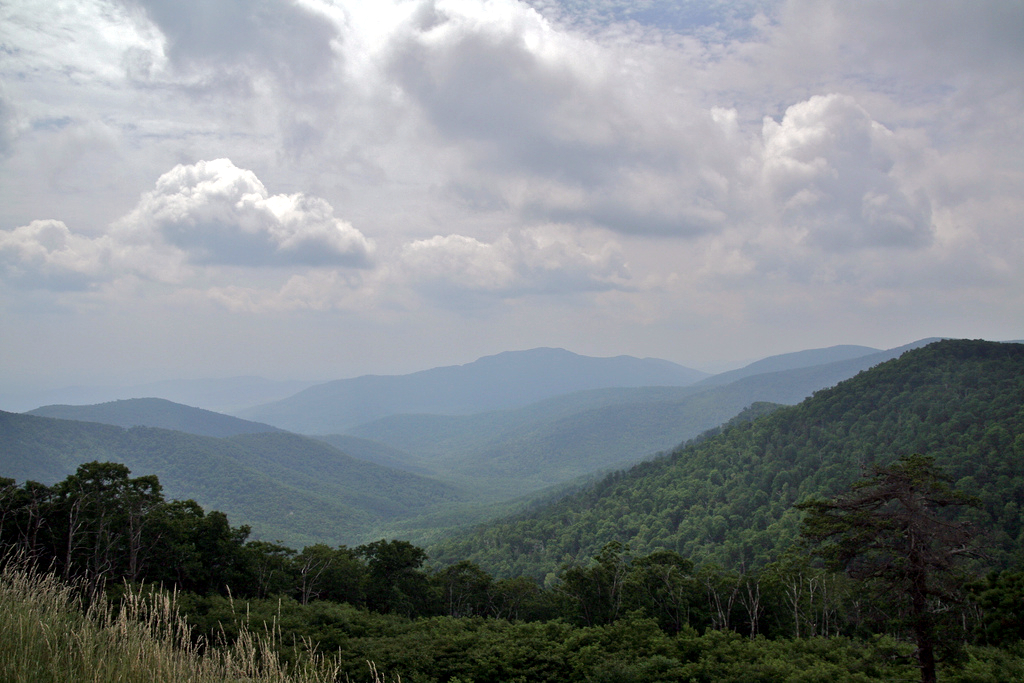
This is perhaps the most beautiful part of the Appalachians. There are plenty of opportunities for hiking, camping, and fishing in the park, and if nothing else, simply the leisurely drive along the mountaintops. If any of my readers should visit this part of the country, I highly recommend taking a day (or better, two or three) for this. Here is a typical view from the road.
By evening, I am at my sister's house, in a Maryland suburb of Washington. It is as it has been for decades; almost every horizontal surface is covered with books, knick-knacks, plants, quilting supplies. The cabinets, the many bookcases all groaning under double-shelved books -- everything overflows. There are piles of books on the floor, to the point where one can hardly enter some of the rooms. In the front yard, the old white Mitsubishi van is filled with more books, boxes of them, blue tarps lashed over it all with clothesline ropes, the tires flat. It has been no more than a storage building for ten years and more, reminding me of the old rusting cars and trucks on cinder blocks in the hill country.
Those who have seen my office may be tempted to say "It runs in the family," and they would be right. Were I not married to a Midwestern woman of Dutch descent who likes everything to be tidy, I would be just like my sister. Living with a slovenly hillbilly was a huge adjustment for her after we got married; she has improved me somewhat.
But there is a glory to this old house of my sister's, bursting at the seams with decades of clutter. It is the back yard: a riotous profusion of wildflowers, ferns, vegetables, trees, birds. Whenever an empty bit of soil becomes available, my sister puts a plant in it.
I sit in their glass-walled back room and feel as if I am in a forest, on this quarter-acre suburban lot within earshot of the Beltway. Over the almost forty years that she has lived there, she has created a little paradise. The arrangement of the plants seems random, but she has considered patterns of sun and shade, shelter from wind and frost, companion-planting principles. The result is an unstudied naturalness and beauty.
She and her husband love science fiction and fantasy -- it is she that introduced me to Tolkien in my childhood, and it is she who cajoled my parents into letting the two of us stay up late to watch the original Star Trek episodes every week. We saw three science fiction movies during my visit, including the current Star Trek movie (disappointing). One of the three movies was excellent, the one that we watched at home on DVD: "The Hunger Games." It is in part a commentary on the manner in which a small number of wealthy and powerful people, living in the "Capitol," manipulate and exploit everyone else. The protagonists are from District 12, the coal-fields, where most people live on the edge of starvation. Here is an account of the Hunger Games universe.
I am a little surprised that such an explicit indictment of the "one percent" was allowed to enter the public sphere. The lords of public opinion doubtless presume that these books and movies will have their few minutes in the spotlight and then be buried under the torrent of trivia and filth that spews endlessly from the Media.
Having seen how some of my choristers reacted to the Hunger Games, I would not be so sure. My impression is that these books and movies have entered the ongoing corpus of young adult literature every bit as much as Harry Potter. For a long time to come, young folk will read these books, see these movies, and be formed by them. The result is unknowable.
July 8: The Valley of Virginia
I roll up I-81 through the Virginia Highlands, the foothills again shrouded with morning mist, behind them the mountaintops blue in the distance. I had hoped to drive part of the day on the Blue Ridge Parkway which winds northeast along the ridgetops, but instead I spend three hours at the rest area near Roanoke after the long descent from Christiansburg into the Valley of Virginia. I sit at a picnic table and write my account of yesterday's visit with old friends. By the time I finish, it is three o'clock in the afternoon, a fine hot day of white cumulus and blue sky.
A road trip such as this is for me a spiritual retreat, and the writing is part of it. The Daily Office, the long silences, the solitude, the (mostly) simple food, sleeping in the car, the unfolding vista of Nature... these are my teachers and companions. It is for this that I once thought to become a truck driver so that I could be on the road all the time. But it is enough to be as it is, and I do bless the Lord for the Road, and for the coming Home at last.
As is my practice, I stop at Lexington for a brief visit to the burial places of my heroes Lee and Jackson, arriving at the Lee Chapel minutes before closing time. I buy a photograph of Lee taken a year before his death, dressed in tuxedo and bow tie as president of Washington College. It will go on my desk with my icons as a reminder of this man's diligence in his administrative work. The Episcopal Church nearby is closed for the day, but I walk out to the cemetery to Jackson's grave.
From there, I go up at last to the Parkway for the late afternoon and sunset, with a night this time in an old-fashioned motel at Buena Vista, the sort of motel where each room is an individual tiny cottage. It is run by a gentleman from the Fiji Islands, and does not appear to be prospering; one gets the impression that no one has slept in this room for a long time.
July 9-12: A drive, a backyard and a movie
On this day, I briefly stop at the Green Valley Book Fair and buy gifts for two of my co-workers, plus a book for myself. Then, it is up the mountain again; my plan is to drive the northern half of the Skyline Drive, through the Shenandoah National Park.
Yesterday, I had thought to enter the park late in the day and stay for the night in one of the campgrounds, but I thought "They will be full. It is July, right after the fourth, a holiday week." No, I could have easily stayed there instead of the motel; the campgrounds I saw were less than half full. "People don't camp out much anymore," I am told by one of the park rangers. Nor do they drive through the Park; there is almost no traffic. I hardly see two score of cars all day. I can remember visits over the years when there was heavy traffic in this park: long lines of cars, trucks with campers, motor homes.
This is perhaps the most beautiful part of the Appalachians. There are plenty of opportunities for hiking, camping, and fishing in the park, and if nothing else, simply the leisurely drive along the mountaintops. If any of my readers should visit this part of the country, I highly recommend taking a day (or better, two or three) for this. Here is a typical view from the road.
By evening, I am at my sister's house, in a Maryland suburb of Washington. It is as it has been for decades; almost every horizontal surface is covered with books, knick-knacks, plants, quilting supplies. The cabinets, the many bookcases all groaning under double-shelved books -- everything overflows. There are piles of books on the floor, to the point where one can hardly enter some of the rooms. In the front yard, the old white Mitsubishi van is filled with more books, boxes of them, blue tarps lashed over it all with clothesline ropes, the tires flat. It has been no more than a storage building for ten years and more, reminding me of the old rusting cars and trucks on cinder blocks in the hill country.
Those who have seen my office may be tempted to say "It runs in the family," and they would be right. Were I not married to a Midwestern woman of Dutch descent who likes everything to be tidy, I would be just like my sister. Living with a slovenly hillbilly was a huge adjustment for her after we got married; she has improved me somewhat.
But there is a glory to this old house of my sister's, bursting at the seams with decades of clutter. It is the back yard: a riotous profusion of wildflowers, ferns, vegetables, trees, birds. Whenever an empty bit of soil becomes available, my sister puts a plant in it.
I sit in their glass-walled back room and feel as if I am in a forest, on this quarter-acre suburban lot within earshot of the Beltway. Over the almost forty years that she has lived there, she has created a little paradise. The arrangement of the plants seems random, but she has considered patterns of sun and shade, shelter from wind and frost, companion-planting principles. The result is an unstudied naturalness and beauty.
She and her husband love science fiction and fantasy -- it is she that introduced me to Tolkien in my childhood, and it is she who cajoled my parents into letting the two of us stay up late to watch the original Star Trek episodes every week. We saw three science fiction movies during my visit, including the current Star Trek movie (disappointing). One of the three movies was excellent, the one that we watched at home on DVD: "The Hunger Games." It is in part a commentary on the manner in which a small number of wealthy and powerful people, living in the "Capitol," manipulate and exploit everyone else. The protagonists are from District 12, the coal-fields, where most people live on the edge of starvation. Here is an account of the Hunger Games universe.
I am a little surprised that such an explicit indictment of the "one percent" was allowed to enter the public sphere. The lords of public opinion doubtless presume that these books and movies will have their few minutes in the spotlight and then be buried under the torrent of trivia and filth that spews endlessly from the Media.
Having seen how some of my choristers reacted to the Hunger Games, I would not be so sure. My impression is that these books and movies have entered the ongoing corpus of young adult literature every bit as much as Harry Potter. For a long time to come, young folk will read these books, see these movies, and be formed by them. The result is unknowable.
Sunday, July 21, 2013
A week on the road
Wednesday, July 3: A beginning
Mrs C. helped me carry my gear to the car. "I want to see you get everything in," she said. I am traveling alone, but I will be on the road for eighteen days and have packed many things. I have what I need to sleep in the car; I have what I need for the Hymn Society conference; I have food for many days, mostly dried fruit, nuts and seeds, whole wheat tortillas, a box of granola bars, a gallon of water which I plan to replenish at rest areas. Mrs. C. shakes her head at the quantity of baggage.
Everything fits.
I am driving the new 2013 Toyota Corolla; 312 miles on the odometer as I begin what will be a journey of almost three thousand miles. One of the principal objectives of this trip is to gently break in this vehicle. The first thousand miles are critical, and if driven carefully, the engine and transmission are on their way to a long life, God willing.
I eschew the interstates for this purpose, seeking to vary the highway speed in a range from 45 to 55 miles per hour, up to 60 if I must make a foray onto the interstate (as soon proves to be the case, when part of my chosen route is closed because of flooding, with a detour to I-80, and later another twenty miles on I-74). I plan on taking frequent and long breaks, having read that in this initial break-in, one should stop for an hour or so after every two hours of driving.
This is precisely the manner in which I most love to travel cross-country.
First stop: a civic park on U.S. 6 in small-town Iowa for Matins. I have brought my Hebrew Psalter, so the appointed psalms take about a half-hour to read. Halfway through Psalm 16, an elderly man crosses the street and comes straight up to me. "Where are you from?" he asks; it is a sufficiently small town that he knows I don't live there. I tell him, and add that I am on my way Out East to visit family. I lay my office books aside and chat. His name is Skip; he is 83 years old, retired from a career as a barber; his shop used to be right across the street. We talk of the notable restaurant that used to be next to his shop; until it closed, I would try to time my trips along this road to arrive at dinnertime. Their macaroni salad, their potato salad, their versatility with what used to be called "congealed salads," were legendary. I have heard that their pork tenderloin was equally memorable, though I cannot speak to that from experience. The restaurant is no more; even the building is gone, replaced by a parking lot.
Second stop: another attempt at Matins, at a rest area on I-74 in Illinois. It is almost noon by now, and a family is having a picnic lunch nearby. The two small children eye me with curiosity. The second lesson is Philip and the Ethiopian, a good story for a day on the road. Like him, I proceed "on my way rejoicing."
Third stop: a civic park in a mid-sized town on U.S. 24, still in Illinois. It is almost 4:00 by now, and hot. I find a shaded picnic table in the deserted park and spend an hour writing of the day.
July 3, 1863, one hundred and fifty years ago today: the third day of the Battle of Gettysburg, with Pickett's Charge. "Always remember that you are from Old Virginia," he cried to the men as they started across the field. As ever, my mind fills with "what ifs." What if Jackson had lived, and led his corps on the first day? What if Longstreet had not been so obstinate? What if the artillery had not overshot the Union lines as the guns grew hot, spending most of their ammunition with little damage to the foe? Despite it all, they almost did it; they reached the Union lines and almost broke them.
But they didn't. So many brave men -- Virginians, Carolinians, Georgians, men of Mississippi, Alabama, Florida, Texas, Tennessee, units from every state in the Confederacy -- men from my home town among them -- dead on that field.
May they rest in peace, and their Union brothers with them.
May I always remember them, and remember that I too am from Old Virginia.
Independence Day
West Virginia, that would be. It became a state that summer of 1863, though there was almost no Union sympathy in my part of the state. My feelings about the making of West Virginia are a mixture of pride in the mountains and their cantankerous, independent people; and shame that we left Old Virginia and the Confederacy. Well: Jackson and many of his men were from what is now the Mountain State. There is no shame in that.
I sing Matins on this Independence Day in the parking area across the street from the birthplace of a man who did more for this country than most: Ulysses S Grant. As with the Battle of Gettysburg, this week marks the 150th anniversary of one of General Grant's triumphs: the surrender of Vicksburg after a long siege. In this campaign, Grant showed his considerable perseverance.
On travel days, I am mostly silent except for the Daily Office. But the Toyota has a modern audio system with a CD player. We have never had one of these in a vehicle, so I packed the three-CD soundtrack to the Lord of the Rings movies. Today is rainy, so I worked through all of them as the day progressed, repeating many of the tracks as I went.
For a project such as LOTR, the composer Howard Shore drew heavily on Wagner. As I listen this day, I find more influence from Bruckner than I had remembered, especially in the use of horns and low brass, and the choral voicings (very much like those in the second Mass setting of Bruckner, the one in eight parts with wind orchestra). It is good music, suitable for its purpose. That purpose, the accompaniment of visual action, causes it to be disjointed, held together mostly by its leitmotifs and the relationships of key centers, but the same can be said of Wagner's operas. I will not pretend that Shore's music is the equal of Bruckner's or Wagner's, but there is much that I can learn from it.
The rain continues all day, heavily at times. I finish the day at my base of operations for the next two days: the travel plaza on I-77 in Beckley. It proves a good vantage for the city's fireworks display. Before saying Compline and drifting off to sleep, I sit in the Toyota watching the fireworks and listening to the final tracks of Return of the King.
July 5: Kinfolk
I visit three of my cousins, and decant a shot of white lightning from its mason jar, saved from my uncle's funeral. We toast our ancestors and talk of old times. I lived in that little valley for a while; I could have stayed. But my vocation lay elsewhere.
I return to the travel plaza for the night, which becomes rainy and cool; a good night for sleeping. The windows fog, the rain beats on the roof. I settle into the passenger seat under my sleeping bag and bless the Lord.
July 6: Memorials and collard greens
Onward: this is the day to visit the graves of my parents. I bring them white daisies and read part of the Burial Office, Rite One. I eat at the cafeteria where I used to take my mother; their collard greens, mashed potatoes, and soft rolls are as splendid as I had remembered.
I visit also the Confederate Memorial and the graves of those who died in defense of this town. Someone has planted old-time perennial flowers around the granite monument. I do not go by the old home place, but I look for the oak tree from the memorial; yes, there it is. My head spins in sudden memory of standing on that spot, a boy of eight or nine years, doing the same -- looking for our oak tree.
Onward again: to East Tennessee for the Lord's Day.
July 7: A Sunday among Presbyterians
Summer mornings come gently out here. I eat breakfast and sing Matins from the edge of a truck stop parking lot. The hills are shrouded in mist; the sun rises through the clouds. It is fully 10:00 before the morning clouds and mists disperse into a clear day. When I lived briefly in the Caribbean many years ago, I longed for mornings like this. There I was surrounded by sunshine, but my dreams were of foggy mountains, of grey soft mornings like those of the southern Appalachians.
I have returned to the town where we lived for seventeen years, probably the best and most productive of my years in this life. I miss this place.
The fine long main street now has many restaurants and antique shops where there had been empty storefronts. The upper storeys of some of these buildings have been made into lofts, luxury condominiums. But I when I turn left into the neighborhood of my former church and our home across the street, almost nothing has changed.
When we lived there, two dogwoods, two large holly trees, and an old lilac bush graced the front yard; all are now gone save one dogwood. The house is unchanged. The old garage, already bedraggled in our time, now leans slightly to the left.
Across the street at the church, I am most struck by the trees. I remember the planting of a row of saplings along the street; they are now thirty feet tall. The old single-pane windows in the office-and-classroom wing have been replaced with energy efficient (and, I learn, un-openable) windows. And they have air-conditioned the choir room and music office. I think of the long sultry afternoons at my desk, sweat pouring down in the ninety-degree temperature, or at the piano in the choir room, the windows wide open to the natural world. I miss those days.
The church has a front lawn of about two acres, needing only a flock of sheep to remind one of certain English cathedrals. A few years ago, they dug up this expanse of lawn, laid several miles of crisscrossing pipes, and installed geothermal heating and cooling as a commitment to environmental sustainability. Blessings be on them for this.
I last attended a service at F.P.C. fourteen years ago, and wondered whether anyone would recognize me, or I them. The moment I walked into the nave, Bob and Betty and their daughter Scottie saw me and immediately recognized me. Soon I was surrounded by a group of old-timers. I was deeply moved that they had not forgotten me.
Later, at the offertory, the usher that handed me an offering plate was K., a veteran of the girls' choir and former piano student, now grown plump and looking much like I remember her mother. She almost dropped the plate when she recognized me, a smile of delight on her face. After church I met her husband and two children, and we talked. "Are you still composing?" she asked. Nonplussed at such a question, I answered: "When I have to." She told me that the two pieces she most remembered from choir were Rutter's "All things bright and beautiful" and one that I wrote for the girls and had almost forgotten, a setting of the Genevan text and tune for Psalm 43. "I enjoyed choir," she said, "but I didn't realize what we had until my children got to choir age and I saw what they sang. Little children's songs." She paused, and added: "You taught us to sing quality music. Thank you."
The singing choirs are on vacation: the handbell choir plays a prelude, part of a hymn accompaniment, and a piece at the offertory that I had taught them. Three of the ringers date from my tenure, and I talked of old-timers with them afterwards: Jim, Lou, Bonnie - who I learned is now married to Gene, who (then and now) is a tenor in the singing choir.
I sit at church with Pat and Beth. It is a delight to sing the hymns with them: Pat's fine clear tenor, Beth's clear intelligent alto, all three of us singing the harmony parts. I notice how well they sing, with good phrase shape and diction. I had made music with them for seventeen years, but never until today had I sung at their side.
Several passages in the Revelation of St. John the Divine imply that the Body of Christ will finally be one, fulfilling the prayer of John 17, only when we sing together (e.g., Rev. 5:8-14). Today, singing with these old friends, is a glimpse of that day.
They take me around the church. The parish hall has been redone, now primarily designed as the worship space for their contemporary congregation, with stage, drumset, microphones, amps, speakers, screens, and no cross or other Christian symbol in sight. It is the larger of the two Sunday congregations.
The old Chapel is about the same, with its fine 19th century stained glass, moved from the congregation's previous building. The Hammond organ is gone, but the fine old wooden chairs remain. In room after room I encounter more old friends -- the pianos I used to tend. The church used to have thirteen upright pianos; I see six today, and others may be in the education wing. The old choir room Baldwin grand is now in the chapel, replacing the Hammond; the big nine-foot Knabe that was rebuilt during my tenure is still in the front of the nave; the seven-foot Steinway (which I had restrung) has been moved from the organ gallery to the choir room. Most of all, the pipe organ that was installed during my tenure remains in place, impressive and full-bodied.
In the evening, Pat and Beth make a dinner for me. The guests are Al and Loretta, whose three girls were choristers, and whom (all of them) I had grown to love; Ann and Pete, who sang in the church choir and whose two girls were also choristers; Steve and Vicki, my successors at the church. I am pleased to finally meet them, and even more pleased to see how deeply they have immersed themselves in this congregation and community. They have done excellent work, better than mine.
[Before church, I had stepped into the parish library, unchanged from my days, and saluted the portrait of my predecessor of blessed memory, Clifford L. He was there longer than any of us, almost forty years, and was the one who made F.P.C. a place for good music.]
I am glad that I came back. I miss this place and these people. But my parting from them is not forever.
From the "About Me" sidebar of this blog:
Mrs C. helped me carry my gear to the car. "I want to see you get everything in," she said. I am traveling alone, but I will be on the road for eighteen days and have packed many things. I have what I need to sleep in the car; I have what I need for the Hymn Society conference; I have food for many days, mostly dried fruit, nuts and seeds, whole wheat tortillas, a box of granola bars, a gallon of water which I plan to replenish at rest areas. Mrs. C. shakes her head at the quantity of baggage.
Everything fits.
I am driving the new 2013 Toyota Corolla; 312 miles on the odometer as I begin what will be a journey of almost three thousand miles. One of the principal objectives of this trip is to gently break in this vehicle. The first thousand miles are critical, and if driven carefully, the engine and transmission are on their way to a long life, God willing.
I eschew the interstates for this purpose, seeking to vary the highway speed in a range from 45 to 55 miles per hour, up to 60 if I must make a foray onto the interstate (as soon proves to be the case, when part of my chosen route is closed because of flooding, with a detour to I-80, and later another twenty miles on I-74). I plan on taking frequent and long breaks, having read that in this initial break-in, one should stop for an hour or so after every two hours of driving.
This is precisely the manner in which I most love to travel cross-country.
First stop: a civic park on U.S. 6 in small-town Iowa for Matins. I have brought my Hebrew Psalter, so the appointed psalms take about a half-hour to read. Halfway through Psalm 16, an elderly man crosses the street and comes straight up to me. "Where are you from?" he asks; it is a sufficiently small town that he knows I don't live there. I tell him, and add that I am on my way Out East to visit family. I lay my office books aside and chat. His name is Skip; he is 83 years old, retired from a career as a barber; his shop used to be right across the street. We talk of the notable restaurant that used to be next to his shop; until it closed, I would try to time my trips along this road to arrive at dinnertime. Their macaroni salad, their potato salad, their versatility with what used to be called "congealed salads," were legendary. I have heard that their pork tenderloin was equally memorable, though I cannot speak to that from experience. The restaurant is no more; even the building is gone, replaced by a parking lot.
Second stop: another attempt at Matins, at a rest area on I-74 in Illinois. It is almost noon by now, and a family is having a picnic lunch nearby. The two small children eye me with curiosity. The second lesson is Philip and the Ethiopian, a good story for a day on the road. Like him, I proceed "on my way rejoicing."
Third stop: a civic park in a mid-sized town on U.S. 24, still in Illinois. It is almost 4:00 by now, and hot. I find a shaded picnic table in the deserted park and spend an hour writing of the day.
July 3, 1863, one hundred and fifty years ago today: the third day of the Battle of Gettysburg, with Pickett's Charge. "Always remember that you are from Old Virginia," he cried to the men as they started across the field. As ever, my mind fills with "what ifs." What if Jackson had lived, and led his corps on the first day? What if Longstreet had not been so obstinate? What if the artillery had not overshot the Union lines as the guns grew hot, spending most of their ammunition with little damage to the foe? Despite it all, they almost did it; they reached the Union lines and almost broke them.
But they didn't. So many brave men -- Virginians, Carolinians, Georgians, men of Mississippi, Alabama, Florida, Texas, Tennessee, units from every state in the Confederacy -- men from my home town among them -- dead on that field.
May they rest in peace, and their Union brothers with them.
May I always remember them, and remember that I too am from Old Virginia.
Independence Day
West Virginia, that would be. It became a state that summer of 1863, though there was almost no Union sympathy in my part of the state. My feelings about the making of West Virginia are a mixture of pride in the mountains and their cantankerous, independent people; and shame that we left Old Virginia and the Confederacy. Well: Jackson and many of his men were from what is now the Mountain State. There is no shame in that.
I sing Matins on this Independence Day in the parking area across the street from the birthplace of a man who did more for this country than most: Ulysses S Grant. As with the Battle of Gettysburg, this week marks the 150th anniversary of one of General Grant's triumphs: the surrender of Vicksburg after a long siege. In this campaign, Grant showed his considerable perseverance.
On travel days, I am mostly silent except for the Daily Office. But the Toyota has a modern audio system with a CD player. We have never had one of these in a vehicle, so I packed the three-CD soundtrack to the Lord of the Rings movies. Today is rainy, so I worked through all of them as the day progressed, repeating many of the tracks as I went.
For a project such as LOTR, the composer Howard Shore drew heavily on Wagner. As I listen this day, I find more influence from Bruckner than I had remembered, especially in the use of horns and low brass, and the choral voicings (very much like those in the second Mass setting of Bruckner, the one in eight parts with wind orchestra). It is good music, suitable for its purpose. That purpose, the accompaniment of visual action, causes it to be disjointed, held together mostly by its leitmotifs and the relationships of key centers, but the same can be said of Wagner's operas. I will not pretend that Shore's music is the equal of Bruckner's or Wagner's, but there is much that I can learn from it.
The rain continues all day, heavily at times. I finish the day at my base of operations for the next two days: the travel plaza on I-77 in Beckley. It proves a good vantage for the city's fireworks display. Before saying Compline and drifting off to sleep, I sit in the Toyota watching the fireworks and listening to the final tracks of Return of the King.
Lay down your sweet and weary head;
Night is falling, you have come to journey's end.
Sleep now, and dream of the ones who came before;
They are calling from across the distant shore...
(from the closing song, "Into the West")
July 5: Kinfolk
I visit three of my cousins, and decant a shot of white lightning from its mason jar, saved from my uncle's funeral. We toast our ancestors and talk of old times. I lived in that little valley for a while; I could have stayed. But my vocation lay elsewhere.
I return to the travel plaza for the night, which becomes rainy and cool; a good night for sleeping. The windows fog, the rain beats on the roof. I settle into the passenger seat under my sleeping bag and bless the Lord.
July 6: Memorials and collard greens
Onward: this is the day to visit the graves of my parents. I bring them white daisies and read part of the Burial Office, Rite One. I eat at the cafeteria where I used to take my mother; their collard greens, mashed potatoes, and soft rolls are as splendid as I had remembered.
I visit also the Confederate Memorial and the graves of those who died in defense of this town. Someone has planted old-time perennial flowers around the granite monument. I do not go by the old home place, but I look for the oak tree from the memorial; yes, there it is. My head spins in sudden memory of standing on that spot, a boy of eight or nine years, doing the same -- looking for our oak tree.
Onward again: to East Tennessee for the Lord's Day.
July 7: A Sunday among Presbyterians
Summer mornings come gently out here. I eat breakfast and sing Matins from the edge of a truck stop parking lot. The hills are shrouded in mist; the sun rises through the clouds. It is fully 10:00 before the morning clouds and mists disperse into a clear day. When I lived briefly in the Caribbean many years ago, I longed for mornings like this. There I was surrounded by sunshine, but my dreams were of foggy mountains, of grey soft mornings like those of the southern Appalachians.
I have returned to the town where we lived for seventeen years, probably the best and most productive of my years in this life. I miss this place.
The fine long main street now has many restaurants and antique shops where there had been empty storefronts. The upper storeys of some of these buildings have been made into lofts, luxury condominiums. But I when I turn left into the neighborhood of my former church and our home across the street, almost nothing has changed.
When we lived there, two dogwoods, two large holly trees, and an old lilac bush graced the front yard; all are now gone save one dogwood. The house is unchanged. The old garage, already bedraggled in our time, now leans slightly to the left.
Across the street at the church, I am most struck by the trees. I remember the planting of a row of saplings along the street; they are now thirty feet tall. The old single-pane windows in the office-and-classroom wing have been replaced with energy efficient (and, I learn, un-openable) windows. And they have air-conditioned the choir room and music office. I think of the long sultry afternoons at my desk, sweat pouring down in the ninety-degree temperature, or at the piano in the choir room, the windows wide open to the natural world. I miss those days.
The church has a front lawn of about two acres, needing only a flock of sheep to remind one of certain English cathedrals. A few years ago, they dug up this expanse of lawn, laid several miles of crisscrossing pipes, and installed geothermal heating and cooling as a commitment to environmental sustainability. Blessings be on them for this.
I last attended a service at F.P.C. fourteen years ago, and wondered whether anyone would recognize me, or I them. The moment I walked into the nave, Bob and Betty and their daughter Scottie saw me and immediately recognized me. Soon I was surrounded by a group of old-timers. I was deeply moved that they had not forgotten me.
Later, at the offertory, the usher that handed me an offering plate was K., a veteran of the girls' choir and former piano student, now grown plump and looking much like I remember her mother. She almost dropped the plate when she recognized me, a smile of delight on her face. After church I met her husband and two children, and we talked. "Are you still composing?" she asked. Nonplussed at such a question, I answered: "When I have to." She told me that the two pieces she most remembered from choir were Rutter's "All things bright and beautiful" and one that I wrote for the girls and had almost forgotten, a setting of the Genevan text and tune for Psalm 43. "I enjoyed choir," she said, "but I didn't realize what we had until my children got to choir age and I saw what they sang. Little children's songs." She paused, and added: "You taught us to sing quality music. Thank you."
The singing choirs are on vacation: the handbell choir plays a prelude, part of a hymn accompaniment, and a piece at the offertory that I had taught them. Three of the ringers date from my tenure, and I talked of old-timers with them afterwards: Jim, Lou, Bonnie - who I learned is now married to Gene, who (then and now) is a tenor in the singing choir.
I sit at church with Pat and Beth. It is a delight to sing the hymns with them: Pat's fine clear tenor, Beth's clear intelligent alto, all three of us singing the harmony parts. I notice how well they sing, with good phrase shape and diction. I had made music with them for seventeen years, but never until today had I sung at their side.
Several passages in the Revelation of St. John the Divine imply that the Body of Christ will finally be one, fulfilling the prayer of John 17, only when we sing together (e.g., Rev. 5:8-14). Today, singing with these old friends, is a glimpse of that day.
They take me around the church. The parish hall has been redone, now primarily designed as the worship space for their contemporary congregation, with stage, drumset, microphones, amps, speakers, screens, and no cross or other Christian symbol in sight. It is the larger of the two Sunday congregations.
The old Chapel is about the same, with its fine 19th century stained glass, moved from the congregation's previous building. The Hammond organ is gone, but the fine old wooden chairs remain. In room after room I encounter more old friends -- the pianos I used to tend. The church used to have thirteen upright pianos; I see six today, and others may be in the education wing. The old choir room Baldwin grand is now in the chapel, replacing the Hammond; the big nine-foot Knabe that was rebuilt during my tenure is still in the front of the nave; the seven-foot Steinway (which I had restrung) has been moved from the organ gallery to the choir room. Most of all, the pipe organ that was installed during my tenure remains in place, impressive and full-bodied.
In the evening, Pat and Beth make a dinner for me. The guests are Al and Loretta, whose three girls were choristers, and whom (all of them) I had grown to love; Ann and Pete, who sang in the church choir and whose two girls were also choristers; Steve and Vicki, my successors at the church. I am pleased to finally meet them, and even more pleased to see how deeply they have immersed themselves in this congregation and community. They have done excellent work, better than mine.
[Before church, I had stepped into the parish library, unchanged from my days, and saluted the portrait of my predecessor of blessed memory, Clifford L. He was there longer than any of us, almost forty years, and was the one who made F.P.C. a place for good music.]
I am glad that I came back. I miss this place and these people. But my parting from them is not forever.
From the "About Me" sidebar of this blog:
There is no greater privilege for a church musician than to help the congregation give voice to its prayers and praise. I sing the Daily Offices; the constant flow of Psalmody, Scripture and prayer are the foundations of my life... I look "for that blessed hope, and the glorious appearing of the great God and our Saviour Jesus Christ" (Titus 2:13). I hope to follow him as long as this life lasts, and be granted mercy when I see him face to face. I hope to sing his praises forever, alongside the choristers I have worked with in this life and alongside every creature in heaven and on earth.
Sunday, May 5, 2013
A New Car
A couple of years ago, Mrs. C.'s 1981 Toyota Tercel reached the point where it was no longer safe to drive due to body rust and expensive brake repairs. We have since gone with one car, our (formerly my) 1996 Honda Civic. It has not been without inconvenience, especially when I head down the highway to an RSCM Course or a trip Out East, leaving her to walk wherever she needs to go. Sundays are a weekly inconvenience; the transit buses do not run, and I must be dressed up for work (which precludes cycling), so I drive into town. She has Sundays off every other weekend, and is left without transportation.
Thus, she wanted a new car. There were further convincing reasons:
Despite the way this may sound, I concur with the decision. It was incumbent upon me, however, to keep my mouth shut. I tend to be a Know-It-All. I always have, even in childhood when I would drive my teachers and parents to distraction. I am pleased to say that I mostly succeeded. Last week, we purchased a red 2013 Toyota Corolla. Although I was with her when she bought the car (and I ended up taking care of such details as getting a cashier's check from the bank and arranging for insurance), I said little and was careful to not disagree with anything she said. It helped that I was able to do so in all honesty, for I agree with her choice of vehicle. And (again), This Is Not My Car. It is hers.
Or (perhaps) ours; she put my name on the title along with hers. I suppose that means she intends to keep me around.
And she not only offers to let me drive it Out East this summer, she insists. I can drive it carefully and at varying speeds on the "blue highways" that I love, properly breaking it in (although they claim that cars no longer need such babying in their first few thousand miles), and be fully used to it before going to the RSCM Course later in the summer. I feel guilty about this; why should I have the pleasure of driving the New Car? But she does not view long road trips as a pleasure. Aside from necessary trips to see her parents, she intends to use the car strictly in town and for short day trips, which is how she used her old Tercel.
I will be fearful of putting the First Scratch on it, or getting the upholstery dirty. And I still love our Civic; I would rather drive it, on the whole. I continue to trust it implicitly on the highway, or in any circumstance.
But it will be fun to drive a New Car, for the first time in seventeen years.
And, very possibly, the last time. It occurred to both of us in the days following that this will probably be the last time we purchase an automobile, barring accidents. The Civic probably has another ten or fifteen years in it. By then, we will be retired (I hope!), and we can get by with just the Corolla. And by the time it wears out some time in the 2040's, we will be dead, or so old that we ought not to be driving.
That assumes that there will be fuel for motor vehicles, a proposition that I consider extremely doubtful over the long term.
In the meantime, I will enjoy the ride. Long automobile trips are among my favorite activities, right up there with playing the organ or singing. I love our Honda; I can see that I will love our Toyota as well. After I got home with it and parked it in the apartment parking lot, I repeatedly went to the bedroom window and looked out at it, all shiny and red and new. I am carefully reading the owner's manuals -- a stack of five books, not far short of a thousand pages. There is even a thick manual just for the sound system. I can remember the manual for my first car, a 1976 Civic - a little booklet of about twenty pages in broken English-from-Japanese. Times have changed.
They have indeed: the salesman was probably bemused with us, for he had to explain to us how to use a car key that has push buttons on it to open and lock the doors. He began talking about "bluetooth capability" until I gently observed that we do not have cell phones. "Oh," he said, at a loss for words. "Well, it is there if you ever get one."
It is a marvel to me to get behind the wheel of a car and drive, whether it is a simple trip down to the church on Sunday or a journey of a thousand miles. I am thankful to be living in such a time, thankful for the engineering of these vehicles -- I have been under the hood of the Civic enough to hold its design in high esteem, and I have no doubt that the new Toyota is equally fine. More complex, certainly; that worries me a little. I am thankful for the fossil fuel that undergirds all of this. What a magnificent gift it is from our Creator! There are responsibilities that accompany this or any gift, but it must begin with thanksgiving.
Thus, she wanted a new car. There were further convincing reasons:
- Her parents are getting older and she is likely to need to drive down to visit them more frequently, perhaps on short notice. She is increasingly uncomfortable in driving the Civic on a long highway trip, or in the traffic of a major city.
- She thinks, rightly, that one could question the safety of driving to the RSCM Course with other people's children in a seventeen-year-old vehicle, one which lacks modern safety features.
- It has worked well for us to have two cars: one fairly new, the other quite a bit older. That way, we are not replacing two cars at once, or even in the same decade. The Civic remains in good condition and should suffice as a second car for many years - but it is time to add a newer car.
- She brought her Tercel into our marriage and never put my name on the title, nor did she permit me to drive it very much until we had been married twenty years or so and it was becoming an Old Car. It is time for her to have another car of her own.
Despite the way this may sound, I concur with the decision. It was incumbent upon me, however, to keep my mouth shut. I tend to be a Know-It-All. I always have, even in childhood when I would drive my teachers and parents to distraction. I am pleased to say that I mostly succeeded. Last week, we purchased a red 2013 Toyota Corolla. Although I was with her when she bought the car (and I ended up taking care of such details as getting a cashier's check from the bank and arranging for insurance), I said little and was careful to not disagree with anything she said. It helped that I was able to do so in all honesty, for I agree with her choice of vehicle. And (again), This Is Not My Car. It is hers.
Or (perhaps) ours; she put my name on the title along with hers. I suppose that means she intends to keep me around.
And she not only offers to let me drive it Out East this summer, she insists. I can drive it carefully and at varying speeds on the "blue highways" that I love, properly breaking it in (although they claim that cars no longer need such babying in their first few thousand miles), and be fully used to it before going to the RSCM Course later in the summer. I feel guilty about this; why should I have the pleasure of driving the New Car? But she does not view long road trips as a pleasure. Aside from necessary trips to see her parents, she intends to use the car strictly in town and for short day trips, which is how she used her old Tercel.
I will be fearful of putting the First Scratch on it, or getting the upholstery dirty. And I still love our Civic; I would rather drive it, on the whole. I continue to trust it implicitly on the highway, or in any circumstance.
But it will be fun to drive a New Car, for the first time in seventeen years.
And, very possibly, the last time. It occurred to both of us in the days following that this will probably be the last time we purchase an automobile, barring accidents. The Civic probably has another ten or fifteen years in it. By then, we will be retired (I hope!), and we can get by with just the Corolla. And by the time it wears out some time in the 2040's, we will be dead, or so old that we ought not to be driving.
That assumes that there will be fuel for motor vehicles, a proposition that I consider extremely doubtful over the long term.
In the meantime, I will enjoy the ride. Long automobile trips are among my favorite activities, right up there with playing the organ or singing. I love our Honda; I can see that I will love our Toyota as well. After I got home with it and parked it in the apartment parking lot, I repeatedly went to the bedroom window and looked out at it, all shiny and red and new. I am carefully reading the owner's manuals -- a stack of five books, not far short of a thousand pages. There is even a thick manual just for the sound system. I can remember the manual for my first car, a 1976 Civic - a little booklet of about twenty pages in broken English-from-Japanese. Times have changed.
They have indeed: the salesman was probably bemused with us, for he had to explain to us how to use a car key that has push buttons on it to open and lock the doors. He began talking about "bluetooth capability" until I gently observed that we do not have cell phones. "Oh," he said, at a loss for words. "Well, it is there if you ever get one."
It is a marvel to me to get behind the wheel of a car and drive, whether it is a simple trip down to the church on Sunday or a journey of a thousand miles. I am thankful to be living in such a time, thankful for the engineering of these vehicles -- I have been under the hood of the Civic enough to hold its design in high esteem, and I have no doubt that the new Toyota is equally fine. More complex, certainly; that worries me a little. I am thankful for the fossil fuel that undergirds all of this. What a magnificent gift it is from our Creator! There are responsibilities that accompany this or any gift, but it must begin with thanksgiving.
Tuesday, January 8, 2013
The International Space Station
The commander of the ISS Mission 32, Sunita Williams, conducts a 25-minute tour of the ISS in November 2012.
LINK
Just seeing her and the other astronauts gliding through the passageways as if they were swimming is astonishing to an old science fiction fan such as I am. For all its faults, it is a Real Space Station. In orbit. Out there in Space.
Back in the old days, I was a Star Trek fan. I was a teenager when the original television series aired, with Captain Kirk, Scottie, Bones, Spock, and all the rest. My parents gave my sister and me special permission to stay up late this one night of the week to watch it with them on our black and white TV. Later on, I watched the Star Trek Next Generation series, and was a big fan of Deep Space Nine – for one thing, DS-9 included a character who took Religion seriously, something notably absent from the other incarnations of Star Trek, and from much of print science fiction.
For I devoured the books. I was a subscriber to the Science Fiction Book Club for decades, and likewise to the Analog science fiction magazine. Heinlein, Asimov, Poul Anderson, James White... later on Anne McCaffrey and the Pern novels (ah, Masterharper Robinton!!! And Menolly. And all the other harpers and musicians in those books... And the Dragons!!!). These days I read much less of the genre, indeed very little of it beyond the works of Carol Cherryh and Lois McMaster Bujold.
Among Bujold's early books was “Falling Free,” which I read in a four-part serialization in Analog with fabulous cover art based on the story by Michael Whelan (not, be it noted, the art from the later reprint that appears in the linked Wikipedia article, but rather this). Part of Bujold's point in this book was to explore what it would mean in a world of genetic engineering for one's engineering projects – living beings, in this case sentient beings – to become obsolete, a moral question that remains open. The characters who populate this story are the Quaddies – genetically engineered from Homo sapiens to be better suited for zero-gravity and life in space. Most easily noticed are their four arms (two of them in place of our legs). About the time that they are fully developed and there is a good-sized population ready to be sold and leased (for, being genetically-engineered corporate property, they are not “people” and thus have no rights), artificial gravity is invented, and the corporation is pulling the plug on the project, including killing all of the now-useless quaddies. It is a great story, and turns out well (the quaddies reappear in some of her later stories, including a character who is a four-handed keyboard musician, and most of all in the 2002 novel "Diplomatic Immunity," which takes place some two centuries later), but my point for today is that the ISS video puts me in mind of them. We humans are not well-suited for living in space. But oh, how splendid it is to go there!!!
At one point, Commander Williams takes us to the Cupola, where one can watch the Earth go by underneath. Words fail me.
The NASA program costs a lot of money (though an order of magnitude less than, say, bailing out the TBTF banks). No doubt the day will come when some penny-pinching Congress shuts it down. In 2009, NASA announced plans to end the ISS program in early 2016 (just three years from now!); the current President has said he would like to extend it to 2020. The Russians have plans to re-use their modules for a possible new station, but it may be that they will go it alone, without international cooperation. The European Space Agency, especially, has had a hard time coming up with funding for their part of the ISS, and the US is not in much better shape.
It will be hard to watch the dream die; a part of me will die with it.
---
Here is the website for further information about the International Space Station. There are a variety of other videos, and lots of pictures. There is even a live video/audio stream where you can follow the day-to-day activity.
LINK
Just seeing her and the other astronauts gliding through the passageways as if they were swimming is astonishing to an old science fiction fan such as I am. For all its faults, it is a Real Space Station. In orbit. Out there in Space.
Back in the old days, I was a Star Trek fan. I was a teenager when the original television series aired, with Captain Kirk, Scottie, Bones, Spock, and all the rest. My parents gave my sister and me special permission to stay up late this one night of the week to watch it with them on our black and white TV. Later on, I watched the Star Trek Next Generation series, and was a big fan of Deep Space Nine – for one thing, DS-9 included a character who took Religion seriously, something notably absent from the other incarnations of Star Trek, and from much of print science fiction.
For I devoured the books. I was a subscriber to the Science Fiction Book Club for decades, and likewise to the Analog science fiction magazine. Heinlein, Asimov, Poul Anderson, James White... later on Anne McCaffrey and the Pern novels (ah, Masterharper Robinton!!! And Menolly. And all the other harpers and musicians in those books... And the Dragons!!!). These days I read much less of the genre, indeed very little of it beyond the works of Carol Cherryh and Lois McMaster Bujold.
Among Bujold's early books was “Falling Free,” which I read in a four-part serialization in Analog with fabulous cover art based on the story by Michael Whelan (not, be it noted, the art from the later reprint that appears in the linked Wikipedia article, but rather this). Part of Bujold's point in this book was to explore what it would mean in a world of genetic engineering for one's engineering projects – living beings, in this case sentient beings – to become obsolete, a moral question that remains open. The characters who populate this story are the Quaddies – genetically engineered from Homo sapiens to be better suited for zero-gravity and life in space. Most easily noticed are their four arms (two of them in place of our legs). About the time that they are fully developed and there is a good-sized population ready to be sold and leased (for, being genetically-engineered corporate property, they are not “people” and thus have no rights), artificial gravity is invented, and the corporation is pulling the plug on the project, including killing all of the now-useless quaddies. It is a great story, and turns out well (the quaddies reappear in some of her later stories, including a character who is a four-handed keyboard musician, and most of all in the 2002 novel "Diplomatic Immunity," which takes place some two centuries later), but my point for today is that the ISS video puts me in mind of them. We humans are not well-suited for living in space. But oh, how splendid it is to go there!!!
At one point, Commander Williams takes us to the Cupola, where one can watch the Earth go by underneath. Words fail me.
The NASA program costs a lot of money (though an order of magnitude less than, say, bailing out the TBTF banks). No doubt the day will come when some penny-pinching Congress shuts it down. In 2009, NASA announced plans to end the ISS program in early 2016 (just three years from now!); the current President has said he would like to extend it to 2020. The Russians have plans to re-use their modules for a possible new station, but it may be that they will go it alone, without international cooperation. The European Space Agency, especially, has had a hard time coming up with funding for their part of the ISS, and the US is not in much better shape.
It will be hard to watch the dream die; a part of me will die with it.
---
Here is the website for further information about the International Space Station. There are a variety of other videos, and lots of pictures. There is even a live video/audio stream where you can follow the day-to-day activity.
Tuesday, January 31, 2012
Be careful what you ask for
I was wondering what to do about several options for this summer; I would need to decide pretty soon about one of them.
- Fortieth high school reunion. One of my high school classmates was kind enough to come to my Mother's funeral, and that put me in mind of these people with whom I shared those years. I would like to see them again.
- The Hymn Society of America conference, in Winnipeg. I love Canada, and have told myself that if the conference ever came to Manitoba or Saskatchewan, I would go. Well, here it is.
- A visit to my sister, as I did last year.
- A visit to my cousins and other family, and to the farm that we own “back home.” I cannot do both this and a visit to my sister, so I have not seen the rest of the family since the aforementioned funeral. I have only walked around on the farm once since it came into our possession quite a few years ago, and I would like to see it again. I wonder, too, about my responsibilities toward that piece of land. Family property or not, if I cannot be there to look after it, perhaps we should sell it to someone who can. Here is a bit more about the farm, wherein we had a "near miss" on selling the mineral rights. Fracking was in the background and was clearly the intent of the purchasers, though they carefully hid the consequences from the landowners and I did not then understand what was afoot. I continue to thank God that the deal fell through. My invitation still stands: "... when all things are made new, come and visit me. I will be up there in the hills, planting trees, or playing Bach, or sitting on the porch as the sun goes behind the hill drinking a cool glass of water from the spring. I'll pour one for you, too."
- Stay home and work. As much as I enjoy long highway trips, it is environmentally irresponsible to do any traveling that is not necessary. This applies to all of the options outlined above. The responsible thing to do would be to stay at home. I might then be better prepared for the fall choir season. I might even read some of the books that overflow my shelves at home.
- At my recent staff evaluation with the Rector, he asked that I select a date in the fall to play an organ recital, and inform him of the date. If I am going to do this, I will have to get all of the music “settled” and ready to play by mid-August, because I know from experience that there will be time for no more than maintenance practice once the choir season begins on August 22.
These decisions have been a matter of prayer, and seemed to come to the fore yesterday. Today brought me something of an answer. We had our spring planning day as a church staff, and I watched my summer pretty much disappear, especially the month of June. The first Sunday when I am not committed to duty is July 8, and that seems very distant.
Answers to prayer are not always what we want to hear. It is sounding to me like I need to stay home and work. Even if I do this, I do not see how I can prepare a fall recital. After today's news, it is clear that the whole month of June will be a matter of scrambling from one Sunday to the next, just like the rest of the year, so that leaves July and half of August – and RSCM takes a week out of that. So on that part of my prayers, I think I am hearing that I must aim for a later date. I would suggest fall 2013, but that is contingent on summer 2013 being better than summer 2012.
But I must not feel sorry for myself. Sunday night, I sought a quotation for the weekly Order of Rehearsal sheet for the adult choir, and saw this. It is a reminder that the sort of thing I have described is the normal lot of a musician, and that the work is important enough to persevere:
On another note, yesterday was the feast of King Charles the Martyr. I revere his saintly memory and his stand on behalf of the Church and the poor and needy of the realm, and that of his coworker and Archbishop William Laud. Mention of these two arouses strong negative reactions among some of my co-workers, so I will say no more. I will, however, provide two links:
Tobias Haller BSG
Kiefer's Bios
From Kiefer's biographical sketch:
From Haller's essay:
- Fortieth high school reunion. One of my high school classmates was kind enough to come to my Mother's funeral, and that put me in mind of these people with whom I shared those years. I would like to see them again.
- The Hymn Society of America conference, in Winnipeg. I love Canada, and have told myself that if the conference ever came to Manitoba or Saskatchewan, I would go. Well, here it is.
- A visit to my sister, as I did last year.
- A visit to my cousins and other family, and to the farm that we own “back home.” I cannot do both this and a visit to my sister, so I have not seen the rest of the family since the aforementioned funeral. I have only walked around on the farm once since it came into our possession quite a few years ago, and I would like to see it again. I wonder, too, about my responsibilities toward that piece of land. Family property or not, if I cannot be there to look after it, perhaps we should sell it to someone who can. Here is a bit more about the farm, wherein we had a "near miss" on selling the mineral rights. Fracking was in the background and was clearly the intent of the purchasers, though they carefully hid the consequences from the landowners and I did not then understand what was afoot. I continue to thank God that the deal fell through. My invitation still stands: "... when all things are made new, come and visit me. I will be up there in the hills, planting trees, or playing Bach, or sitting on the porch as the sun goes behind the hill drinking a cool glass of water from the spring. I'll pour one for you, too."
- Stay home and work. As much as I enjoy long highway trips, it is environmentally irresponsible to do any traveling that is not necessary. This applies to all of the options outlined above. The responsible thing to do would be to stay at home. I might then be better prepared for the fall choir season. I might even read some of the books that overflow my shelves at home.
- At my recent staff evaluation with the Rector, he asked that I select a date in the fall to play an organ recital, and inform him of the date. If I am going to do this, I will have to get all of the music “settled” and ready to play by mid-August, because I know from experience that there will be time for no more than maintenance practice once the choir season begins on August 22.
These decisions have been a matter of prayer, and seemed to come to the fore yesterday. Today brought me something of an answer. We had our spring planning day as a church staff, and I watched my summer pretty much disappear, especially the month of June. The first Sunday when I am not committed to duty is July 8, and that seems very distant.
Answers to prayer are not always what we want to hear. It is sounding to me like I need to stay home and work. Even if I do this, I do not see how I can prepare a fall recital. After today's news, it is clear that the whole month of June will be a matter of scrambling from one Sunday to the next, just like the rest of the year, so that leaves July and half of August – and RSCM takes a week out of that. So on that part of my prayers, I think I am hearing that I must aim for a later date. I would suggest fall 2013, but that is contingent on summer 2013 being better than summer 2012.
But I must not feel sorry for myself. Sunday night, I sought a quotation for the weekly Order of Rehearsal sheet for the adult choir, and saw this. It is a reminder that the sort of thing I have described is the normal lot of a musician, and that the work is important enough to persevere:
Often, when contending with obstacles of every sort that interfered with my work, often when my powers of both body and mind were failing and I felt it a hard matter to persevere in the course I had entered on, a secret feeling within me whispered: 'There are but few contented and happy men here below: grief and care prevail everywhere; perhaps your labors may one day be a source from which the weary and worn, or the man burdened with affairs, may derive a few moments' rest and refreshment.' What a powerful motive for pressing onward! (Joseph Haydn)
On another note, yesterday was the feast of King Charles the Martyr. I revere his saintly memory and his stand on behalf of the Church and the poor and needy of the realm, and that of his coworker and Archbishop William Laud. Mention of these two arouses strong negative reactions among some of my co-workers, so I will say no more. I will, however, provide two links:
Tobias Haller BSG
Kiefer's Bios
From Kiefer's biographical sketch:
In his struggle with his opponents, Charles considered himself to be contending for two things:
(1) the good of the realm and the liberty and well-being of the people, which he believed would be better served by the monarch ruling according to ancient precedent, maintaining the traditional rights of the people as enshrined in the common law, than by a Parliament that ended up denying that it was either bound by the law or accountable to the people; and
(2) the Church of England, preaching the doctrine of the undivided Church of the first ten centuries, administering sacraments regarded not as mere psychological aids to devotion but as vehicles of the presence and activity of God in his Church, governed by bishops who had been consecrated by bishops who had been consecrated by bishops... back certainly to the second century, and, as many have believed, back to the Twelve Apostles and to the command of Christ himself.
From Haller's essay:
Not that Charles was perfect. He was as flawed as any saint on the Calendar, the BVM excepted, of course. But in the day of decision, he stood for something — not only as a lay leader defending the episcopate, or as a pious Christian defending the Prayer Book, but in witness to a whole religious way of life, a way we call Anglicanism.
Sunday, July 24, 2011
the Valley of Virginia
Wednesday, July 6
Again, multiple paths beckoned. After a while, I ended up on U.S. 460, headed up the New River Valley through Giles County, Virginia, and on to Blacksburg, Roanoke, and I-81, a road I once knew well.
The interstate parallels U.S. 11, one of the oldest roads in America. It was the route followed by settlers down the great Valley of Virginia toward the west, meeting up with the Wilderness Road of Daniel Boone across the Cumberland Gap into Kentucky. By the 1860’s, it was the Valley Pike, a well-maintained road that became the focus of Jackson’s Valley Campaign. The Blue Ridge Mountains lie to the east; the Allegheny Mountains to the west. The Valley was the breadbasket of the Confederacy until Phil Sheridan and his Federal soldiers burned it in the latter stages of the War, under orders from General Grant, leaving not a farmstead untouched.
Those days still seem close in this part of Virginia, and nowhere closer than the town of Lexington. I stopped there to pay my respects to that great Episcopalian, R. E. Lee, and his friend, the Presbyterian deacon Thomas Jackson, both of them buried there. Jackson taught at the Virginia Military Institute, by all accounts not much of a teacher. But when the war came, he mustered a regiment from the town and its environs. He recruited and trained four other regiments, all from the Shenandoah Valley and the mountains to the west. Under his leadership at the Battle of Manassas, they earned a name etched in the heart of every son of the South: the Stonewall Brigade. At the Lee Chapel on the campus of what is now Washington & Lee University, one can view the memorial book from the Brigade. A majority of the men perished in the war, their great Commander among them.
Later, I visited his grave, a few blocks west of the campus in the old cemetery. I had nothing for Jackson beyond my respect, but others had left small Confederate flags -- and lemons. He loved them, and could often be found sitting on a rail fence in his battered cast-off VMI cadet's hat and ill-fitting ragged clothing, thoughtfully sucking on a lemon as he pondered some problem of strategy or battle.
I love Jackson, that uncouth genius of the hill country, with his stern Calvinistic vision of Divine Providence. But I wish I were more like Lee, the Episcopal gentleman from the banks of the Potomac. He bore the Light of Christ through the defeat at Gettysburg, the slow death of his army in the winter of 1864-5, the day at Appomattox, and beyond.
In the museum under the Chapel, I read General Order #9 in his handwriting, one of the great documents of American history. Lee was not a man of words, but in these few sentences he gave hope and honor to his defeated nation. I followed the tour through the Chapel, with its portraits of Washington and Lee, the two greatest Virginians; I saw the front-row pew where Lee sat erect for daily chapel before going downstairs to his office and his duty. I went across the green to his church where he was Senior Warden, seeking to lead church as well as college and a generation of students through the dark aftermath of war.
During this trip, I have also stood by the river where Ulysses Grant spent his boyhood. Grant is harder to admire than Mr. Lee; troubled by depression and drink, he was a failure at most everything he tried, including the Presidency. But he was stubborn. Others would have retreated from Vicksburg, or after the Wilderness, or Spotsylvania Court House, or Cold Harbor. Not Grant.
Lee respected him and so do I, most of all for his graciousness at Appomattox, a spirit that began to heal the nation, as Lincoln had hoped:
Again, multiple paths beckoned. After a while, I ended up on U.S. 460, headed up the New River Valley through Giles County, Virginia, and on to Blacksburg, Roanoke, and I-81, a road I once knew well.
The interstate parallels U.S. 11, one of the oldest roads in America. It was the route followed by settlers down the great Valley of Virginia toward the west, meeting up with the Wilderness Road of Daniel Boone across the Cumberland Gap into Kentucky. By the 1860’s, it was the Valley Pike, a well-maintained road that became the focus of Jackson’s Valley Campaign. The Blue Ridge Mountains lie to the east; the Allegheny Mountains to the west. The Valley was the breadbasket of the Confederacy until Phil Sheridan and his Federal soldiers burned it in the latter stages of the War, under orders from General Grant, leaving not a farmstead untouched.
Those days still seem close in this part of Virginia, and nowhere closer than the town of Lexington. I stopped there to pay my respects to that great Episcopalian, R. E. Lee, and his friend, the Presbyterian deacon Thomas Jackson, both of them buried there. Jackson taught at the Virginia Military Institute, by all accounts not much of a teacher. But when the war came, he mustered a regiment from the town and its environs. He recruited and trained four other regiments, all from the Shenandoah Valley and the mountains to the west. Under his leadership at the Battle of Manassas, they earned a name etched in the heart of every son of the South: the Stonewall Brigade. At the Lee Chapel on the campus of what is now Washington & Lee University, one can view the memorial book from the Brigade. A majority of the men perished in the war, their great Commander among them.
Later, I visited his grave, a few blocks west of the campus in the old cemetery. I had nothing for Jackson beyond my respect, but others had left small Confederate flags -- and lemons. He loved them, and could often be found sitting on a rail fence in his battered cast-off VMI cadet's hat and ill-fitting ragged clothing, thoughtfully sucking on a lemon as he pondered some problem of strategy or battle.
I love Jackson, that uncouth genius of the hill country, with his stern Calvinistic vision of Divine Providence. But I wish I were more like Lee, the Episcopal gentleman from the banks of the Potomac. He bore the Light of Christ through the defeat at Gettysburg, the slow death of his army in the winter of 1864-5, the day at Appomattox, and beyond.
In the museum under the Chapel, I read General Order #9 in his handwriting, one of the great documents of American history. Lee was not a man of words, but in these few sentences he gave hope and honor to his defeated nation. I followed the tour through the Chapel, with its portraits of Washington and Lee, the two greatest Virginians; I saw the front-row pew where Lee sat erect for daily chapel before going downstairs to his office and his duty. I went across the green to his church where he was Senior Warden, seeking to lead church as well as college and a generation of students through the dark aftermath of war.
During this trip, I have also stood by the river where Ulysses Grant spent his boyhood. Grant is harder to admire than Mr. Lee; troubled by depression and drink, he was a failure at most everything he tried, including the Presidency. But he was stubborn. Others would have retreated from Vicksburg, or after the Wilderness, or Spotsylvania Court House, or Cold Harbor. Not Grant.
Lee respected him and so do I, most of all for his graciousness at Appomattox, a spirit that began to heal the nation, as Lincoln had hoped:
Neither party expected for the war the magnitude or the duration which it has already attained. Neither anticipated that the cause of the conflict might cease with, or even before, the conflict itself should cease. Each looked for an easier triumph, and a result less fundamental and astounding....
With malice toward none; with charity for all; with firmness in the right, as God gives us to see the right, let us strive on to finish the work we are in; to bind up the nation’s wounds; to care for him who shall have borne the battle, and for his widow, and his orphan -- to do all which may achieve and cherish a just and lasting peace among ourselves, and with all nations.
Wednesday, July 20, 2011
An errand to the East
Monday, July 4: Independence Day
There are innovations for this trip East, one I have made a score of times. I departed in leisurely manner on Monday instead of rushing off on Sunday afternoon. Quiet and productive Sunday afternoons are precious, and rare during the academic year; I treasure them. I completed my packing on Monday morning instead of Saturday afternoon; I ate a solid Monday breakfast at home, sufficient for me to nibble bread and fruit as I drove the rest of the day; I visited with my wife instead of rushing off without conversation.
I took the Basic Route that I have most often used: I-74. This would give me a good sleeping place at the Indiana rest area at milepost 150, between Indianapolis and Cincinnati. It was an easy and comfortable drive through the agricultural heart of America. I arrived at the rest area in time to finish Evensong before dark.
A large sign proclaimed “No overnight parking or camping,” causing me some unease. But no one awakened me; I had a restful night's sleep and was ready to roll by 4 am local time.
Tuesday, July 5
The early start allowed me to sail around the Cincinnati Beltway before dawn, eating a chunk of bread as I drove. The first light of day and the onset of heavier traffic arrived about the time I stopped for fuel at New Richmond, on U.S. 52 upriver from the city. I drove a few more miles to Point Pleasant and the rest area by the Ohio River, across the highway from the birthplace of Ulysses S Grant. I watched the morning light come to the river, and took an hour's nap to let the morning fog clear.
It lifted, a little. But the sun did not break through until well into the day. I drove most of the way southeast to Portsmouth with the river a mist-shrouded presence on my right.
There is an old-fashioned highway rest stop near Portsmouth at Sandy Point, about a hundred miles upriver from Cincinnati. I sang Matins there, with slow progress through the Sefer Tehillim making the Office extend beyond an hour.
Always before on my drives Eastward, there was haste; Mother was waiting, begrudging the hours I lingered on the way. My principal purpose in this trip is unchanged: a visit to my parents. But this time, they are in no hurry.
From the West Virginia line, my path was in doubt: the quicker way through Charleston and Beckley on the interstates, or the more enjoyable way down State Route 10 through Logan and the coalfields of Wyoming County, along the Guyandotte River? It seemed a choice of little import, but it did no harm to ask: “Lord, which should I take?” As soon as a sense came to take the quicker way, a rebellious voice urged me to indulge myself with the scenic route. It was a surprisingly intense struggle over such a little thing.
I arrived at my destination in the mid-afternoon, hungry, tired from the traffic-choked highway, low on fuel. A perplexing two hours followed, in which my options for sleeping in the car evaporated – not the truck stop, which was defunct; not the Wal-Mart parking lot, which was posted; no campgrounds closer than a state park a half-hour's drive away. I got back on the road and drove there, just missing the 4:00 closing of the campground office. There were a few sites available and I could claim one, as the sign on the office door indicated. But I could not leave until I checked out and paid the next morning at an undisclosed hour.
I returned to town. Now I was facing the prospect of the florist closing for the day. I went there, bought a bouquet of daisies with five minutes to spare, took it to the cemetery, and found myself too agitated for a proper visitation. I left the flowers with water in the bronze vase, and headed for the funeral home. Eight months have passed, and there was no placard on the headstone with Mother's date of death.
It was obvious that the secretary of the funeral home did not want to see me, this unshaven old hillbilly in T-shirt and jeans, not with dressed-up people arriving for a wake and staring at me. The secretary told me that the placard was the family's responsibility, not theirs. I clearly remembered otherwise, and said so. She called Mr. S., the proprietor. He said that he would take care of it and send us a bill, and got me out the door as quickly and quietly as possible.
I still had no place to park my car. I drove across town and registered at an old motel that had been there since my childhood. I balked at the price: $60.61. But it proved to be a fine clean room where I slept well, did Pilates in the morning, showered and shaved, and ate breakfast in a plastic chair outside my door, watching the end of a morning rain shower.
The lady at the desk was young, blonde, and pretty, with “West Virginia teeth” as I have described elsewhere – crooked, two of them missing, the others tobacco-stained. She and her husband (who came over to introduce himself as I ate breakfast) bought the motel and are trying to make a go of this old landmark, now surrounded by big chain motels. May God bless them in this endeavor, in its way a battle against the Principalities and Powers.
Finally, I could slow down. After registering at the motel, I fueled the Honda, considering how the “little” decision of which route to drive through West Virginia had proven to be not so little. Had I taken the other road, I would have arrived too late to deal with the funeral home, too late to buy flowers that day.
I wish I were more attentive to the “still, small voice.” And I wish that I would do what it says when it comes. The Collect for next Sunday applies:
After some thought, I drove to a local cafeteria where Mother and I enjoyed many luncheons until the final years when it became too hard for her to go out. I had a splendid dinner of vegetables and their fine Soft Rolls and Cornbread, finishing with a $10 tab, a stack of nine vegetable dishes and two bread plates.
At last, I made it to the graveside, the daisies blowing prettily in the evening breeze.
What does one do after driving a thousand miles to visit a grave? More is needed than flowers and a quick prayer. I sang Evensong, followed by the Burial Office (Rite One), with three readings, Psalms, prayers, and the Committal service. Yes, they have already been committed to the earth and to God's care. It nonetheless felt right to do it again, for I continue to commit these my parents into the Hand of God.
[To Be Continued]
There are innovations for this trip East, one I have made a score of times. I departed in leisurely manner on Monday instead of rushing off on Sunday afternoon. Quiet and productive Sunday afternoons are precious, and rare during the academic year; I treasure them. I completed my packing on Monday morning instead of Saturday afternoon; I ate a solid Monday breakfast at home, sufficient for me to nibble bread and fruit as I drove the rest of the day; I visited with my wife instead of rushing off without conversation.
I took the Basic Route that I have most often used: I-74. This would give me a good sleeping place at the Indiana rest area at milepost 150, between Indianapolis and Cincinnati. It was an easy and comfortable drive through the agricultural heart of America. I arrived at the rest area in time to finish Evensong before dark.
A large sign proclaimed “No overnight parking or camping,” causing me some unease. But no one awakened me; I had a restful night's sleep and was ready to roll by 4 am local time.
Tuesday, July 5
The early start allowed me to sail around the Cincinnati Beltway before dawn, eating a chunk of bread as I drove. The first light of day and the onset of heavier traffic arrived about the time I stopped for fuel at New Richmond, on U.S. 52 upriver from the city. I drove a few more miles to Point Pleasant and the rest area by the Ohio River, across the highway from the birthplace of Ulysses S Grant. I watched the morning light come to the river, and took an hour's nap to let the morning fog clear.
It lifted, a little. But the sun did not break through until well into the day. I drove most of the way southeast to Portsmouth with the river a mist-shrouded presence on my right.
There is an old-fashioned highway rest stop near Portsmouth at Sandy Point, about a hundred miles upriver from Cincinnati. I sang Matins there, with slow progress through the Sefer Tehillim making the Office extend beyond an hour.
Always before on my drives Eastward, there was haste; Mother was waiting, begrudging the hours I lingered on the way. My principal purpose in this trip is unchanged: a visit to my parents. But this time, they are in no hurry.
From the West Virginia line, my path was in doubt: the quicker way through Charleston and Beckley on the interstates, or the more enjoyable way down State Route 10 through Logan and the coalfields of Wyoming County, along the Guyandotte River? It seemed a choice of little import, but it did no harm to ask: “Lord, which should I take?” As soon as a sense came to take the quicker way, a rebellious voice urged me to indulge myself with the scenic route. It was a surprisingly intense struggle over such a little thing.
I arrived at my destination in the mid-afternoon, hungry, tired from the traffic-choked highway, low on fuel. A perplexing two hours followed, in which my options for sleeping in the car evaporated – not the truck stop, which was defunct; not the Wal-Mart parking lot, which was posted; no campgrounds closer than a state park a half-hour's drive away. I got back on the road and drove there, just missing the 4:00 closing of the campground office. There were a few sites available and I could claim one, as the sign on the office door indicated. But I could not leave until I checked out and paid the next morning at an undisclosed hour.
I returned to town. Now I was facing the prospect of the florist closing for the day. I went there, bought a bouquet of daisies with five minutes to spare, took it to the cemetery, and found myself too agitated for a proper visitation. I left the flowers with water in the bronze vase, and headed for the funeral home. Eight months have passed, and there was no placard on the headstone with Mother's date of death.
It was obvious that the secretary of the funeral home did not want to see me, this unshaven old hillbilly in T-shirt and jeans, not with dressed-up people arriving for a wake and staring at me. The secretary told me that the placard was the family's responsibility, not theirs. I clearly remembered otherwise, and said so. She called Mr. S., the proprietor. He said that he would take care of it and send us a bill, and got me out the door as quickly and quietly as possible.
I still had no place to park my car. I drove across town and registered at an old motel that had been there since my childhood. I balked at the price: $60.61. But it proved to be a fine clean room where I slept well, did Pilates in the morning, showered and shaved, and ate breakfast in a plastic chair outside my door, watching the end of a morning rain shower.
The lady at the desk was young, blonde, and pretty, with “West Virginia teeth” as I have described elsewhere – crooked, two of them missing, the others tobacco-stained. She and her husband (who came over to introduce himself as I ate breakfast) bought the motel and are trying to make a go of this old landmark, now surrounded by big chain motels. May God bless them in this endeavor, in its way a battle against the Principalities and Powers.
Finally, I could slow down. After registering at the motel, I fueled the Honda, considering how the “little” decision of which route to drive through West Virginia had proven to be not so little. Had I taken the other road, I would have arrived too late to deal with the funeral home, too late to buy flowers that day.
I wish I were more attentive to the “still, small voice.” And I wish that I would do what it says when it comes. The Collect for next Sunday applies:
O Lord, we beseech thee mercifully to receive the prayers of thy people who call upon thee, and grant that they may both perceive and know what things they ought to do, and also may have grace and power faithfully to fulfill the same; through Jesus Christ our Lord, who liveth and reigneth with thee and the Holy Spirit, one God, now and for ever. Amen.
After some thought, I drove to a local cafeteria where Mother and I enjoyed many luncheons until the final years when it became too hard for her to go out. I had a splendid dinner of vegetables and their fine Soft Rolls and Cornbread, finishing with a $10 tab, a stack of nine vegetable dishes and two bread plates.
At last, I made it to the graveside, the daisies blowing prettily in the evening breeze.
What does one do after driving a thousand miles to visit a grave? More is needed than flowers and a quick prayer. I sang Evensong, followed by the Burial Office (Rite One), with three readings, Psalms, prayers, and the Committal service. Yes, they have already been committed to the earth and to God's care. It nonetheless felt right to do it again, for I continue to commit these my parents into the Hand of God.
[To Be Continued]
Wednesday, October 27, 2010
"In the midst of life..."
In the midst of life we are in death;
of whom then may we seek for succor,
but of thee, O Lord,
who for our sins art justly displeased?
Yet, O Lord God most holy, O Lord most mighty,
O holy and most merciful Savior,
deliver us not into the bitter pains of eternal death.
Thou knowest, Lord, the secrets of our hearts;
shut not thy merciful ears to our prayer;
but spare us, Lord most holy, O God most mighty,
O holy and merciful Savior,
thou most worthy Judge eternal.
Suffer us not at our last hour,
through any pains of death, to fall from thee.
(BCP p. 484)
Sunday and Monday: October 10 and 11
“You'd better come right away,” my sister said. “I don't think she'll last more than another day or two.” Kathy, my sister, had been trying for several hours to contact me. I was at the church, Sunday services complete, tying up loose ends. Our mother had suffered a stroke several days previous, and I had already planned to leave for home Monday morning, to arrive midday Tuesday. Mother had been stable as late as Saturday, but her condition deteriorated overnight, leading to my sister's anxious efforts to contact me. Now I would have to leave immediately. But I had not packed, and our apartment was a quarter-hour's drive in the wrong direction. By the time I got home, my wife had done most of my packing. She loaded the Honda as I ate some lentils and rice. It was 4:30 before I was rolling.
Haste or not, I stopped for Evensong, singing it at a deserted roadside park in northern Missouri. The sun was behind thickening clouds, but the thin crescent of the new moon peeked through the clouds during the Magnificat. I munched on a chunk of bread and an apple as I drove on, traversing St. Louis and the Mississippi crossing well into the night and rolling on into Illinois. I slept for a few hours at a rest area and pressed on, stopping for Matins and fuel, eating the rest of my bread and cheese as Indiana and Kentucky rolled by.
Hardly twenty miles from home, the traffic slowed to a crawl, then a full stop. There was a truck accident ahead, blocking the highway. Eventually they got one lane open, and we all crawled forward in stop-and-go fashion. At last I was home, in twenty-five hours' time, a record time for a trip I have made many times. My sister was waiting, impatient for my arrival. But there was, after all, no need for haste; Mother's condition had stabilized. We headed out for the hospital.
Monday evening and Tuesday: October 11 and 12
“Mother, I'm here. It's me.” She opened her eyes and perhaps was aware of me. Or perhaps not.
On Wednesday, I had again been unavailable when Kathy wanted me; my wife tracked me down in adult choir rehearsal by calling J.'s cell phone. My sister, who had the medical rights,was being pressed to have a feeding tube installed to see if Mother might improve. In accordance with the promises Mother had extracted from both of us, Kathy at first refused, the doctor responding with “How can you do this, and watch your mother starve to death?” At this, Kathy started trying to reach me for my opinion. The idea was to install the tube “just for a few days” in hopes that she would improve enough to go to a nursing home and, my sister thought, perhaps begin rehabilitation and regain the ability to swallow. I agreed with Kathy's decision to go ahead with the feeding tube; we both regretted it later, and we bear the guilt of betraying our Mother.
Perhaps because of the food and the IV fluids, Mother was now in a stable condition, her vital signs strong and steady – though paralyzed and unconscious, living in her worst nightmare. And it was clear that she could survive indefinitely in this state. The physician had gotten his way.
Through the entire process, we rarely encountered any physicians. One of them stuck his head in Mother's room once while I was there and spoke with me for a total of five seconds. Kathy interacted with him hardly any more than that except for the time when he was laying guilt on her about the feeding tube, long enough to pressure her into agreement. Despite his lack of interest in the patient and her family, I have no doubt that he will collect the lion's share of payments from Medicare and private insurance.
Physicians roam the hospital corridors like demigods, demanding complete subservience from the nurses and other staff. Despite appearances, I believe that many of them mean well. I think that they would like to have more time to interact with patients and families, or at least evaluate and treat patients without Medicare and the insurance companies watching over their shoulder and the specter of malpractice suits always in the background. To be fair to our specific physician, he was of Indian descent, living in a prejudiced small town -- one of the "foreign doctors" about whom Mother frequently complained. It must be a difficult existence, and he can be forgiven for his haughty demeanor; I suspect that he despises the community and all of the unwashed and ignorant hicks who are his patients as thoroughly as they despise him.
Thank heavens for Nurses, and their assistants. They were the ones who cared for Mother, and they were unfailingly excellent, except for the Hospice personnel.
Much of Tuesday was devoted to waiting for them. The Hospice case manager made an appointment with us for 11:00; she appeared about noon. The nurse who performed the admittance evaluation said she'd show up about 2:00; it was 5:30 when she arrived. Neither of these ladies had the courtesy to call Kathy's cell phone to tell her that they were running late.
In my innocence, I thought that Hospice was a work of mercy, involving volunteers and supported by donations. Not so; they are simply another corporate vulture gnawing at the carcass of the American medical system, having found a niche by living on the 100% Medicare reimbursements for Hospice care. When I finally returned to the Midwest, my wife said that her parents wanted to make a memorial donation to Hospice. I said “Not Hospice. They can give a donation anywhere else, but not to them.”
But for all my griping, I am grateful to these gatekeepers of death for admitting our Mother to Hospice, which stopped the feedings and IV's and provided morphine for pain. That was well worth the day of waiting. [Edited to add: After reading this, M.W., whose mother died not long ago, told me that Hospice was wonderful in caring for her. I am glad that my family's experience with Hospice was not the way it is everywhere.]
Wednesday through Saturday: October 13 through 16
They moved her to a nursing home on Thursday. At the hospital, I had read poetry to her for hours, and quietly sung Evensong in her room, on the chance that she might hear it. At the nursing home, she was in a double room and I did not wish to disturb her roommate. In any event, Mother grew increasingly more distant and was probably beyond hearing anything I said.
My father died suddenly. For various reasons, I was far away and absent when my other relatives of that generation died. This was my first experience of sitting with someone, day after day, as they shed all earthly bonds. The nursing home room was cramped, so my sister and I took turns, an hour or so at a time through the day, leaving her alone for hours at a stretch as we ate meals at home and worked at the task of clearing the house of sixty years of Mother's life therein.
Aside from the Psalter, the Episcopal Book of Common Prayer was less helpful than I expected, at least in any obvious way. There are prayers for the sick, but they presume a recovery. There is a “Ministration at the Time of Death,” but it is in cheesy Rite Two language, mostly dumbed down from the Great Litany. This latter in its proper form (page 147) was better. Several of the Additional Prayers at the end of the Rite One burial service (page 487) are excellent, as is the Anthem “In the midst of life we are in death”(page 484, quoted at the beginning of this post). Silence, with only my breath-prayer (“Deo gratias”) was good. Best of all was the Ave Maria; I wished for a Rosary.
Ora pro nobis peccatoribus
nunc et in hora mortis nostrae. Amen.
I thought much about the intercessions of Our Lady for her children at the hour of their death, beginning with her own Son. On that day when the universe hung in the balance, it may be that her prayers were heard by the Father, as well as the Son.
of whom then may we seek for succor,
but of thee, O Lord,
who for our sins art justly displeased?
Yet, O Lord God most holy, O Lord most mighty,
O holy and most merciful Savior,
deliver us not into the bitter pains of eternal death.
Thou knowest, Lord, the secrets of our hearts;
shut not thy merciful ears to our prayer;
but spare us, Lord most holy, O God most mighty,
O holy and merciful Savior,
thou most worthy Judge eternal.
Suffer us not at our last hour,
through any pains of death, to fall from thee.
(BCP p. 484)
Sunday and Monday: October 10 and 11
“You'd better come right away,” my sister said. “I don't think she'll last more than another day or two.” Kathy, my sister, had been trying for several hours to contact me. I was at the church, Sunday services complete, tying up loose ends. Our mother had suffered a stroke several days previous, and I had already planned to leave for home Monday morning, to arrive midday Tuesday. Mother had been stable as late as Saturday, but her condition deteriorated overnight, leading to my sister's anxious efforts to contact me. Now I would have to leave immediately. But I had not packed, and our apartment was a quarter-hour's drive in the wrong direction. By the time I got home, my wife had done most of my packing. She loaded the Honda as I ate some lentils and rice. It was 4:30 before I was rolling.
Haste or not, I stopped for Evensong, singing it at a deserted roadside park in northern Missouri. The sun was behind thickening clouds, but the thin crescent of the new moon peeked through the clouds during the Magnificat. I munched on a chunk of bread and an apple as I drove on, traversing St. Louis and the Mississippi crossing well into the night and rolling on into Illinois. I slept for a few hours at a rest area and pressed on, stopping for Matins and fuel, eating the rest of my bread and cheese as Indiana and Kentucky rolled by.
Hardly twenty miles from home, the traffic slowed to a crawl, then a full stop. There was a truck accident ahead, blocking the highway. Eventually they got one lane open, and we all crawled forward in stop-and-go fashion. At last I was home, in twenty-five hours' time, a record time for a trip I have made many times. My sister was waiting, impatient for my arrival. But there was, after all, no need for haste; Mother's condition had stabilized. We headed out for the hospital.
Monday evening and Tuesday: October 11 and 12
“Mother, I'm here. It's me.” She opened her eyes and perhaps was aware of me. Or perhaps not.
On Wednesday, I had again been unavailable when Kathy wanted me; my wife tracked me down in adult choir rehearsal by calling J.'s cell phone. My sister, who had the medical rights,was being pressed to have a feeding tube installed to see if Mother might improve. In accordance with the promises Mother had extracted from both of us, Kathy at first refused, the doctor responding with “How can you do this, and watch your mother starve to death?” At this, Kathy started trying to reach me for my opinion. The idea was to install the tube “just for a few days” in hopes that she would improve enough to go to a nursing home and, my sister thought, perhaps begin rehabilitation and regain the ability to swallow. I agreed with Kathy's decision to go ahead with the feeding tube; we both regretted it later, and we bear the guilt of betraying our Mother.
Perhaps because of the food and the IV fluids, Mother was now in a stable condition, her vital signs strong and steady – though paralyzed and unconscious, living in her worst nightmare. And it was clear that she could survive indefinitely in this state. The physician had gotten his way.
Through the entire process, we rarely encountered any physicians. One of them stuck his head in Mother's room once while I was there and spoke with me for a total of five seconds. Kathy interacted with him hardly any more than that except for the time when he was laying guilt on her about the feeding tube, long enough to pressure her into agreement. Despite his lack of interest in the patient and her family, I have no doubt that he will collect the lion's share of payments from Medicare and private insurance.
Physicians roam the hospital corridors like demigods, demanding complete subservience from the nurses and other staff. Despite appearances, I believe that many of them mean well. I think that they would like to have more time to interact with patients and families, or at least evaluate and treat patients without Medicare and the insurance companies watching over their shoulder and the specter of malpractice suits always in the background. To be fair to our specific physician, he was of Indian descent, living in a prejudiced small town -- one of the "foreign doctors" about whom Mother frequently complained. It must be a difficult existence, and he can be forgiven for his haughty demeanor; I suspect that he despises the community and all of the unwashed and ignorant hicks who are his patients as thoroughly as they despise him.
Thank heavens for Nurses, and their assistants. They were the ones who cared for Mother, and they were unfailingly excellent, except for the Hospice personnel.
Much of Tuesday was devoted to waiting for them. The Hospice case manager made an appointment with us for 11:00; she appeared about noon. The nurse who performed the admittance evaluation said she'd show up about 2:00; it was 5:30 when she arrived. Neither of these ladies had the courtesy to call Kathy's cell phone to tell her that they were running late.
In my innocence, I thought that Hospice was a work of mercy, involving volunteers and supported by donations. Not so; they are simply another corporate vulture gnawing at the carcass of the American medical system, having found a niche by living on the 100% Medicare reimbursements for Hospice care. When I finally returned to the Midwest, my wife said that her parents wanted to make a memorial donation to Hospice. I said “Not Hospice. They can give a donation anywhere else, but not to them.”
But for all my griping, I am grateful to these gatekeepers of death for admitting our Mother to Hospice, which stopped the feedings and IV's and provided morphine for pain. That was well worth the day of waiting. [Edited to add: After reading this, M.W., whose mother died not long ago, told me that Hospice was wonderful in caring for her. I am glad that my family's experience with Hospice was not the way it is everywhere.]
Wednesday through Saturday: October 13 through 16
They moved her to a nursing home on Thursday. At the hospital, I had read poetry to her for hours, and quietly sung Evensong in her room, on the chance that she might hear it. At the nursing home, she was in a double room and I did not wish to disturb her roommate. In any event, Mother grew increasingly more distant and was probably beyond hearing anything I said.
My father died suddenly. For various reasons, I was far away and absent when my other relatives of that generation died. This was my first experience of sitting with someone, day after day, as they shed all earthly bonds. The nursing home room was cramped, so my sister and I took turns, an hour or so at a time through the day, leaving her alone for hours at a stretch as we ate meals at home and worked at the task of clearing the house of sixty years of Mother's life therein.
Aside from the Psalter, the Episcopal Book of Common Prayer was less helpful than I expected, at least in any obvious way. There are prayers for the sick, but they presume a recovery. There is a “Ministration at the Time of Death,” but it is in cheesy Rite Two language, mostly dumbed down from the Great Litany. This latter in its proper form (page 147) was better. Several of the Additional Prayers at the end of the Rite One burial service (page 487) are excellent, as is the Anthem “In the midst of life we are in death”(page 484, quoted at the beginning of this post). Silence, with only my breath-prayer (“Deo gratias”) was good. Best of all was the Ave Maria; I wished for a Rosary.
Ora pro nobis peccatoribus
nunc et in hora mortis nostrae. Amen.
I thought much about the intercessions of Our Lady for her children at the hour of their death, beginning with her own Son. On that day when the universe hung in the balance, it may be that her prayers were heard by the Father, as well as the Son.
Sunday, August 29, 2010
August 15: A Sunday on the Road
A note for those who read the paper-and-ink version of the "Music Box" in our church newsletter: the September essay should be read in the context of what follows, and is, to some extent, an answer to it. As much as I might like to be in the places I describe, I am not, in any manner other than a tourist and stranger. I am here, now, in the place where God has put me. And that is best. For those who do not see the newsletter, I will append the essay to this posting.
--------------
My principal task for the day: driving from Nashville to my home in the hills to the east. But it was Sunday, the Lord's Day. I decided that I would head up the road and see if a likely-looking church might appear at 10:30 or 11:00.
I ended up at Lafayette Missionary Baptist Church, in Lafayette, Tennessee. From the moment the music started, I knew that I had been led to the right place.
People were pouring into the church from the parking lot. I was glad that I was in white shirt and tie, because most of them were dressed in similar fashion. I followed the crowd into the sanctuary, which was already full at ten minutes before the hour, filled with people of all ages and with the happy buzz of conversation. These people obviously enjoyed one another's company.
I will borrow from the format of the Mystery Worshippers at ship-of-fools.com:
The Church: It was, the sign said, established in 1849. There was an older building with facade in colonial style with white columns, and a much larger new building alongside it to the left with similar facade, connecting by a short passageway.
The Denomination: There are dozens of varieties of Baptist, and at least two sorts of "Missionary Baptists" to which this congregation could be affiliated: the "Old Time Missionary Baptists," whose heartland is this very region of Middle Tennessee and Kentucky, and the more modernistic churches who are closer to the Southern Baptists in practice, but are not affiliated with the Southern Baptist Convention because of its liberalism. The lack of an invitation at the end of the sermon inclines me to think that this might be more of an "Old Time" congregation, as one of their hallmarks is that they consider "decisional regeneration," or choosing to accept Christ as personal savior, to be biblically unsound, while those closer to the Southern Baptists regularly include an invitation to accept Christ as part of their services. Also, the lack of a baptistry might be indicative; the Old Time churches prefer to conduct baptisms in rivers, by immersion.
On the other hand, this congregation would be quite large for the "Old Time" group, whose churches tend to be small, and the use of an organ along with the piano would be unusual. Then again, such congregations are independent of one another, and far from uniform in their practice. In the end, they are what they are. There was a Church Covenant inscribed in a large plaque on the wall above the pulpit; this probably served as a description of their beliefs, but I was sitting too far back to read it. The Wikipedia article linked above includes the "Eighteen Articles of Faith" typically considered to be fundamental doctrine by Old Time Missionary Baptists. I heard and saw nothing in my visit at the Lafayette Church that would not be in keeping with these doctrines.
The Building: As I eventually learned, they were in their third week of worship in a new facility, built alongside their old one, which had been transformed into their church school. It was a plain, square room with plain white walls, red carpet, and heavily padded pews. In the front was an area on the right for a choir, filled with about thirty people, a pulpit in the center with two chairs behind it and the Church Covenant above -- no communion table or cross anywhere in sight and no decorations anywhere -- and on the left, an upright piano and electronic organ. The songleader stood by these instruments.
The Neighborhood: A block from the Macon County Courthouse, in the middle of the small town of Lafayette (northeast of Nashville, near the Kentucky line on State Route 52), with many of the businesses closed and boarded up as they are in most small rural towns -- the center of business activity had moved to the Wal-Mart on the edge of town. Some of the abandoned nature of the downtown is probably the aftermath of an EF-3 class tornado on the night of February 5, 2008, which came to ground in downtown Lafayette, killing fourteen people in Macon County.
The Cumberland Plateau of Tennessee and Kentucky is one of the more isolated parts of America, a region of rolling countryside, farms, and woods, of cornfields, pasture, and burley tobacco, beautiful with its fully mature leaves a bright yellow, much of it already cut and stacked in the fields, ready for drying in sheds over the winter. This was my kind of place.
The Cast: The service was led by an unnamed Elder. Besides the choir of about thirty people (who had no independent part in the service; their function was to support the congregational singing), there was a young man in white shirt and tie, perhaps eighteen or twenty years old, as songleader; another young man perhaps in his mid-twenties at the piano; and a woman in her seventies or eighties at the organ. I did not learn any of their names.
The Date and Time: Sunday, August 15, 11:00 a.m.
What was the name of the service? No name was given, either inside or outside on the church sign, which did not list service times. This was simply what people did; show up at 11:00 on the Lord's Day. It did not need a name.
How full was the building? Filled to overflowing. As mentioned, I arrived ten minutes early; I nonetheless seated myself in a folding chair in the back, because there were no other seats. All of the pews were full, and others continued to arrive, pretty much filling all of the overflow seating. All told, I would guess at 250 people or thereabouts, of all ages, with probably fifty or seventy-five of them under the age of sixteen. Being a new facility, I worried a bit that it was already overflowing, and that on a Sunday in mid-August when our church back home was likely pretty much empty. Perhaps it should have been larger. But perhaps this was all they could afford; it was about twice the size of their old worship space. On the whole, the people looked comfortable, but not at all well-to-do financially. They had the look of hard-working country people. Upon reflection, I realized that part of it was the teeth.
I have bad teeth, three of them missing and the rest crooked. This comes, in part, from not having access to orthodontics in my childhood; only the children of the wealthiest families wore braces in that time and place. The people among whom I live these days all have fine straight teeth, thanks (in many cases) to extensive dental work recently and throughout their lives. The only ones with bad teeth are some of the street people, and immigrants from Eastern Europe or Africa. But back home in the Appalachians, pretty much anyone of my generation has teeth like mine. As did the people in Lafayette Missionary Baptist Church. These were not people who spend thousands of dollars on their appearance.
In this light, it is worth mentioning that two offerings were taken, back to back -- two sets of ushers (all male), two sets of plates going around at the same time while the piano and organ played a couple of gospel songs as an offertory. Both sets of plates were overflowing with cash, with lots of $20's and $50's in evidence. The songleader mentioned the purpose of the two offerings, but I didn't catch it.
Did anyone welcome you personally? No. In fact, no one sat within three seats of me in my row despite the crowded conditions, and some people (especially children) stared at me as an obvious stranger. There were no ushers or greeters. Then again, Lafayette is well off the beaten path, and small enough that people probably recognize everyone in town and are unused to seeing strangers.
Was your pew comfortable? The pews appeared to be comfortable; the folding chair was not.
How would you describe the pre-service atmosphere? Happy. A family reunion. There was something of a sense of anticipation, as well.
What were the exact opening words of the service? From the songleader: "In the blue book, number ...."
What books did the congregation use during the service? There were four songbooks in the pew racks (or on the chairs, in my case), all of them Stamps-Baxter gospel collections in shape-note notation and all of them well-worn. In this service we used only one of them, referred to as the "blue book." I neglected to note its title. About half the congregation had brought their own Bibles, and used them during the sermon. I was sorry I had left mine in the car.
I must describe, for the uninitiated, what a "Stamps-Baxter" book is. They were a publishing house which specialized in Southern Gospel, producing thousands of songs in the genre and printing them in small paperback songbooks with shape-note notation, even though the music bears little relation to the older Sacred Harp or Southern Harmony shape-note singing traditions. It is a unique part of Americana, and of the history of church music in the United States. Donald Hustad describes it in this manner: "In the 1930's . . . the Stamps-Baxter "gospel quartet" emerged to present all-night "gospel sings" and to publish scores of small songbooks which became popular, particularly in rural churches in the South. Most of these "southern hymns" were "up-tempo", combining the call-and-response techniques of spirituals with the word repetition common to the quartet song." (from Jubilate II: Church Music in Worship and Renewal: Donald P. Hustad, Hope Publishing Co., 1993). Such music was obviously this congregation's entire repertoire and delight. While this repertoire is often sung by quartets, in this church all of the singing was congregational, sometimes in parts and sometimes in unison. Sometimes it departed quite a bit from the notation.
In a way, the relation of Southern Gospel to the old Sacred Harp singing is analogous to the relation between Bluegrass and old-time traditional Mountain Music of the southern Appalachians. In both cases, the latter is a genuine folk tradition, and the former is an adaptation and commercialization of it in accord with the differing circumstances of the mid-twentieth century, especially the advent of radio broadcasting and recordings.
What musical instruments were played? Piano and organ together, in the grand Baptist style. From the first notes of the prelude, a lively gospel song, I was entranced. The pianist was a young genius. He played this style as well as I have ever heard it, even in recordings. He combined formidable technique with a solid understanding of the music and the accompanying of congregational song. The organist was good, too, though in this style the organ's role is that of playing sustained chords while the pianist has all the fun. As a team, pianist and organist were impeccable. The songleader was in the stiff, no-nonsense style that one commonly finds among the Latter-Day Saints churches; no emoting, no commentary or exhortation, just the songs, announced and conducted in a thoroughly straightforward way. I loved it.
Did anything distract you? No. I was in heaven.
Was the worship stiff-upper-lip, happy-clappy, or what? Very happy, in a dignified old-school country Baptist manner. Not at all "happy-clappy" in the forced and artificial modern evangelical sense; it could not be further removed from that sort of churchmanship.
Exactly how long was the sermon? I did not time it, but it was somewhat over forty-five minutes.
In a nutshell, what was the sermon about? The presiding elder, a gentleman in his sixties or seventies, began with the "Reading Lesson," which was the entire twenty-sixth chapter of the Acts of the Apostles, being Paul's defense before King Agrippa (in the King James Version, as were all of the many Scriptures that were quoted). But that was merely the lead-in to an account of the Promises of God, beginning in Genesis 3 and running through the "Old Bible," as he called it, right up to Malachi, with a half-dozen or so passages from Acts and the Epistles for good measure, most tellingly Acts 2:38-39 -- "the promise is unto you, and to your children, and to all that are afar off, even as many as the Lord our God shall call." He probably quoted twenty or thirty passages, all appropriate to his point. It reminded me of what we Anglicans do in a different way in a Service of Lessons and Carols. As mentioned, there was no invitation or altar call at the end. His stated purpose, which he fulfilled, was to show what a firm foundation we have in Christ, whose incarnation was the fulfillment of the unshakable and eternal promises of God. There were many "Amens" scattered through the sermon, some of them from me. At the completion, he said "And that is what the Lord has put on my heart for today. Let's have a Christian handshake with one another."
If this was indeed an "Old Time" church, the elder probably had no theological education. It is frowned upon in this tradition. But he had spent a lot of time with his Bible.
Which part of the service was like being in heaven? The music. The congregational singing and especially the pianist and organist. I could listen to them for days on end. And the "Christian handshake." And the sermon; it was good to hear a sermon with plenty of meat on its bones. I doubt that the elder has encountered his writings, but I thought of Lancelot Andrewes more than once.
And which part was like being in... er... the other place? The folding chair got pretty uncomfortable before all was done. We remained seated throughout until after the sermon, a good hour and a quarter or more into the service. The acoustics were horrible, which is typical of Baptists. I thought more than once how much better the singing would be with bare hardwood floors. But it was good enough as it was.
What happened when you hung around after the service looking lost? By this time, several people had spoken with me in the "Christian handshake," which I will shortly describe. After the closing prayer, an elderly gentleman engaged me in conversation; he proved to be the husband of the organist. I spoke with her as well, telling her that I was a church organist "back home." She said "Oh, if I'd known that, we'd have had you play instead of me." I demurred, and told her I could never play this music as well as she and her pianist companion had done. Several other people spoke with me briefly, inviting me back anytime I was in the area.
How would you describe the after-service coffee? There was none. No coffee, no cookies, no nothing. But people hung around for a long time, talking and having a good time. I left after ten minutes or so, and I was one of the first to do so.
How would you feel about making this church your regular home (where 10 = ecstatic, 0 = terminal)? Four. For a one-time visit, I was ecstatic. But I spent many years in a related branch of the Baptist tradition, and left it for the Episcopal Church. As fine as it was, the music was one-dimensional, pretty much all in the same tempo and "feel," and all geared toward the life of eternity. In this style, there is not even the Watts and Wesley that one finds in the old Shape-Note traditions that lie behind the Stamps-Baxter music. There were no Psalms, and no Eucharist -- they probably do it once a quarter, call it the "Lord's Supper," and deny that it has any sacramental character. Bach or Messiaen or Howells would be unimaginable in this setting. There would be neither Matins nor Evensong, and no devotion to the Mother of God or the Blessed Sacrament. I would miss the heritage of hymnody in all styles from plainsong onward, the Sunday Lectionary (which, as one learns in a "free" church, is a safeguard against the whims and prejudices of the clergy), the Nicene Creed and other parts of the Ordinary, the elegant language of collects and liturgy when conducted in Rite One, the liturgical year, the sanctoral calendar. Perhaps the hardest part would be giving up the Anglican choral tradition, and my work with choirs, as well as my playing of the classical organ literature. It would be a lot to sacrifice.
Nonetheless, were I to live in Macon County, Tennessee - with the nearest Episcopal churches probably an hour's drive away and not at all a part of the local community - I would probably join this congregation, learn to live with its limitations, and sing the Daily Office at home. And I would learn from these fine musicians how to play gospel piano and organ.
Did the service make you feel glad to be a Christian? Absolutely. I am pleased and honored that these people are my brethren, and that they (eventually) gave me the right hand of Christian fellowship, even though a stranger. I am very glad that such congregations still exist in this degenerate age.
What one thing will you remember about all this in seven days' time? The delight in my heart at the first measures of piano and organ, playing this music the way it ought to be done. I almost floated out of my seat into the rafters for joy.
----------
Afterword:
I have mentioned the "Christian handshake." This was a ritual which was new to me. After the sermon, the songleader announced the first of eight or ten songs, and the elder started shaking hands with people in the choir. Gradually, people in the choir and congregation got up, lined up along the right-side wall, and started filing down to the front, shaking hands with all they encountered, often exchanging hugs and entering into conversation. They continued on around across the front and up the left-side wall and aisle and the whole thing dissolved into as fine an example of the Peace as I have encountered, the singing continuing throughout. This process occupied about a half-hour. When it was time, the presiding elder called for the closing prayer, which he delegated to an elder in the congregation, and the service was finished with a postlude, with which some of the people sang along. And people continued to mingle for quite a while.
Partway through this ritual, a few people began to shake my hand -- quite a few had gone right past me at first. Then more and more, and finally nearly everyone. It was if it simply took them a while to warm up to a stranger in their midst. And this was fine.
The order of service: After a short prelude, we began with two congregational gospel songs. The presiding elder then stood, and without any introductory statements or welcome, asked for prayer requests. People spoke up, many scores of people, briefly naming those who were in need of prayer, sometimes adding a sentence describing the reason. After it was clear that everyone had spoken who had something to say, the presiding elder called on "elder ...." in the choir to "lead off the prayer." The elder who was indicated knelt on his knees and started praying. Others joined him, sometimes simultaneously. In the carpeted church, it was almost impossible to hear what they were saying if they were at any distance in the room. The whole process of requests and intercessory prayer took about twenty-five or thirty minutes.
Then came the two offerings, as mentioned, and we sang a couple more gospel songs. After that, the presiding elder stood for the "Reading Lesson" and sermon, followed by the "Christian handshake," a brief closing prayer by an elder out in the congregation (right in front of me, as it happened), and postlude.
Another Afterword:
According to the so-called "church growth experts," a place such as this should not exist. They do nothing that the pollsters and pop-sociologists say a church should do to attract newcomers: they are positively unfriendly to a stranger on first appearance; they make no effort to explain their manner of worship; their music is miles away from the mainstream of Christian pop that is supposed to attract the crowds; they use the King James Bible; they are located in what appears to be a decaying rural community, instead of the wealthy upscale suburbs favored by the likes of Willow Creek; their service is uncompromisingly long, with a sermon filled with Scripture and devoid of any contemporary cultural or topical reference. There are no written materials of any kind other than the Stamps-Baxter songbooks and the Bibles that people bring with them. No video screens, no lighting or stage effects. No announcements, save a brief reminder of the Sunday evening service, and a call to "always pray for the lost." The church does not appear to have a website.
Yet, this church was filled, and not just with old people. The mix of age groups was similar to the contemporary service in our parish; lots of children, including small children with their families, plus more teens than we have in our services. There was no children's chapel, or children's sermon. There was nothing whatsoever that was specifically aimed at children or youth, but the place was full of them, and they appeared to be having a good time. The very young ones enjoyed being with their parents and playing in the pews -- and the congregation happily tolerated the noise and disorder that young children always bring -- the older children and teens tended to sit with their friends in groups, and did a good bit of quiet talking among themselves, but they were there, and seemingly happy to be there.
Two Lists:
Here are some of the songs that were sung. There were many others, but I did not know most of them, and I was so entranced that I was simply flowing along with them, not paying much attention to what they were. I was too shy to sing alto, so I sang melody, tenor, and bass, easily falling into my native hillbilly accent, and had a grand time.
- I'd rather be an old-time Christian
- I'll fly away
- Trust and obey
- Victory in Jesus
- There's a better home the other side of Jordan
After church, I drove for a while eastward on Route 52, finding the "Gone Country" Cafe in the next county seat: Celina, Tennessee, in Clay County. It was a little downtown place run by three women -- one of them young, perhaps the daughter or daughter-in-law of the oldest woman who was working the kitchen. She (the young woman) was, I think, the widow of a soldier killed in Afghanistan -- "Gone, but not forgotten," as the little display on the refrigerator door said, above a collection of fading newspaper clippings and photos.
I had the Vegetable Plate:
- Mixed Beans (pinto and navy, cooked to perfection)
- Hoecake (like a pancake, but made with corn meal. This was what appeared in response to the question "Do you want corn bread or light bread?" That is what my mother used to ask my father when starting to fix supper, and it took me right back to those days.)
- Mashed Potatoes
- Cole Slaw
- Green Tomatoes, battered and fried
- Apple Cobbler with Ice Cream
Once again, I was in heaven. This little place had food that was a hundred times better than the fancy fare at the Doubletree Hotel. May these three women live long and prosper, and may their beloved soldier rest in peace.
Sunset and Evening Star
Evening found me in far Southwest Virginia, after a sultry afternoon on U.S. 58 running up the east side of Cumberland Mountain as the shadows lengthened, along the route of Daniel Boone's Wilderness Road. It is one of the most beautiful drives in America. For a while, U.S. 58 is joined by the north-south highway U.S. 23. Loretta Lynn, the "Coal Miner's Daughter," was born and raised not far north on this highway in Butcher Hollow, Kentucky, before following her husband (to whom she was married just after her fourteenth birthday and bore four children by the age of nineteen) out west, and later driving cross-country with him, trying to get radio stations to play her songs. Some of them did.
Dr. Ralph Stanley and the Clinch Mountain Boys are from around here too, near Clintwood in the next county east, along with elder brother Carter Stanley (1925-66), guitarist and mentor to Ralph. They are among the great practitioners of Bluegrass, Gospel, and traditional music. If one wishes to understand this region and its people, one could do worse than listen to Ralph and Loretta's songs, such as "The Fields Have Turned Brown" (a Carter Stanley song, which Ralph still sings), "When I Wake to Sleep No More," and "Coal Miner's Daughter."
Following this road, I began working my way north, deeper into the mountains. At the top of one of the mountain gaps just south of the city of Norton, there is a roadside overlook. I arrived there shortly past sunset, and walked out the long path to the edge of the cliff. The mountains rolled away into the distance, into the summer haze that softens the contours of the Virginia hill country.
Castanea dentata used to be the dominant tree species in these parts. It loved the steep slopes with their thin, rocky soil, the temperate summers with plenty of rain, the moderate winters. I may walk far from these hills in my journeys, but part of me will always be here.
As I watched, the evening star appeared in the darkening sky.
O gracious Light,
pure brightness of the everliving Father in heaven;
O Jesus Christ, holy and blessed.
Now as we come to the setting of the sun,
and our eyes behold the vesper light,
we sing thy praises, O God: Father, Son, and Holy Spirit.
Thou art worthy at all times to be praised by happy voices,
O Son of God, O Giver of life,
and to be glorified through all the worlds.
----------------
Appendix: I am here, now
"I am here, now." This remains in my mind from a sermon many years ago in our parish. We are limited in space and time. "I am here, now." That means I am not in other places, some of which I would like very much to be. We can learn much from the trees in this; once the seed commits to germination, it is in that place for the rest of its life, perhaps centuries. It may find the place to be uncongenial -- choked with pollution, too dry or too wet, poor soil, insect and animal pests in abundance, harsh winters. It may find itself in the path of a highway, or a subdivision, or a logging company. But it is committed to that one place, come what may.
We animals have more flexibility. Nonetheless, we, like the trees, are only in one place at a time, and prosper only when we stay in that place long enough to learn its ways. We must cast forth roots and seek to bear fruit, whether the circumstances are favorable or not. We must work for the good of the place where we are, of the people around us, in the present moment, and in the manner committed to us.
We might fail, insofar as we can judge the results of our work. By the time he died, "Old Bach" of Leipzig was an obsolete relic, his ways abandoned by his sons and students, the Lutheran orthodoxy he loved cast aside for modern ways. But his work lay for generations like seeds in the soil, bearing fruit in ways he could not have foreseen.
The work is given to us, but it is not ours, and our personal success or failure in it matters not at all. The work is the LORD's, and it shall not fail.
--------------
My principal task for the day: driving from Nashville to my home in the hills to the east. But it was Sunday, the Lord's Day. I decided that I would head up the road and see if a likely-looking church might appear at 10:30 or 11:00.
I ended up at Lafayette Missionary Baptist Church, in Lafayette, Tennessee. From the moment the music started, I knew that I had been led to the right place.
People were pouring into the church from the parking lot. I was glad that I was in white shirt and tie, because most of them were dressed in similar fashion. I followed the crowd into the sanctuary, which was already full at ten minutes before the hour, filled with people of all ages and with the happy buzz of conversation. These people obviously enjoyed one another's company.
I will borrow from the format of the Mystery Worshippers at ship-of-fools.com:
The Church: It was, the sign said, established in 1849. There was an older building with facade in colonial style with white columns, and a much larger new building alongside it to the left with similar facade, connecting by a short passageway.
The Denomination: There are dozens of varieties of Baptist, and at least two sorts of "Missionary Baptists" to which this congregation could be affiliated: the "Old Time Missionary Baptists," whose heartland is this very region of Middle Tennessee and Kentucky, and the more modernistic churches who are closer to the Southern Baptists in practice, but are not affiliated with the Southern Baptist Convention because of its liberalism. The lack of an invitation at the end of the sermon inclines me to think that this might be more of an "Old Time" congregation, as one of their hallmarks is that they consider "decisional regeneration," or choosing to accept Christ as personal savior, to be biblically unsound, while those closer to the Southern Baptists regularly include an invitation to accept Christ as part of their services. Also, the lack of a baptistry might be indicative; the Old Time churches prefer to conduct baptisms in rivers, by immersion.
On the other hand, this congregation would be quite large for the "Old Time" group, whose churches tend to be small, and the use of an organ along with the piano would be unusual. Then again, such congregations are independent of one another, and far from uniform in their practice. In the end, they are what they are. There was a Church Covenant inscribed in a large plaque on the wall above the pulpit; this probably served as a description of their beliefs, but I was sitting too far back to read it. The Wikipedia article linked above includes the "Eighteen Articles of Faith" typically considered to be fundamental doctrine by Old Time Missionary Baptists. I heard and saw nothing in my visit at the Lafayette Church that would not be in keeping with these doctrines.
The Building: As I eventually learned, they were in their third week of worship in a new facility, built alongside their old one, which had been transformed into their church school. It was a plain, square room with plain white walls, red carpet, and heavily padded pews. In the front was an area on the right for a choir, filled with about thirty people, a pulpit in the center with two chairs behind it and the Church Covenant above -- no communion table or cross anywhere in sight and no decorations anywhere -- and on the left, an upright piano and electronic organ. The songleader stood by these instruments.
The Neighborhood: A block from the Macon County Courthouse, in the middle of the small town of Lafayette (northeast of Nashville, near the Kentucky line on State Route 52), with many of the businesses closed and boarded up as they are in most small rural towns -- the center of business activity had moved to the Wal-Mart on the edge of town. Some of the abandoned nature of the downtown is probably the aftermath of an EF-3 class tornado on the night of February 5, 2008, which came to ground in downtown Lafayette, killing fourteen people in Macon County.
The Cumberland Plateau of Tennessee and Kentucky is one of the more isolated parts of America, a region of rolling countryside, farms, and woods, of cornfields, pasture, and burley tobacco, beautiful with its fully mature leaves a bright yellow, much of it already cut and stacked in the fields, ready for drying in sheds over the winter. This was my kind of place.
The Cast: The service was led by an unnamed Elder. Besides the choir of about thirty people (who had no independent part in the service; their function was to support the congregational singing), there was a young man in white shirt and tie, perhaps eighteen or twenty years old, as songleader; another young man perhaps in his mid-twenties at the piano; and a woman in her seventies or eighties at the organ. I did not learn any of their names.
The Date and Time: Sunday, August 15, 11:00 a.m.
What was the name of the service? No name was given, either inside or outside on the church sign, which did not list service times. This was simply what people did; show up at 11:00 on the Lord's Day. It did not need a name.
How full was the building? Filled to overflowing. As mentioned, I arrived ten minutes early; I nonetheless seated myself in a folding chair in the back, because there were no other seats. All of the pews were full, and others continued to arrive, pretty much filling all of the overflow seating. All told, I would guess at 250 people or thereabouts, of all ages, with probably fifty or seventy-five of them under the age of sixteen. Being a new facility, I worried a bit that it was already overflowing, and that on a Sunday in mid-August when our church back home was likely pretty much empty. Perhaps it should have been larger. But perhaps this was all they could afford; it was about twice the size of their old worship space. On the whole, the people looked comfortable, but not at all well-to-do financially. They had the look of hard-working country people. Upon reflection, I realized that part of it was the teeth.
I have bad teeth, three of them missing and the rest crooked. This comes, in part, from not having access to orthodontics in my childhood; only the children of the wealthiest families wore braces in that time and place. The people among whom I live these days all have fine straight teeth, thanks (in many cases) to extensive dental work recently and throughout their lives. The only ones with bad teeth are some of the street people, and immigrants from Eastern Europe or Africa. But back home in the Appalachians, pretty much anyone of my generation has teeth like mine. As did the people in Lafayette Missionary Baptist Church. These were not people who spend thousands of dollars on their appearance.
In this light, it is worth mentioning that two offerings were taken, back to back -- two sets of ushers (all male), two sets of plates going around at the same time while the piano and organ played a couple of gospel songs as an offertory. Both sets of plates were overflowing with cash, with lots of $20's and $50's in evidence. The songleader mentioned the purpose of the two offerings, but I didn't catch it.
Did anyone welcome you personally? No. In fact, no one sat within three seats of me in my row despite the crowded conditions, and some people (especially children) stared at me as an obvious stranger. There were no ushers or greeters. Then again, Lafayette is well off the beaten path, and small enough that people probably recognize everyone in town and are unused to seeing strangers.
Was your pew comfortable? The pews appeared to be comfortable; the folding chair was not.
How would you describe the pre-service atmosphere? Happy. A family reunion. There was something of a sense of anticipation, as well.
What were the exact opening words of the service? From the songleader: "In the blue book, number ...."
What books did the congregation use during the service? There were four songbooks in the pew racks (or on the chairs, in my case), all of them Stamps-Baxter gospel collections in shape-note notation and all of them well-worn. In this service we used only one of them, referred to as the "blue book." I neglected to note its title. About half the congregation had brought their own Bibles, and used them during the sermon. I was sorry I had left mine in the car.
I must describe, for the uninitiated, what a "Stamps-Baxter" book is. They were a publishing house which specialized in Southern Gospel, producing thousands of songs in the genre and printing them in small paperback songbooks with shape-note notation, even though the music bears little relation to the older Sacred Harp or Southern Harmony shape-note singing traditions. It is a unique part of Americana, and of the history of church music in the United States. Donald Hustad describes it in this manner: "In the 1930's . . . the Stamps-Baxter "gospel quartet" emerged to present all-night "gospel sings" and to publish scores of small songbooks which became popular, particularly in rural churches in the South. Most of these "southern hymns" were "up-tempo", combining the call-and-response techniques of spirituals with the word repetition common to the quartet song." (from Jubilate II: Church Music in Worship and Renewal: Donald P. Hustad, Hope Publishing Co., 1993). Such music was obviously this congregation's entire repertoire and delight. While this repertoire is often sung by quartets, in this church all of the singing was congregational, sometimes in parts and sometimes in unison. Sometimes it departed quite a bit from the notation.
In a way, the relation of Southern Gospel to the old Sacred Harp singing is analogous to the relation between Bluegrass and old-time traditional Mountain Music of the southern Appalachians. In both cases, the latter is a genuine folk tradition, and the former is an adaptation and commercialization of it in accord with the differing circumstances of the mid-twentieth century, especially the advent of radio broadcasting and recordings.
What musical instruments were played? Piano and organ together, in the grand Baptist style. From the first notes of the prelude, a lively gospel song, I was entranced. The pianist was a young genius. He played this style as well as I have ever heard it, even in recordings. He combined formidable technique with a solid understanding of the music and the accompanying of congregational song. The organist was good, too, though in this style the organ's role is that of playing sustained chords while the pianist has all the fun. As a team, pianist and organist were impeccable. The songleader was in the stiff, no-nonsense style that one commonly finds among the Latter-Day Saints churches; no emoting, no commentary or exhortation, just the songs, announced and conducted in a thoroughly straightforward way. I loved it.
Did anything distract you? No. I was in heaven.
Was the worship stiff-upper-lip, happy-clappy, or what? Very happy, in a dignified old-school country Baptist manner. Not at all "happy-clappy" in the forced and artificial modern evangelical sense; it could not be further removed from that sort of churchmanship.
Exactly how long was the sermon? I did not time it, but it was somewhat over forty-five minutes.
In a nutshell, what was the sermon about? The presiding elder, a gentleman in his sixties or seventies, began with the "Reading Lesson," which was the entire twenty-sixth chapter of the Acts of the Apostles, being Paul's defense before King Agrippa (in the King James Version, as were all of the many Scriptures that were quoted). But that was merely the lead-in to an account of the Promises of God, beginning in Genesis 3 and running through the "Old Bible," as he called it, right up to Malachi, with a half-dozen or so passages from Acts and the Epistles for good measure, most tellingly Acts 2:38-39 -- "the promise is unto you, and to your children, and to all that are afar off, even as many as the Lord our God shall call." He probably quoted twenty or thirty passages, all appropriate to his point. It reminded me of what we Anglicans do in a different way in a Service of Lessons and Carols. As mentioned, there was no invitation or altar call at the end. His stated purpose, which he fulfilled, was to show what a firm foundation we have in Christ, whose incarnation was the fulfillment of the unshakable and eternal promises of God. There were many "Amens" scattered through the sermon, some of them from me. At the completion, he said "And that is what the Lord has put on my heart for today. Let's have a Christian handshake with one another."
If this was indeed an "Old Time" church, the elder probably had no theological education. It is frowned upon in this tradition. But he had spent a lot of time with his Bible.
Which part of the service was like being in heaven? The music. The congregational singing and especially the pianist and organist. I could listen to them for days on end. And the "Christian handshake." And the sermon; it was good to hear a sermon with plenty of meat on its bones. I doubt that the elder has encountered his writings, but I thought of Lancelot Andrewes more than once.
And which part was like being in... er... the other place? The folding chair got pretty uncomfortable before all was done. We remained seated throughout until after the sermon, a good hour and a quarter or more into the service. The acoustics were horrible, which is typical of Baptists. I thought more than once how much better the singing would be with bare hardwood floors. But it was good enough as it was.
What happened when you hung around after the service looking lost? By this time, several people had spoken with me in the "Christian handshake," which I will shortly describe. After the closing prayer, an elderly gentleman engaged me in conversation; he proved to be the husband of the organist. I spoke with her as well, telling her that I was a church organist "back home." She said "Oh, if I'd known that, we'd have had you play instead of me." I demurred, and told her I could never play this music as well as she and her pianist companion had done. Several other people spoke with me briefly, inviting me back anytime I was in the area.
How would you describe the after-service coffee? There was none. No coffee, no cookies, no nothing. But people hung around for a long time, talking and having a good time. I left after ten minutes or so, and I was one of the first to do so.
How would you feel about making this church your regular home (where 10 = ecstatic, 0 = terminal)? Four. For a one-time visit, I was ecstatic. But I spent many years in a related branch of the Baptist tradition, and left it for the Episcopal Church. As fine as it was, the music was one-dimensional, pretty much all in the same tempo and "feel," and all geared toward the life of eternity. In this style, there is not even the Watts and Wesley that one finds in the old Shape-Note traditions that lie behind the Stamps-Baxter music. There were no Psalms, and no Eucharist -- they probably do it once a quarter, call it the "Lord's Supper," and deny that it has any sacramental character. Bach or Messiaen or Howells would be unimaginable in this setting. There would be neither Matins nor Evensong, and no devotion to the Mother of God or the Blessed Sacrament. I would miss the heritage of hymnody in all styles from plainsong onward, the Sunday Lectionary (which, as one learns in a "free" church, is a safeguard against the whims and prejudices of the clergy), the Nicene Creed and other parts of the Ordinary, the elegant language of collects and liturgy when conducted in Rite One, the liturgical year, the sanctoral calendar. Perhaps the hardest part would be giving up the Anglican choral tradition, and my work with choirs, as well as my playing of the classical organ literature. It would be a lot to sacrifice.
Nonetheless, were I to live in Macon County, Tennessee - with the nearest Episcopal churches probably an hour's drive away and not at all a part of the local community - I would probably join this congregation, learn to live with its limitations, and sing the Daily Office at home. And I would learn from these fine musicians how to play gospel piano and organ.
Did the service make you feel glad to be a Christian? Absolutely. I am pleased and honored that these people are my brethren, and that they (eventually) gave me the right hand of Christian fellowship, even though a stranger. I am very glad that such congregations still exist in this degenerate age.
What one thing will you remember about all this in seven days' time? The delight in my heart at the first measures of piano and organ, playing this music the way it ought to be done. I almost floated out of my seat into the rafters for joy.
----------
Afterword:
I have mentioned the "Christian handshake." This was a ritual which was new to me. After the sermon, the songleader announced the first of eight or ten songs, and the elder started shaking hands with people in the choir. Gradually, people in the choir and congregation got up, lined up along the right-side wall, and started filing down to the front, shaking hands with all they encountered, often exchanging hugs and entering into conversation. They continued on around across the front and up the left-side wall and aisle and the whole thing dissolved into as fine an example of the Peace as I have encountered, the singing continuing throughout. This process occupied about a half-hour. When it was time, the presiding elder called for the closing prayer, which he delegated to an elder in the congregation, and the service was finished with a postlude, with which some of the people sang along. And people continued to mingle for quite a while.
Partway through this ritual, a few people began to shake my hand -- quite a few had gone right past me at first. Then more and more, and finally nearly everyone. It was if it simply took them a while to warm up to a stranger in their midst. And this was fine.
The order of service: After a short prelude, we began with two congregational gospel songs. The presiding elder then stood, and without any introductory statements or welcome, asked for prayer requests. People spoke up, many scores of people, briefly naming those who were in need of prayer, sometimes adding a sentence describing the reason. After it was clear that everyone had spoken who had something to say, the presiding elder called on "elder ...." in the choir to "lead off the prayer." The elder who was indicated knelt on his knees and started praying. Others joined him, sometimes simultaneously. In the carpeted church, it was almost impossible to hear what they were saying if they were at any distance in the room. The whole process of requests and intercessory prayer took about twenty-five or thirty minutes.
Then came the two offerings, as mentioned, and we sang a couple more gospel songs. After that, the presiding elder stood for the "Reading Lesson" and sermon, followed by the "Christian handshake," a brief closing prayer by an elder out in the congregation (right in front of me, as it happened), and postlude.
Another Afterword:
According to the so-called "church growth experts," a place such as this should not exist. They do nothing that the pollsters and pop-sociologists say a church should do to attract newcomers: they are positively unfriendly to a stranger on first appearance; they make no effort to explain their manner of worship; their music is miles away from the mainstream of Christian pop that is supposed to attract the crowds; they use the King James Bible; they are located in what appears to be a decaying rural community, instead of the wealthy upscale suburbs favored by the likes of Willow Creek; their service is uncompromisingly long, with a sermon filled with Scripture and devoid of any contemporary cultural or topical reference. There are no written materials of any kind other than the Stamps-Baxter songbooks and the Bibles that people bring with them. No video screens, no lighting or stage effects. No announcements, save a brief reminder of the Sunday evening service, and a call to "always pray for the lost." The church does not appear to have a website.
Yet, this church was filled, and not just with old people. The mix of age groups was similar to the contemporary service in our parish; lots of children, including small children with their families, plus more teens than we have in our services. There was no children's chapel, or children's sermon. There was nothing whatsoever that was specifically aimed at children or youth, but the place was full of them, and they appeared to be having a good time. The very young ones enjoyed being with their parents and playing in the pews -- and the congregation happily tolerated the noise and disorder that young children always bring -- the older children and teens tended to sit with their friends in groups, and did a good bit of quiet talking among themselves, but they were there, and seemingly happy to be there.
Two Lists:
Here are some of the songs that were sung. There were many others, but I did not know most of them, and I was so entranced that I was simply flowing along with them, not paying much attention to what they were. I was too shy to sing alto, so I sang melody, tenor, and bass, easily falling into my native hillbilly accent, and had a grand time.
- I'd rather be an old-time Christian
- I'll fly away
- Trust and obey
- Victory in Jesus
- There's a better home the other side of Jordan
After church, I drove for a while eastward on Route 52, finding the "Gone Country" Cafe in the next county seat: Celina, Tennessee, in Clay County. It was a little downtown place run by three women -- one of them young, perhaps the daughter or daughter-in-law of the oldest woman who was working the kitchen. She (the young woman) was, I think, the widow of a soldier killed in Afghanistan -- "Gone, but not forgotten," as the little display on the refrigerator door said, above a collection of fading newspaper clippings and photos.
I had the Vegetable Plate:
- Mixed Beans (pinto and navy, cooked to perfection)
- Hoecake (like a pancake, but made with corn meal. This was what appeared in response to the question "Do you want corn bread or light bread?" That is what my mother used to ask my father when starting to fix supper, and it took me right back to those days.)
- Mashed Potatoes
- Cole Slaw
- Green Tomatoes, battered and fried
- Apple Cobbler with Ice Cream
Once again, I was in heaven. This little place had food that was a hundred times better than the fancy fare at the Doubletree Hotel. May these three women live long and prosper, and may their beloved soldier rest in peace.
Sunset and Evening Star
Evening found me in far Southwest Virginia, after a sultry afternoon on U.S. 58 running up the east side of Cumberland Mountain as the shadows lengthened, along the route of Daniel Boone's Wilderness Road. It is one of the most beautiful drives in America. For a while, U.S. 58 is joined by the north-south highway U.S. 23. Loretta Lynn, the "Coal Miner's Daughter," was born and raised not far north on this highway in Butcher Hollow, Kentucky, before following her husband (to whom she was married just after her fourteenth birthday and bore four children by the age of nineteen) out west, and later driving cross-country with him, trying to get radio stations to play her songs. Some of them did.
Dr. Ralph Stanley and the Clinch Mountain Boys are from around here too, near Clintwood in the next county east, along with elder brother Carter Stanley (1925-66), guitarist and mentor to Ralph. They are among the great practitioners of Bluegrass, Gospel, and traditional music. If one wishes to understand this region and its people, one could do worse than listen to Ralph and Loretta's songs, such as "The Fields Have Turned Brown" (a Carter Stanley song, which Ralph still sings), "When I Wake to Sleep No More," and "Coal Miner's Daughter."
Following this road, I began working my way north, deeper into the mountains. At the top of one of the mountain gaps just south of the city of Norton, there is a roadside overlook. I arrived there shortly past sunset, and walked out the long path to the edge of the cliff. The mountains rolled away into the distance, into the summer haze that softens the contours of the Virginia hill country.
Castanea dentata used to be the dominant tree species in these parts. It loved the steep slopes with their thin, rocky soil, the temperate summers with plenty of rain, the moderate winters. I may walk far from these hills in my journeys, but part of me will always be here.
As I watched, the evening star appeared in the darkening sky.
O gracious Light,
pure brightness of the everliving Father in heaven;
O Jesus Christ, holy and blessed.
Now as we come to the setting of the sun,
and our eyes behold the vesper light,
we sing thy praises, O God: Father, Son, and Holy Spirit.
Thou art worthy at all times to be praised by happy voices,
O Son of God, O Giver of life,
and to be glorified through all the worlds.
----------------
Appendix: I am here, now
"I am here, now." This remains in my mind from a sermon many years ago in our parish. We are limited in space and time. "I am here, now." That means I am not in other places, some of which I would like very much to be. We can learn much from the trees in this; once the seed commits to germination, it is in that place for the rest of its life, perhaps centuries. It may find the place to be uncongenial -- choked with pollution, too dry or too wet, poor soil, insect and animal pests in abundance, harsh winters. It may find itself in the path of a highway, or a subdivision, or a logging company. But it is committed to that one place, come what may.
We animals have more flexibility. Nonetheless, we, like the trees, are only in one place at a time, and prosper only when we stay in that place long enough to learn its ways. We must cast forth roots and seek to bear fruit, whether the circumstances are favorable or not. We must work for the good of the place where we are, of the people around us, in the present moment, and in the manner committed to us.
We might fail, insofar as we can judge the results of our work. By the time he died, "Old Bach" of Leipzig was an obsolete relic, his ways abandoned by his sons and students, the Lutheran orthodoxy he loved cast aside for modern ways. But his work lay for generations like seeds in the soil, bearing fruit in ways he could not have foreseen.
The work is given to us, but it is not ours, and our personal success or failure in it matters not at all. The work is the LORD's, and it shall not fail.
Subscribe to:
Posts (Atom)


 Posts
Posts