US 30 is one of the Great Roads, stretching from the boardwalk of Atlantic City to to the mouth of the Columbia River in the west. I drive eastward, the towns ever closer together, the buildings now often in the old Federal style of the early 1800's.
Mansfield, Ohio, about halfway across the state: the first Hill. But I am too busy to admire it, for the road has of a sudden become urban, crowded, and under construction. To my mind, this town of Mansfield marks the uttermost edge of the Midwest; I am entering the Rust Belt, the old industrial heartland centered on Cleveland and Pittsburgh. At Wooster, I leave US 30, dropping south on US 250 through Amish country, and on down a bit of Interstate 79 to the Ohio River, Parkersburg, and US 50. This is another of the Great Roads, from Ocean City and Assateague Island on the Maryland coast through the District of Columbia and westwards, eventually reaching Sacramento, California. I drive it through the forest-clad mountains of West Virginia as far as Clarksburg. Discouraged by traffic and construction (much of it truck traffic obviously related to the fracking industry, about which I will not here write), I turn north again, to Morgantown and Interstate 68.
Few people know the western part of Maryland, tucked between the Potomac River and the Mason-Dixon Line, a land of mountains and long fertile valleys. After two hours of white-knuckle high speed traffic on the Interstates, I look forward to the Maryland Welcome Center, just across the state line from West Virginia. It is early, still two hours until sunset, but seeing that the center is permanently closed due to state budget cuts, I worry about finding a place to lay my head further east. There have been other rest area closings on my journey, all of them appearing to be for lack of money, and the areas that are open have deferred a lot of maintenance.
Here, the rest area remains open; it is just the welcome center building that is boarded up. I stop for the day, claiming a picnic table up the hill behind the parking lot, looking out over the lake and river far below, the mountain ridges hazy and blue, three of them visible from here, one behind the other, all covered with forest. The hot afternoon settles into evening, the storm clouds that have trailed me for two days piling high in the west. I write, and eat a picnic supper. I begin Evensong, watching a curtain of rain approach in the valley. The rain comes while I am saying the Collects, driving me undercover into the Toyota. It proves to be a brief, intense squall; behind it, the clouds scatter, with the promise of a clear evening and a fine cool breeze.
I settle in for the night, listening to a CD of some of my own work, piano improvisations, and looking out over the mountains until they disappear in the darkness. A few stars appear in the sky.
July 8 - Wednesday
The rain returned after midnight, this time steady, settling in for a long stay. At dawn, the valley was entirely shrouded in mist, invisible.
Today is a short travel day, less than two hundred miles. But the temptation to Not Pray is present, as ever: Get Going!!!! Don't waste time here; you have miles to go. Matins is long enough, but the Litany as well?
Yes, the Litany; it is Wednesday.
As always, once I begin the Office, sitting in the Toyota with the rain drumming on the roof, it proves worthwhile. I find this to be more generally true, applying to any endeavor that takes a bit of effort – practicing, exercise, household chores. Starting is often the hardest part.
Matins and Litany completed, breakfast eaten, shaved and cleaned up in the rest area bathroom, I roll out, ending a fifteen-hour stay in this place.
No wonder my wife refuses to travel with me.
10:30 am – Sideling Hill, Maryland, on I-68.
This parallels US 40, the old National Road. It was a child of that most visionary of presidents, Mr. Jefferson. He obtained Congressional authorization for this road, which runs from Baltimore and points east across the Alleghenies to Indianapolis and St. Louis, fulfilling Jefferson's vision of a link between the Thirteen States and the new Louisiana Purchase.
The interstate climbs through an impressive man-made gap in the hill (there is a good photograph in the Wikipedia link), with a rest area near the top. Again, the exhibit center is permanently closed due to a “$280 million budget reduction package.” But the pedestrian bridge across the highway remains. I hike across to the westbound side, where the empty exhibit center remains, gradually crumbling from neglect, for there is something which I must revisit. There it is, down at the end of the parking lot, entirely ignored by the other travellers: the Vietnam Veterans' Memorial for the State of Maryland. It is a large native stone with a plaque, under some shade trees with a black POW/MIA flag and a magnificent view of the valley eastward, noting that this highway, Interstate 68, is dedicated to these Veterans.
It was here, in Vietnam, that we got seriously off-track. Our role in the Second World War, in which both of my parents served, was just, insofar as we can judge such things, and more just perhaps than we knew at the time, for the immensity of what the Nazis were up to did not become clear until the end. And Korea – it seemed equally just, for we were standing alongside a small country struggling to be free and find its own way in the world (as South Korea has in the years since). At first, Vietnam appeared to be another Korea. But it proved more complicated than that.
The Vietnam War ended with the fall of Saigon in 1975, forty years ago. The remaining veterans are old now, and will soon be gone (and I with them, for I am at the very tail end of that generation, the last birth-year of the draft lottery). But so long as I live, I will not forget.
I cannot pass so near without a stop at another place of memory: the Antietam Battlefield. I wrote of it here, on the anniversary of that fearsome day.
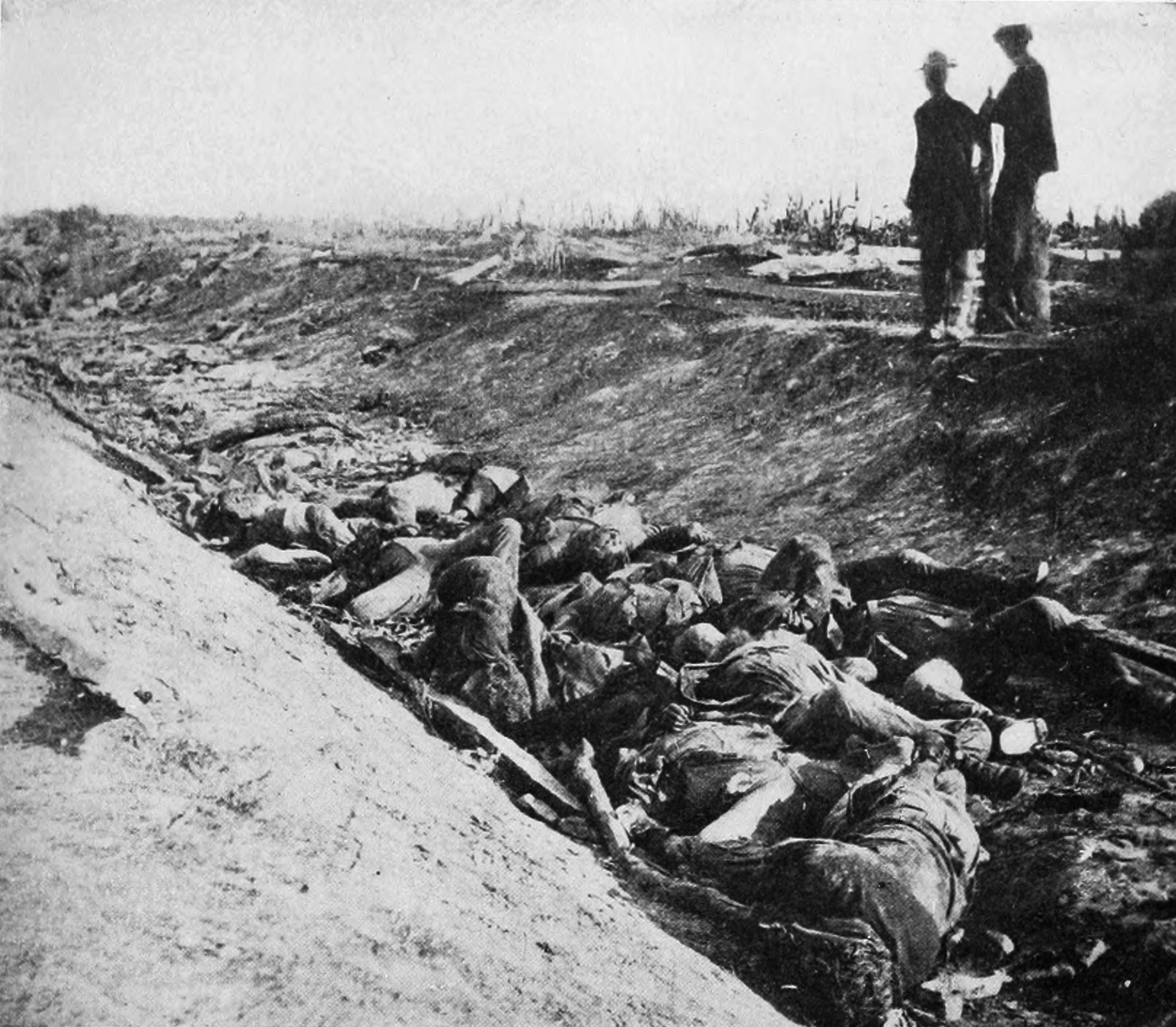
Today, I walk the Sunken Road, which was the center of the Confederate line. For a place that is so large in its significance to American history, its small size was surprising. It is an old farm lane sunk down under years of wagon traffic about six or seven feet below the neighboring fields, with a rail fence at the top, similar to an old county road on my farm, and hardly more than one or two hundred yards long. On September 17, 1862, the division of D. H. Hill, between 2000 and 2500 men, many of whom had already suffered from heavy fighting on the left flank of the army that morning, faced a frontal assault by some ten to twelve thousand Federals, all of them fresh and ready for battle.
After a terrible three-hour struggle, the Federals managed to gain a foothold at one end of the lane. From there they poured fire down the lane, breaking the Confederate position. Photographs such as this one, a few days later, showed the bodies of the Confederate soldiers “stacked like cordwood” in the lane. “We were shooting them like sheep in a pen,” one of the New York soldiers later wrote.
On this one day, more American soldiers fell than in the Revolution, the War of 1812, and the Mexican War combined.
A middle-aged woman who had been working as a clerk in the U.S. Patent Office, Clara Barton, had just the previous month gained permission to serve as a nurse on the front lines, where women had previously not been allowed. She was there at Antietam that day, and the events and suffering of that time started her on a path that led to the founding of the American Red Cross in 1881. That struggle involved her in arguments against those who maintained that such an organization was not needed because the United States “would never again face a calamity like the Civil War.” She knew better.
July 9-11
My mission for the week is a visit with my sister and her husband in suburban Maryland. I will say little of these days; they were quiet, and a renewal of such family ties as I have.
I had intended a visit to my cousins. All but one of them live within a ten-mile radius in southern West Virginia, an area that also includes my farm. A funeral scheduled for July 18 has lopped two days from the vacation, so I will see neither farm nor cousins.
But there is one other visit in West Virginia that I am not going to cancel.
(to be continued)
Showing posts with label War Between the States. Show all posts
Showing posts with label War Between the States. Show all posts
Sunday, July 19, 2015

Sunday, July 5, 2015
Deep in my heart I do believe...
On this day, our parish had a service of readings and songs related to U.S. history, starting with part of the Declaration of Independence, including the Gettysburg Address, part of the letter written by Chief Seattle to the U.S. President, Dr. Martin Luther King's “I have a dream” speech, and concluding (this time) with part of the U.S. Supreme Court majority opinion, upholding the principle of same-sex marriage as a constitutional right. The Collect and Gospel for Independence Day then followed, and the Eucharist.
It is an interesting time to consider such things.
How does one begin such a service? I committed myself to an improvisation, and found it unusually difficult to even begin my work on it. With the patriotic music and themes that we were to hear, it would be all too easy to indulge in musical flag-waving.
That was easier in another time, and some have done it well:
The Star-Spangled Banner, as performed by Virgil Fox
Or this, a splendid and virtuosic piece by one the leading American composers of his generation:
Concert Variations on The Star-Spangled Banner (Dudley Buck, 1839-1909)
Performance: Adam Brakel, at the Cathedral Basilica of St. Augustine in the City of St. Augustine, Florida.
Today was not the time, and I am certainly not the organist for such an approach. Truth be told, I am not especially proud of my country right now. The despicable shootings in a Charleston church and a series of church burnings across the South that have ensued have awakened old demons. And there are other old scars. I determined to begin with one of them, a reminder of the status of Native Americans. We were to sing the Dakota hymn “Many and great” after the Chief Seattle lesson, so I began with it, after an introduction that I hope suggested where I would eventually end up. That led to the tune Materna (“America the Beautiful,” which would shortly be the opening hymn), in minor, with “Many and great” continuing. Then, some development based on the Negro National Anthem, “Lift every voice and sing,” with the previous two tunes mixed in.
Finally, I got to what I wanted to say:
And that is what I think was needed as a beginning to this service, on this day.
Improvisation (organ): July 5, 2015
Photos: of Native American subjects (the old man is Chief Seattle), from the Civil Rights Movement, and from the Great Smokies National Park, a place I used to frequent.
------------
Footnote:
I am a Son of the South, and that has made the racial hatred of recent weeks all the more painful. The Christians who were martyred in Charleston were sons and daughters of the South, just as I am; the people whose churches have been burned are my brothers and sisters.
It has been discouraging to see the symbols of the Old South appropriated by some to represent their racism, their hatred of black people. And that is the worst of the old demons, now raging across our country as it did in the bad old days of Jim Crow and the Klan.
I revere the flag of the Confederate States of America because I remember the men who fought under it, from Lee and Jackson right on down to the handful of old men and boys who died in the defense of my home town. They were Americans too, but they believed that their duty was to defend their homes.
It is an interesting time to consider such things.
How does one begin such a service? I committed myself to an improvisation, and found it unusually difficult to even begin my work on it. With the patriotic music and themes that we were to hear, it would be all too easy to indulge in musical flag-waving.
That was easier in another time, and some have done it well:
The Star-Spangled Banner, as performed by Virgil Fox
Or this, a splendid and virtuosic piece by one the leading American composers of his generation:
Concert Variations on The Star-Spangled Banner (Dudley Buck, 1839-1909)
Performance: Adam Brakel, at the Cathedral Basilica of St. Augustine in the City of St. Augustine, Florida.
Today was not the time, and I am certainly not the organist for such an approach. Truth be told, I am not especially proud of my country right now. The despicable shootings in a Charleston church and a series of church burnings across the South that have ensued have awakened old demons. And there are other old scars. I determined to begin with one of them, a reminder of the status of Native Americans. We were to sing the Dakota hymn “Many and great” after the Chief Seattle lesson, so I began with it, after an introduction that I hope suggested where I would eventually end up. That led to the tune Materna (“America the Beautiful,” which would shortly be the opening hymn), in minor, with “Many and great” continuing. Then, some development based on the Negro National Anthem, “Lift every voice and sing,” with the previous two tunes mixed in.
Finally, I got to what I wanted to say:
We shall overcome.I dropped a hint at about the 6:25 mark, as I had in the introduction. At about the 7:58 mark I began the great hymn of the Civil Rights movement. In my practice I had noticed that it could combine with Materna, so I put the latter in the pedals.
We shall overcome.
We shall overcome someday.
Deep in my heart,
I do believe
That we shall overcome someday.
And that is what I think was needed as a beginning to this service, on this day.
Improvisation (organ): July 5, 2015
Photos: of Native American subjects (the old man is Chief Seattle), from the Civil Rights Movement, and from the Great Smokies National Park, a place I used to frequent.
------------
Footnote:
I am a Son of the South, and that has made the racial hatred of recent weeks all the more painful. The Christians who were martyred in Charleston were sons and daughters of the South, just as I am; the people whose churches have been burned are my brothers and sisters.
It has been discouraging to see the symbols of the Old South appropriated by some to represent their racism, their hatred of black people. And that is the worst of the old demons, now raging across our country as it did in the bad old days of Jim Crow and the Klan.
I revere the flag of the Confederate States of America because I remember the men who fought under it, from Lee and Jackson right on down to the handful of old men and boys who died in the defense of my home town. They were Americans too, but they believed that their duty was to defend their homes.
With all my devotion to the Union and the feeling of loyalty and duty of an American citizen, I have not been able to make up my mind to raise my hand against my relatives, my children, my home. I have therefore resigned my commission in the Army, and save in defense of my native State, with the sincere hope that my poor services may never be needed, I hope I may never be called on to draw my sword... (R. E. Lee, after having been offered the command of the Union armies, with promotion from colonel to major general. After considering the matter overnight, he declined the offer.)The war is over. It has been over for one hundred and fifty years. We must continue to “bind up the wounds” of our country, as Lincoln phrased it near the end of his life.
So far from engaging in a war to perpetuate slavery, I am rejoiced that Slavery is abolished. I believe it will be greatly for the interest of the South. So fully am I satisfied of this that I would have cheerfully lost all that I have lost by the war, and have suffered all that I have suffered to have this object attained. (R. E. Lee)There is still work to be done.
Friday, April 3, 2015
Good Friday, and a Remembrance
7 am – The Mass of the Pre-Sanctified: Fr. Hulme was Officiant for this conclusion to the overnight Vigil, assisted by my friend John, who bore the processional cross, veiled in black. A handful of us came forward to the Altar and partook of the Body and Blood of our Lord, reserved from last night's service.
After that: Matins and Litany, for which I was Officiant. Psalm 22, Abraham's near-sacrifice of Isaac (Genesis 22), and three verses from St. John's Gospel:
One other Loose End: John told me of the man who was asleep in the Healing Touch room; he had been to the church yesterday, again in the evening, and in the early hours of this day during the all-night vigil, from there finding a place to sleep. He would not leave when we asked him, so we called the police, who spoke to him sternly and escorted him out. He was in bad shape, with the looks of one emaciated by addiction. I was not feeling charitable toward him, not nearly so much as John and Nora were, but he too is among those for whom we prayed at Matins, and will again tonight:
The musical thought that has been uppermost in my mind all morning is the nightingale from the Messiaen that I played as last night's prelude. I did not record my playing of it; here is a better performance.
The calm music represents the Upper Room, with the Words of Institution as a series of slow descending chords – akin in its soft gentle way to the mighty descending figures of Dieu parmi nous from the Nativity Suite. I have little doubt that Messiaen intended the resemblance, for God comes to us in the Bread and Wine just as much as He came among us in the Nativity. And then, a nightingale sings outside the window. All of this is repeated and expanded.
It is the bird, in his own beautiful language so foreign to our slow awkward songs, who proclaims the gentle Grace of the Sacrament, God with us, Dieu parmi nous.
But we are without that Grace for now. Until tomorrow night, we must wait.
Noon - On this day, no organ practice. I need the work, but it would be a desecration. I locked the instrument last night when we were finished with it after the opening hymn, and locked it must remain until tomorrow. I have worked fitfully in the office, but on this day it is always difficult to concentrate, most of all during the Three Hours. But my work – selecting hymns and voluntaries for several weeks of the Easter Season, starting the bulletins for next Sunday – serves as a reminder that the Eucharistic Acclamation is three lines, not just one:
---------
It is but a small thing, a historical detail by comparison, but I would be remiss without a remembrance of the events of this week 150 years ago in 1865. Today, April 3, was the day that the Union army entered Richmond.
In a series of actions on the three previous days, the Union forces had achieved a breakthrough at Five Forks and the Confederate lines south of Petersburg, forcing Lee and the Army of Northern Virginia to withdraw from the city. They were on the march this day, headed for the planned rendezvous at Amelia Court House where they were supposed to find a supply train of food and provisions. But no provisions were there, forcing a delay that allowed the Union forces to catch up. This led to the action at Saylor's Creek on April 6 where about a third of the Confederate force was cut off and forced to surrender; I wrote of these places here when I visited some of them a few years ago.
And on April 9 – Appomatox.
Whitman wrote of his memories of “ever-returning spring” in one of the great poems of the English language, in regard to the events that followed just a few days later at Ford Theater:
Some years ago, I wrote:
On this Day, I find it worth revisiting another thought, as well:
Lamentations: the mystery of Providence
After that: Matins and Litany, for which I was Officiant. Psalm 22, Abraham's near-sacrifice of Isaac (Genesis 22), and three verses from St. John's Gospel:
Simon Peter said unto him, Lord, whither goest thou? Jesus answered him, Whither I go , thou canst not follow me now; but thou shalt follow me afterwards. Peter said unto him, Lord, why cannot I follow thee now? I will lay down my life for thy sake. Jesus answered him, Wilt thou lay down thy life for my sake? Verily, verily, I say unto thee, The cock shall not crow, till thou hast denied me thrice. (13:36-38)And after that: Loose Ends. I cleared the music from last night, which was still at my place in the Choir, set up the choir room for tonight, emptied the dishwasher and washed the crock pots which had been left to soak.
One other Loose End: John told me of the man who was asleep in the Healing Touch room; he had been to the church yesterday, again in the evening, and in the early hours of this day during the all-night vigil, from there finding a place to sleep. He would not leave when we asked him, so we called the police, who spoke to him sternly and escorted him out. He was in bad shape, with the looks of one emaciated by addiction. I was not feeling charitable toward him, not nearly so much as John and Nora were, but he too is among those for whom we prayed at Matins, and will again tonight:
Almighty God, we beseech thee graciously to behold this thy family, for whom our Lord Jesus Christ was contented to be betrayed, and given up into the hands of sinners, and to suffer death upon the cross; who now liveth and reigneth with thee and the Holy Ghost ever, one God, world without end. Amen. (BCP p. 169, the Collect for Good Friday)
The musical thought that has been uppermost in my mind all morning is the nightingale from the Messiaen that I played as last night's prelude. I did not record my playing of it; here is a better performance.
The calm music represents the Upper Room, with the Words of Institution as a series of slow descending chords – akin in its soft gentle way to the mighty descending figures of Dieu parmi nous from the Nativity Suite. I have little doubt that Messiaen intended the resemblance, for God comes to us in the Bread and Wine just as much as He came among us in the Nativity. And then, a nightingale sings outside the window. All of this is repeated and expanded.
It is the bird, in his own beautiful language so foreign to our slow awkward songs, who proclaims the gentle Grace of the Sacrament, God with us, Dieu parmi nous.
But we are without that Grace for now. Until tomorrow night, we must wait.
Noon - On this day, no organ practice. I need the work, but it would be a desecration. I locked the instrument last night when we were finished with it after the opening hymn, and locked it must remain until tomorrow. I have worked fitfully in the office, but on this day it is always difficult to concentrate, most of all during the Three Hours. But my work – selecting hymns and voluntaries for several weeks of the Easter Season, starting the bulletins for next Sunday – serves as a reminder that the Eucharistic Acclamation is three lines, not just one:
Christ has died.There are other reminders: the nightingale's song in my memory, the blue sky and sunshine outside the little windows in my office, the very opportunity to slow down, to lay aside the frantic work of these past days with bulletins and lesson printouts and setups and rehearsal plans, the words and friendship of those with whom I share this work – the wonderful and amazing members of the Adult Choir who sacrifice much to be here for these liturgies, the ladies in the kitchen last night as we washed dishes, my colleagues in the care of this parish. Yes, I am nibbling at the work of the days and weeks that are to come, but these Three Days are the culmination and we have now prepared for them as best we can. Now it remains only to live them, in our liturgies tonight and tomorrow and Sunday – and beyond.
Christ is risen.
Christ will come again.
---------
It is but a small thing, a historical detail by comparison, but I would be remiss without a remembrance of the events of this week 150 years ago in 1865. Today, April 3, was the day that the Union army entered Richmond.
In a series of actions on the three previous days, the Union forces had achieved a breakthrough at Five Forks and the Confederate lines south of Petersburg, forcing Lee and the Army of Northern Virginia to withdraw from the city. They were on the march this day, headed for the planned rendezvous at Amelia Court House where they were supposed to find a supply train of food and provisions. But no provisions were there, forcing a delay that allowed the Union forces to catch up. This led to the action at Saylor's Creek on April 6 where about a third of the Confederate force was cut off and forced to surrender; I wrote of these places here when I visited some of them a few years ago.
And on April 9 – Appomatox.
Whitman wrote of his memories of “ever-returning spring” in one of the great poems of the English language, in regard to the events that followed just a few days later at Ford Theater:
When lilacs last in the dooryard bloom’d,He is welcome to mourn for Mr. Lincoln. But for me, these first days of April will always be bound up with the fall of Richmond, the hungry and desperate march west, and the surrender. The example of these brave men, Mr. Lee most of all, continues to prompt me to greater faithfulness to my own duties.
And the great star early droop’d in the western sky in the night,
I mourn’d, and yet shall mourn with ever-returning spring.
Some years ago, I wrote:
The legacy of the Confederate States of America is a mixed bag. Yes, slavery was part of it. The racism of Jim Crow and the Ku Klux Klan that followed the war must be counted as part of it. In this, the CSA was no better, and in my opinion no worse, than the USA, or any other nation of the earth. For every nation and people of the earth, history and culture amount to a mixed bag, with shameful deeds alongside moments of glory; men and women who would be better forgotten, and those whose names should live forever.
A certain indescribable freedom was lost when Old Dixie went down. I have felt the evanescent spirit of it lingering among gatherings of my older relatives, and in conversation with neighbors and co-workers “back home,” especially the more backward and uneducated among them. I have tasted it in the moonshine at my uncle's funeral, and in my mother's corn bread and beans, made just the way her mother, and her mother's mother, made it. Some of it can be heard in the old “hillbilly” songs, and to a lesser degree in the bluegrass and country music that descended from them, or in the “shape-note” singing that has survived mostly in the Old South.
On this Day, I find it worth revisiting another thought, as well:
Lamentations: the mystery of Providence
Wednesday, September 17, 2014
Scottish Independence
The Scottish vote on the question of independence is this Thursday, September 18. I am among the many Americans whose ancestry is more Scottish than otherwise, so I look on this with interest. And I am a Son of the South, where we were not given an opportunity to vote on secession. Our wishes were clear, but they could not prevail against Sherman, Grant, Lincoln, and their armies [I spare a thought for the men in the trenches around Richmond and Petersburg one hundred fifty years ago, and in the Shenandoah Valley, where Gen. Sheridan was to defeat the Confederate forces there in battles on Sept. 19 and Sept. 21-22, freeing the Yankees to burn the Valley from end to end, destroying all the season's crops and turning it into a wasteland going into winter...]
If it were me, my vote would be a resounding YES, remembering Wallace, the Jacobite risings, the highland clearances, and noting the manner in which the financiers of the City of London currently suck all the life out of the realm (as Wall Street does in this country), leaving little but dregs for the likes of Scotland, Wales, and Northern Ireland.
But I would not want to stray very far; I would remember fighting alongside the English in three centuries of wars. And I would still want to be a subject of the Queen and her successors. That is not directly at question tomorrow, and will take considerable sorting out, should the Yes vote prevail. So will many other things.
On Thursday, it is up to the Scottish people. I wish my Scottish friends – those in our companion diocese of Brechen, and elsewhere in that great Land – the very best, however it turns out.
----
I have been away from the Music Box for too long, and should not be taking the time this evening to write these words. I do not know when I can return more regularly, but you, my readers, are in my thoughts. May God's blessings be with you.
If it were me, my vote would be a resounding YES, remembering Wallace, the Jacobite risings, the highland clearances, and noting the manner in which the financiers of the City of London currently suck all the life out of the realm (as Wall Street does in this country), leaving little but dregs for the likes of Scotland, Wales, and Northern Ireland.
But I would not want to stray very far; I would remember fighting alongside the English in three centuries of wars. And I would still want to be a subject of the Queen and her successors. That is not directly at question tomorrow, and will take considerable sorting out, should the Yes vote prevail. So will many other things.
On Thursday, it is up to the Scottish people. I wish my Scottish friends – those in our companion diocese of Brechen, and elsewhere in that great Land – the very best, however it turns out.
----
I have been away from the Music Box for too long, and should not be taking the time this evening to write these words. I do not know when I can return more regularly, but you, my readers, are in my thoughts. May God's blessings be with you.
Wednesday, July 31, 2013
On to Richmond
July 13-14: a college, a church, and the battlefields
The annual conference of the Hymn Society was held this year on the campus of the University of Richmond, an elite private institution of higher learning. Its elegant campus sits among the wealthy estates of the River Road area of west Richmond, and I could not help thinking of the Capital and its contrast with the poverty of Districts 11 and 12 in the Hunger Games book. Such thoughts do not, however, keep me from taking two desserts from the lavish display at dinner. I am not sure that I have ever eaten in such luxury, and can well imagine what Katniss and Peeta (and Rue and Thresh and many others from the book) would have thought -- as they loaded their plates and came back for seconds and thirds. Or what some of the people elsewhere in Richmond might think.
Years ago, our church sponsored a family of refugees from the Ukraine, back during the days of Soviet rule. There were two adults and four or five children -- the adults were short and thin, the children emaciated and small. I was with them when they first encountered an American supermarket. They could not believe their eyes -- all this food! I think of them as I marvel at this cafeteria.
I understand why the UR campus is so immaculate, why its dining hall and food are so lavish: they must attract students and their tuition dollars, and many of these students come from families of privilege where they assume such luxury as their entitlement. And this is no different from other elite private colleges and universities across the country, including the one where I received my baccalaureate. But I remain uneasy about it, and aware of the fragility of this manner of life: its manicured lawns, its perfect buildings -- and, I noted, its omnipresent security force.
Sunday morning finds me at St. James' Episcopal Church, its spire the focal point at the east end of Monument Avenue in Richmond. On this summer Sunday, the church is about eighty percent full, a lively congregation of all ages, including plenty of children and teens. I am underdressed in white shirt and tie with dress slacks and shoes; almost all of the men are in suits, the women in dresses.
The liturgy is straightforward Rite Two with five hymns, all well-played and sung with vigor. We kneel at appropriate times, but at no point do I see anyone make the sign of the cross; the overall feel of the liturgy is low-church.
I take an instant dislike to the Rector, whose function this day is Talk Show Host (at the announcements) and Celebrant. He reminds me of other clergy I have known, and it is unfair of me to lump him in with them. At the least, the obvious vigor of the parish reflects well on the parish leadership, and the Rector is always part of that.
I had arrived late, slipping into a back pew during the Collect for Purity, so I am curious whether anyone would greet me at the end. The postlude is buried under an instant din of loud chatter following the dismissal. I stand in place, listening as best I can, until the organist finishes (Buxtehude, played very well), and make my way to the door. There is much friendly conversation -- it is obvious that this congregation cherishes its fellowship -- but not a word for me, not so much as a friendly smile. I might as well be invisible. I am in the line for an assisting priest at one of the three doors; she takes my hand and with an artificial smile worthy of Effie Trinket from the Hunger Games, she says "Welcome. I'm so glad you're here." I walk down the avenue to the statue of "Jeb" Stuart, who was a communicant at St. James and was buried from this parish after his death in battle. The President, Jefferson Davis, and his wife Varina, and Mrs. Lee (and Robert, when possible) attended St. Paul's Episcopal, a few blocks away. We will have a hymn festival at St. Paul's later in the week
The afternoon lies before me, free until the conference officially begins at 5:00. I drive east on Broad Street, past the even more historic St. John's Episcopal Church, site of Patrick Henry's words "Give me liberty, or give me death." I linger at the National Park Service welcome center at the top of the hill on Broad Street, site of the Chimbarazo Hospital, the Confederacy's largest. More than 70,000 patients were here during the four years of its existence, with a lower mortality rate than many modern hospitals. A young park ranger makes up with her friendliness for the clergy of St. James; I am the only visitor, and she spends some fifteen minutes telling me about the site and the other National Park Service battlefield sites around Richmond. It is far too much for one afternoon, and I quickly get lost, seeking US 360 out to the Cold Harbor battlefield. I give up, and drive the length of Broad Street back to the university.
Later in the week I visited the battlefield sites east and southeast of Petersburg, some thirty miles south of Richmond. I linger at The Crater, remembering that horrible day. Those who may have seen the movie "Cold Mountain" a few years ago will remember the battle scene early in the film; that was the Crater. Some Pennsylvania coal miners in the Union army dug a tunnel under the Confederate lines and filled it with gunpowder. The explosion immediately killed some 270 South Carolina soldiers who were in the trenches, making a thirty-foot deep crater still visible today. As was too often the case in this war, the Union soldiers were not effectively led -- their commander, Gen. James H. Ledlie, was well behind the lines, drunk -- and they were soon driven back with heavy casualties in hand-to-hand fighting in and around this crater. A division of United States Colored Troops had been specially trained for this day, and their casualties were the heaviest, the Confederate soldiers killing many of them even after they surrendered. Some were bayoneted by their own Union allies, "white soldiers who feared reprisals from victorious CSA troops" (from Wikipedia, s.v. "Battle of the Crater"). There was not such an evil day as this in all the five years of the war.
On my way back west after the conference, I followed the route taken by the Army of Northern Virginia in its retreat from Richmond and Petersburg, and I stopped at Saylor's Creek. This was where Grant's army caught up with the Confederates, who were strung out with their wagon trains over the country roads, and on this day, April 6, 1865, the Army ceased to be an effective fighting force; almost 8,000 men from the Confederate Army were captured, killed, or wounded. In the aftermath, the Union dead received honorable burial in a little cemetery that is still there at the site; the Confederates were left to be eaten by the animals, and their remains were later dumped without ceremony into unmarked mass graves.
Why do I go to places like this?
The best answer is that given by Mr. Lincoln on another battlefield:
Lincoln could not know that the "new birth of freedom" would soon be smothered by the robber barons who were already poised to take over his Republican Party and who control it to this day, and the Democratic Party as well. He could not know what a distant dream "government of the people, by the people, for the people" would become by the twenty-first century, hardly more than a bitter joke.
Perhaps he did not understand that the Confederates were fighting for such a government just as much as those on the Union side; their vision was a Jeffersonian democracy, an escape from what they saw as the tyranny of a too-powerful central government.
But Lincoln was right. So long as we remember those times, those people on both sides who, in their respective ways, fought for freedom, the dream shall not have altogether perished, and may yet in some future age become a reality.
The annual conference of the Hymn Society was held this year on the campus of the University of Richmond, an elite private institution of higher learning. Its elegant campus sits among the wealthy estates of the River Road area of west Richmond, and I could not help thinking of the Capital and its contrast with the poverty of Districts 11 and 12 in the Hunger Games book. Such thoughts do not, however, keep me from taking two desserts from the lavish display at dinner. I am not sure that I have ever eaten in such luxury, and can well imagine what Katniss and Peeta (and Rue and Thresh and many others from the book) would have thought -- as they loaded their plates and came back for seconds and thirds. Or what some of the people elsewhere in Richmond might think.
Years ago, our church sponsored a family of refugees from the Ukraine, back during the days of Soviet rule. There were two adults and four or five children -- the adults were short and thin, the children emaciated and small. I was with them when they first encountered an American supermarket. They could not believe their eyes -- all this food! I think of them as I marvel at this cafeteria.
I understand why the UR campus is so immaculate, why its dining hall and food are so lavish: they must attract students and their tuition dollars, and many of these students come from families of privilege where they assume such luxury as their entitlement. And this is no different from other elite private colleges and universities across the country, including the one where I received my baccalaureate. But I remain uneasy about it, and aware of the fragility of this manner of life: its manicured lawns, its perfect buildings -- and, I noted, its omnipresent security force.
Sunday morning finds me at St. James' Episcopal Church, its spire the focal point at the east end of Monument Avenue in Richmond. On this summer Sunday, the church is about eighty percent full, a lively congregation of all ages, including plenty of children and teens. I am underdressed in white shirt and tie with dress slacks and shoes; almost all of the men are in suits, the women in dresses.
The liturgy is straightforward Rite Two with five hymns, all well-played and sung with vigor. We kneel at appropriate times, but at no point do I see anyone make the sign of the cross; the overall feel of the liturgy is low-church.
I take an instant dislike to the Rector, whose function this day is Talk Show Host (at the announcements) and Celebrant. He reminds me of other clergy I have known, and it is unfair of me to lump him in with them. At the least, the obvious vigor of the parish reflects well on the parish leadership, and the Rector is always part of that.
I had arrived late, slipping into a back pew during the Collect for Purity, so I am curious whether anyone would greet me at the end. The postlude is buried under an instant din of loud chatter following the dismissal. I stand in place, listening as best I can, until the organist finishes (Buxtehude, played very well), and make my way to the door. There is much friendly conversation -- it is obvious that this congregation cherishes its fellowship -- but not a word for me, not so much as a friendly smile. I might as well be invisible. I am in the line for an assisting priest at one of the three doors; she takes my hand and with an artificial smile worthy of Effie Trinket from the Hunger Games, she says "Welcome. I'm so glad you're here." I walk down the avenue to the statue of "Jeb" Stuart, who was a communicant at St. James and was buried from this parish after his death in battle. The President, Jefferson Davis, and his wife Varina, and Mrs. Lee (and Robert, when possible) attended St. Paul's Episcopal, a few blocks away. We will have a hymn festival at St. Paul's later in the week
The afternoon lies before me, free until the conference officially begins at 5:00. I drive east on Broad Street, past the even more historic St. John's Episcopal Church, site of Patrick Henry's words "Give me liberty, or give me death." I linger at the National Park Service welcome center at the top of the hill on Broad Street, site of the Chimbarazo Hospital, the Confederacy's largest. More than 70,000 patients were here during the four years of its existence, with a lower mortality rate than many modern hospitals. A young park ranger makes up with her friendliness for the clergy of St. James; I am the only visitor, and she spends some fifteen minutes telling me about the site and the other National Park Service battlefield sites around Richmond. It is far too much for one afternoon, and I quickly get lost, seeking US 360 out to the Cold Harbor battlefield. I give up, and drive the length of Broad Street back to the university.
Later in the week I visited the battlefield sites east and southeast of Petersburg, some thirty miles south of Richmond. I linger at The Crater, remembering that horrible day. Those who may have seen the movie "Cold Mountain" a few years ago will remember the battle scene early in the film; that was the Crater. Some Pennsylvania coal miners in the Union army dug a tunnel under the Confederate lines and filled it with gunpowder. The explosion immediately killed some 270 South Carolina soldiers who were in the trenches, making a thirty-foot deep crater still visible today. As was too often the case in this war, the Union soldiers were not effectively led -- their commander, Gen. James H. Ledlie, was well behind the lines, drunk -- and they were soon driven back with heavy casualties in hand-to-hand fighting in and around this crater. A division of United States Colored Troops had been specially trained for this day, and their casualties were the heaviest, the Confederate soldiers killing many of them even after they surrendered. Some were bayoneted by their own Union allies, "white soldiers who feared reprisals from victorious CSA troops" (from Wikipedia, s.v. "Battle of the Crater"). There was not such an evil day as this in all the five years of the war.
On my way back west after the conference, I followed the route taken by the Army of Northern Virginia in its retreat from Richmond and Petersburg, and I stopped at Saylor's Creek. This was where Grant's army caught up with the Confederates, who were strung out with their wagon trains over the country roads, and on this day, April 6, 1865, the Army ceased to be an effective fighting force; almost 8,000 men from the Confederate Army were captured, killed, or wounded. In the aftermath, the Union dead received honorable burial in a little cemetery that is still there at the site; the Confederates were left to be eaten by the animals, and their remains were later dumped without ceremony into unmarked mass graves.
Why do I go to places like this?
The best answer is that given by Mr. Lincoln on another battlefield:
But, in a larger sense, we can not dedicate, we can not consecrate, we can not hallow this ground. The brave men, living and dead, who struggled here, have consecrated it, far above our poor power to add or detract. The world will little note, nor long remember what we say here, but it can never forget what they did here. It is for us the living, rather, to be dedicated here to the unfinished work which they who fought here have thus far so nobly advanced. It is rather for us to be here dedicated to the great task remaining before us—that from these honored dead we take increased devotion to that cause for which they gave the last full measure of devotion—that we here highly resolve that these dead shall not have died in vain—that this nation, under God, shall have a new birth of freedom—and that government of the people, by the people, for the people, shall not perish from the earth.
Lincoln could not know that the "new birth of freedom" would soon be smothered by the robber barons who were already poised to take over his Republican Party and who control it to this day, and the Democratic Party as well. He could not know what a distant dream "government of the people, by the people, for the people" would become by the twenty-first century, hardly more than a bitter joke.
Perhaps he did not understand that the Confederates were fighting for such a government just as much as those on the Union side; their vision was a Jeffersonian democracy, an escape from what they saw as the tyranny of a too-powerful central government.
But Lincoln was right. So long as we remember those times, those people on both sides who, in their respective ways, fought for freedom, the dream shall not have altogether perished, and may yet in some future age become a reality.
Sunday, July 21, 2013
A week on the road
Wednesday, July 3: A beginning
Mrs C. helped me carry my gear to the car. "I want to see you get everything in," she said. I am traveling alone, but I will be on the road for eighteen days and have packed many things. I have what I need to sleep in the car; I have what I need for the Hymn Society conference; I have food for many days, mostly dried fruit, nuts and seeds, whole wheat tortillas, a box of granola bars, a gallon of water which I plan to replenish at rest areas. Mrs. C. shakes her head at the quantity of baggage.
Everything fits.
I am driving the new 2013 Toyota Corolla; 312 miles on the odometer as I begin what will be a journey of almost three thousand miles. One of the principal objectives of this trip is to gently break in this vehicle. The first thousand miles are critical, and if driven carefully, the engine and transmission are on their way to a long life, God willing.
I eschew the interstates for this purpose, seeking to vary the highway speed in a range from 45 to 55 miles per hour, up to 60 if I must make a foray onto the interstate (as soon proves to be the case, when part of my chosen route is closed because of flooding, with a detour to I-80, and later another twenty miles on I-74). I plan on taking frequent and long breaks, having read that in this initial break-in, one should stop for an hour or so after every two hours of driving.
This is precisely the manner in which I most love to travel cross-country.
First stop: a civic park on U.S. 6 in small-town Iowa for Matins. I have brought my Hebrew Psalter, so the appointed psalms take about a half-hour to read. Halfway through Psalm 16, an elderly man crosses the street and comes straight up to me. "Where are you from?" he asks; it is a sufficiently small town that he knows I don't live there. I tell him, and add that I am on my way Out East to visit family. I lay my office books aside and chat. His name is Skip; he is 83 years old, retired from a career as a barber; his shop used to be right across the street. We talk of the notable restaurant that used to be next to his shop; until it closed, I would try to time my trips along this road to arrive at dinnertime. Their macaroni salad, their potato salad, their versatility with what used to be called "congealed salads," were legendary. I have heard that their pork tenderloin was equally memorable, though I cannot speak to that from experience. The restaurant is no more; even the building is gone, replaced by a parking lot.
Second stop: another attempt at Matins, at a rest area on I-74 in Illinois. It is almost noon by now, and a family is having a picnic lunch nearby. The two small children eye me with curiosity. The second lesson is Philip and the Ethiopian, a good story for a day on the road. Like him, I proceed "on my way rejoicing."
Third stop: a civic park in a mid-sized town on U.S. 24, still in Illinois. It is almost 4:00 by now, and hot. I find a shaded picnic table in the deserted park and spend an hour writing of the day.
July 3, 1863, one hundred and fifty years ago today: the third day of the Battle of Gettysburg, with Pickett's Charge. "Always remember that you are from Old Virginia," he cried to the men as they started across the field. As ever, my mind fills with "what ifs." What if Jackson had lived, and led his corps on the first day? What if Longstreet had not been so obstinate? What if the artillery had not overshot the Union lines as the guns grew hot, spending most of their ammunition with little damage to the foe? Despite it all, they almost did it; they reached the Union lines and almost broke them.
But they didn't. So many brave men -- Virginians, Carolinians, Georgians, men of Mississippi, Alabama, Florida, Texas, Tennessee, units from every state in the Confederacy -- men from my home town among them -- dead on that field.
May they rest in peace, and their Union brothers with them.
May I always remember them, and remember that I too am from Old Virginia.
Independence Day
West Virginia, that would be. It became a state that summer of 1863, though there was almost no Union sympathy in my part of the state. My feelings about the making of West Virginia are a mixture of pride in the mountains and their cantankerous, independent people; and shame that we left Old Virginia and the Confederacy. Well: Jackson and many of his men were from what is now the Mountain State. There is no shame in that.
I sing Matins on this Independence Day in the parking area across the street from the birthplace of a man who did more for this country than most: Ulysses S Grant. As with the Battle of Gettysburg, this week marks the 150th anniversary of one of General Grant's triumphs: the surrender of Vicksburg after a long siege. In this campaign, Grant showed his considerable perseverance.
On travel days, I am mostly silent except for the Daily Office. But the Toyota has a modern audio system with a CD player. We have never had one of these in a vehicle, so I packed the three-CD soundtrack to the Lord of the Rings movies. Today is rainy, so I worked through all of them as the day progressed, repeating many of the tracks as I went.
For a project such as LOTR, the composer Howard Shore drew heavily on Wagner. As I listen this day, I find more influence from Bruckner than I had remembered, especially in the use of horns and low brass, and the choral voicings (very much like those in the second Mass setting of Bruckner, the one in eight parts with wind orchestra). It is good music, suitable for its purpose. That purpose, the accompaniment of visual action, causes it to be disjointed, held together mostly by its leitmotifs and the relationships of key centers, but the same can be said of Wagner's operas. I will not pretend that Shore's music is the equal of Bruckner's or Wagner's, but there is much that I can learn from it.
The rain continues all day, heavily at times. I finish the day at my base of operations for the next two days: the travel plaza on I-77 in Beckley. It proves a good vantage for the city's fireworks display. Before saying Compline and drifting off to sleep, I sit in the Toyota watching the fireworks and listening to the final tracks of Return of the King.
July 5: Kinfolk
I visit three of my cousins, and decant a shot of white lightning from its mason jar, saved from my uncle's funeral. We toast our ancestors and talk of old times. I lived in that little valley for a while; I could have stayed. But my vocation lay elsewhere.
I return to the travel plaza for the night, which becomes rainy and cool; a good night for sleeping. The windows fog, the rain beats on the roof. I settle into the passenger seat under my sleeping bag and bless the Lord.
July 6: Memorials and collard greens
Onward: this is the day to visit the graves of my parents. I bring them white daisies and read part of the Burial Office, Rite One. I eat at the cafeteria where I used to take my mother; their collard greens, mashed potatoes, and soft rolls are as splendid as I had remembered.
I visit also the Confederate Memorial and the graves of those who died in defense of this town. Someone has planted old-time perennial flowers around the granite monument. I do not go by the old home place, but I look for the oak tree from the memorial; yes, there it is. My head spins in sudden memory of standing on that spot, a boy of eight or nine years, doing the same -- looking for our oak tree.
Onward again: to East Tennessee for the Lord's Day.
July 7: A Sunday among Presbyterians
Summer mornings come gently out here. I eat breakfast and sing Matins from the edge of a truck stop parking lot. The hills are shrouded in mist; the sun rises through the clouds. It is fully 10:00 before the morning clouds and mists disperse into a clear day. When I lived briefly in the Caribbean many years ago, I longed for mornings like this. There I was surrounded by sunshine, but my dreams were of foggy mountains, of grey soft mornings like those of the southern Appalachians.
I have returned to the town where we lived for seventeen years, probably the best and most productive of my years in this life. I miss this place.
The fine long main street now has many restaurants and antique shops where there had been empty storefronts. The upper storeys of some of these buildings have been made into lofts, luxury condominiums. But I when I turn left into the neighborhood of my former church and our home across the street, almost nothing has changed.
When we lived there, two dogwoods, two large holly trees, and an old lilac bush graced the front yard; all are now gone save one dogwood. The house is unchanged. The old garage, already bedraggled in our time, now leans slightly to the left.
Across the street at the church, I am most struck by the trees. I remember the planting of a row of saplings along the street; they are now thirty feet tall. The old single-pane windows in the office-and-classroom wing have been replaced with energy efficient (and, I learn, un-openable) windows. And they have air-conditioned the choir room and music office. I think of the long sultry afternoons at my desk, sweat pouring down in the ninety-degree temperature, or at the piano in the choir room, the windows wide open to the natural world. I miss those days.
The church has a front lawn of about two acres, needing only a flock of sheep to remind one of certain English cathedrals. A few years ago, they dug up this expanse of lawn, laid several miles of crisscrossing pipes, and installed geothermal heating and cooling as a commitment to environmental sustainability. Blessings be on them for this.
I last attended a service at F.P.C. fourteen years ago, and wondered whether anyone would recognize me, or I them. The moment I walked into the nave, Bob and Betty and their daughter Scottie saw me and immediately recognized me. Soon I was surrounded by a group of old-timers. I was deeply moved that they had not forgotten me.
Later, at the offertory, the usher that handed me an offering plate was K., a veteran of the girls' choir and former piano student, now grown plump and looking much like I remember her mother. She almost dropped the plate when she recognized me, a smile of delight on her face. After church I met her husband and two children, and we talked. "Are you still composing?" she asked. Nonplussed at such a question, I answered: "When I have to." She told me that the two pieces she most remembered from choir were Rutter's "All things bright and beautiful" and one that I wrote for the girls and had almost forgotten, a setting of the Genevan text and tune for Psalm 43. "I enjoyed choir," she said, "but I didn't realize what we had until my children got to choir age and I saw what they sang. Little children's songs." She paused, and added: "You taught us to sing quality music. Thank you."
The singing choirs are on vacation: the handbell choir plays a prelude, part of a hymn accompaniment, and a piece at the offertory that I had taught them. Three of the ringers date from my tenure, and I talked of old-timers with them afterwards: Jim, Lou, Bonnie - who I learned is now married to Gene, who (then and now) is a tenor in the singing choir.
I sit at church with Pat and Beth. It is a delight to sing the hymns with them: Pat's fine clear tenor, Beth's clear intelligent alto, all three of us singing the harmony parts. I notice how well they sing, with good phrase shape and diction. I had made music with them for seventeen years, but never until today had I sung at their side.
Several passages in the Revelation of St. John the Divine imply that the Body of Christ will finally be one, fulfilling the prayer of John 17, only when we sing together (e.g., Rev. 5:8-14). Today, singing with these old friends, is a glimpse of that day.
They take me around the church. The parish hall has been redone, now primarily designed as the worship space for their contemporary congregation, with stage, drumset, microphones, amps, speakers, screens, and no cross or other Christian symbol in sight. It is the larger of the two Sunday congregations.
The old Chapel is about the same, with its fine 19th century stained glass, moved from the congregation's previous building. The Hammond organ is gone, but the fine old wooden chairs remain. In room after room I encounter more old friends -- the pianos I used to tend. The church used to have thirteen upright pianos; I see six today, and others may be in the education wing. The old choir room Baldwin grand is now in the chapel, replacing the Hammond; the big nine-foot Knabe that was rebuilt during my tenure is still in the front of the nave; the seven-foot Steinway (which I had restrung) has been moved from the organ gallery to the choir room. Most of all, the pipe organ that was installed during my tenure remains in place, impressive and full-bodied.
In the evening, Pat and Beth make a dinner for me. The guests are Al and Loretta, whose three girls were choristers, and whom (all of them) I had grown to love; Ann and Pete, who sang in the church choir and whose two girls were also choristers; Steve and Vicki, my successors at the church. I am pleased to finally meet them, and even more pleased to see how deeply they have immersed themselves in this congregation and community. They have done excellent work, better than mine.
[Before church, I had stepped into the parish library, unchanged from my days, and saluted the portrait of my predecessor of blessed memory, Clifford L. He was there longer than any of us, almost forty years, and was the one who made F.P.C. a place for good music.]
I am glad that I came back. I miss this place and these people. But my parting from them is not forever.
From the "About Me" sidebar of this blog:
Mrs C. helped me carry my gear to the car. "I want to see you get everything in," she said. I am traveling alone, but I will be on the road for eighteen days and have packed many things. I have what I need to sleep in the car; I have what I need for the Hymn Society conference; I have food for many days, mostly dried fruit, nuts and seeds, whole wheat tortillas, a box of granola bars, a gallon of water which I plan to replenish at rest areas. Mrs. C. shakes her head at the quantity of baggage.
Everything fits.
I am driving the new 2013 Toyota Corolla; 312 miles on the odometer as I begin what will be a journey of almost three thousand miles. One of the principal objectives of this trip is to gently break in this vehicle. The first thousand miles are critical, and if driven carefully, the engine and transmission are on their way to a long life, God willing.
I eschew the interstates for this purpose, seeking to vary the highway speed in a range from 45 to 55 miles per hour, up to 60 if I must make a foray onto the interstate (as soon proves to be the case, when part of my chosen route is closed because of flooding, with a detour to I-80, and later another twenty miles on I-74). I plan on taking frequent and long breaks, having read that in this initial break-in, one should stop for an hour or so after every two hours of driving.
This is precisely the manner in which I most love to travel cross-country.
First stop: a civic park on U.S. 6 in small-town Iowa for Matins. I have brought my Hebrew Psalter, so the appointed psalms take about a half-hour to read. Halfway through Psalm 16, an elderly man crosses the street and comes straight up to me. "Where are you from?" he asks; it is a sufficiently small town that he knows I don't live there. I tell him, and add that I am on my way Out East to visit family. I lay my office books aside and chat. His name is Skip; he is 83 years old, retired from a career as a barber; his shop used to be right across the street. We talk of the notable restaurant that used to be next to his shop; until it closed, I would try to time my trips along this road to arrive at dinnertime. Their macaroni salad, their potato salad, their versatility with what used to be called "congealed salads," were legendary. I have heard that their pork tenderloin was equally memorable, though I cannot speak to that from experience. The restaurant is no more; even the building is gone, replaced by a parking lot.
Second stop: another attempt at Matins, at a rest area on I-74 in Illinois. It is almost noon by now, and a family is having a picnic lunch nearby. The two small children eye me with curiosity. The second lesson is Philip and the Ethiopian, a good story for a day on the road. Like him, I proceed "on my way rejoicing."
Third stop: a civic park in a mid-sized town on U.S. 24, still in Illinois. It is almost 4:00 by now, and hot. I find a shaded picnic table in the deserted park and spend an hour writing of the day.
July 3, 1863, one hundred and fifty years ago today: the third day of the Battle of Gettysburg, with Pickett's Charge. "Always remember that you are from Old Virginia," he cried to the men as they started across the field. As ever, my mind fills with "what ifs." What if Jackson had lived, and led his corps on the first day? What if Longstreet had not been so obstinate? What if the artillery had not overshot the Union lines as the guns grew hot, spending most of their ammunition with little damage to the foe? Despite it all, they almost did it; they reached the Union lines and almost broke them.
But they didn't. So many brave men -- Virginians, Carolinians, Georgians, men of Mississippi, Alabama, Florida, Texas, Tennessee, units from every state in the Confederacy -- men from my home town among them -- dead on that field.
May they rest in peace, and their Union brothers with them.
May I always remember them, and remember that I too am from Old Virginia.
Independence Day
West Virginia, that would be. It became a state that summer of 1863, though there was almost no Union sympathy in my part of the state. My feelings about the making of West Virginia are a mixture of pride in the mountains and their cantankerous, independent people; and shame that we left Old Virginia and the Confederacy. Well: Jackson and many of his men were from what is now the Mountain State. There is no shame in that.
I sing Matins on this Independence Day in the parking area across the street from the birthplace of a man who did more for this country than most: Ulysses S Grant. As with the Battle of Gettysburg, this week marks the 150th anniversary of one of General Grant's triumphs: the surrender of Vicksburg after a long siege. In this campaign, Grant showed his considerable perseverance.
On travel days, I am mostly silent except for the Daily Office. But the Toyota has a modern audio system with a CD player. We have never had one of these in a vehicle, so I packed the three-CD soundtrack to the Lord of the Rings movies. Today is rainy, so I worked through all of them as the day progressed, repeating many of the tracks as I went.
For a project such as LOTR, the composer Howard Shore drew heavily on Wagner. As I listen this day, I find more influence from Bruckner than I had remembered, especially in the use of horns and low brass, and the choral voicings (very much like those in the second Mass setting of Bruckner, the one in eight parts with wind orchestra). It is good music, suitable for its purpose. That purpose, the accompaniment of visual action, causes it to be disjointed, held together mostly by its leitmotifs and the relationships of key centers, but the same can be said of Wagner's operas. I will not pretend that Shore's music is the equal of Bruckner's or Wagner's, but there is much that I can learn from it.
The rain continues all day, heavily at times. I finish the day at my base of operations for the next two days: the travel plaza on I-77 in Beckley. It proves a good vantage for the city's fireworks display. Before saying Compline and drifting off to sleep, I sit in the Toyota watching the fireworks and listening to the final tracks of Return of the King.
Lay down your sweet and weary head;
Night is falling, you have come to journey's end.
Sleep now, and dream of the ones who came before;
They are calling from across the distant shore...
(from the closing song, "Into the West")
July 5: Kinfolk
I visit three of my cousins, and decant a shot of white lightning from its mason jar, saved from my uncle's funeral. We toast our ancestors and talk of old times. I lived in that little valley for a while; I could have stayed. But my vocation lay elsewhere.
I return to the travel plaza for the night, which becomes rainy and cool; a good night for sleeping. The windows fog, the rain beats on the roof. I settle into the passenger seat under my sleeping bag and bless the Lord.
July 6: Memorials and collard greens
Onward: this is the day to visit the graves of my parents. I bring them white daisies and read part of the Burial Office, Rite One. I eat at the cafeteria where I used to take my mother; their collard greens, mashed potatoes, and soft rolls are as splendid as I had remembered.
I visit also the Confederate Memorial and the graves of those who died in defense of this town. Someone has planted old-time perennial flowers around the granite monument. I do not go by the old home place, but I look for the oak tree from the memorial; yes, there it is. My head spins in sudden memory of standing on that spot, a boy of eight or nine years, doing the same -- looking for our oak tree.
Onward again: to East Tennessee for the Lord's Day.
July 7: A Sunday among Presbyterians
Summer mornings come gently out here. I eat breakfast and sing Matins from the edge of a truck stop parking lot. The hills are shrouded in mist; the sun rises through the clouds. It is fully 10:00 before the morning clouds and mists disperse into a clear day. When I lived briefly in the Caribbean many years ago, I longed for mornings like this. There I was surrounded by sunshine, but my dreams were of foggy mountains, of grey soft mornings like those of the southern Appalachians.
I have returned to the town where we lived for seventeen years, probably the best and most productive of my years in this life. I miss this place.
The fine long main street now has many restaurants and antique shops where there had been empty storefronts. The upper storeys of some of these buildings have been made into lofts, luxury condominiums. But I when I turn left into the neighborhood of my former church and our home across the street, almost nothing has changed.
When we lived there, two dogwoods, two large holly trees, and an old lilac bush graced the front yard; all are now gone save one dogwood. The house is unchanged. The old garage, already bedraggled in our time, now leans slightly to the left.
Across the street at the church, I am most struck by the trees. I remember the planting of a row of saplings along the street; they are now thirty feet tall. The old single-pane windows in the office-and-classroom wing have been replaced with energy efficient (and, I learn, un-openable) windows. And they have air-conditioned the choir room and music office. I think of the long sultry afternoons at my desk, sweat pouring down in the ninety-degree temperature, or at the piano in the choir room, the windows wide open to the natural world. I miss those days.
The church has a front lawn of about two acres, needing only a flock of sheep to remind one of certain English cathedrals. A few years ago, they dug up this expanse of lawn, laid several miles of crisscrossing pipes, and installed geothermal heating and cooling as a commitment to environmental sustainability. Blessings be on them for this.
I last attended a service at F.P.C. fourteen years ago, and wondered whether anyone would recognize me, or I them. The moment I walked into the nave, Bob and Betty and their daughter Scottie saw me and immediately recognized me. Soon I was surrounded by a group of old-timers. I was deeply moved that they had not forgotten me.
Later, at the offertory, the usher that handed me an offering plate was K., a veteran of the girls' choir and former piano student, now grown plump and looking much like I remember her mother. She almost dropped the plate when she recognized me, a smile of delight on her face. After church I met her husband and two children, and we talked. "Are you still composing?" she asked. Nonplussed at such a question, I answered: "When I have to." She told me that the two pieces she most remembered from choir were Rutter's "All things bright and beautiful" and one that I wrote for the girls and had almost forgotten, a setting of the Genevan text and tune for Psalm 43. "I enjoyed choir," she said, "but I didn't realize what we had until my children got to choir age and I saw what they sang. Little children's songs." She paused, and added: "You taught us to sing quality music. Thank you."
The singing choirs are on vacation: the handbell choir plays a prelude, part of a hymn accompaniment, and a piece at the offertory that I had taught them. Three of the ringers date from my tenure, and I talked of old-timers with them afterwards: Jim, Lou, Bonnie - who I learned is now married to Gene, who (then and now) is a tenor in the singing choir.
I sit at church with Pat and Beth. It is a delight to sing the hymns with them: Pat's fine clear tenor, Beth's clear intelligent alto, all three of us singing the harmony parts. I notice how well they sing, with good phrase shape and diction. I had made music with them for seventeen years, but never until today had I sung at their side.
Several passages in the Revelation of St. John the Divine imply that the Body of Christ will finally be one, fulfilling the prayer of John 17, only when we sing together (e.g., Rev. 5:8-14). Today, singing with these old friends, is a glimpse of that day.
They take me around the church. The parish hall has been redone, now primarily designed as the worship space for their contemporary congregation, with stage, drumset, microphones, amps, speakers, screens, and no cross or other Christian symbol in sight. It is the larger of the two Sunday congregations.
The old Chapel is about the same, with its fine 19th century stained glass, moved from the congregation's previous building. The Hammond organ is gone, but the fine old wooden chairs remain. In room after room I encounter more old friends -- the pianos I used to tend. The church used to have thirteen upright pianos; I see six today, and others may be in the education wing. The old choir room Baldwin grand is now in the chapel, replacing the Hammond; the big nine-foot Knabe that was rebuilt during my tenure is still in the front of the nave; the seven-foot Steinway (which I had restrung) has been moved from the organ gallery to the choir room. Most of all, the pipe organ that was installed during my tenure remains in place, impressive and full-bodied.
In the evening, Pat and Beth make a dinner for me. The guests are Al and Loretta, whose three girls were choristers, and whom (all of them) I had grown to love; Ann and Pete, who sang in the church choir and whose two girls were also choristers; Steve and Vicki, my successors at the church. I am pleased to finally meet them, and even more pleased to see how deeply they have immersed themselves in this congregation and community. They have done excellent work, better than mine.
[Before church, I had stepped into the parish library, unchanged from my days, and saluted the portrait of my predecessor of blessed memory, Clifford L. He was there longer than any of us, almost forty years, and was the one who made F.P.C. a place for good music.]
I am glad that I came back. I miss this place and these people. But my parting from them is not forever.
From the "About Me" sidebar of this blog:
There is no greater privilege for a church musician than to help the congregation give voice to its prayers and praise. I sing the Daily Offices; the constant flow of Psalmody, Scripture and prayer are the foundations of my life... I look "for that blessed hope, and the glorious appearing of the great God and our Saviour Jesus Christ" (Titus 2:13). I hope to follow him as long as this life lasts, and be granted mercy when I see him face to face. I hope to sing his praises forever, alongside the choristers I have worked with in this life and alongside every creature in heaven and on earth.
Sunday, September 16, 2012
September 16, 1862
On this day one hundred fifty years ago, two armies faced one another near the village of Sharpsburg, Maryland. The Army of Northern Virginia had crossed the Potomac into Maryland on September 3, fresh from victories in the Seven Days' campaign near Richmond and at Second Manassas.
In what I consider an example of the Hand of God at work in this war, two Federal soldiers came across a copy of Special Order 191, which a Confederate officer had wrapped around three cigars and accidentally dropped along the way. It outlined in detail General Lee's plans for the invasion and prodded the normally slow-moving and indecisive General George McClellan to vigorous pursuit, in hopes of catching Lee's army while it was divided in three parts.
After the Federals drove through stiff Confederate resistance at South Mountain (in essence, an extension into Maryland of the Blue Ridge Mountains), the dispersed Confederate forces hurried toward Sharpsburg, hoping to gather before they were overwhelmed by a Federal army three times their size. They set up in a defensive formation at Antietam Creek on September 15, barely ahead of the first Federal divisions. By evening, most of the Federal army had arrived, and the Confederates expected an all-out assault the next day, September 16. It did not come; McClellan thought that Lee had over 100,000 men instead of the 18,000 or so that were actually on hand, and waited for more reinforcements. This allowed time for more of the Confederate army to gather. At dawn on September 17, the Federals attacked.
Battle raged all day, the deadliest single day of battle in American history, some 22,000 casualties – one-third of the Confederate army, and a quarter of the Federal army.
I have walked that field several times; it is now the Antietam National Battlefield Park. The places are etched in history: the Bloody Corn Field, the Dunker's Church, the Sunken Road, Burnside's Bridge (where 400 Georgians stood off Burnside's corps of 12,500 men and 50 artillery pieces for three critical hours in the early afternoon).
I could write of the heroism of the Confederate soldiers, fighting with their backs to the Potomac against overwhelming odds. In some respects, this was their finest hour. But I must also write of the Army of the Potomac. This battle represents much of what the soldiers of this Army endured – they had superiority of numbers, equipment, and supplies, but they were failed by their generals. Some of them had been beaten repeatedly in the Shenandoah Valley campaign that spring, where Jackson with 17,000 men outwitted three Federal armies totaling 52,000 men. All of them had endured the defeats of the Seven Days' Campaign in midsummer, when they had come close enough to Richmond to see the church steeples and then been driven off. Hardly a fortnight before, their supply depot at Manassas had been pillaged and destroyed by Jackson's forces, which had slipped around behind them on the way into Maryland. And now, with a chance to win the war once and for all, their generals could not get them organized. Brigade after brigade, division after division, went into battle, fought bravely, bore heavy casualties, but every time they came close to breaking through, there were no reinforcements behind them to carry the day – even though almost a third of the Federal Army saw no action that day, not firing a single shot.
They would face two more years of this: the senseless and bloody frontal assault on Fredericksburg that winter and the “Mud March” that followed in January, the hell of the Wilderness in 1864, with Spotsylvania and Cold Harbor after that. But they would endure. They held the ground this day at Antietam Creek, they held it again the next summer at Gettysburg, they doggedly fought and battled and pressed on in spite of their generals – and they saved the Union.
I mentioned the Hand of God at work, a "chance" event that changed the complexion of the campaign. Without those three cigars and a couple of sharp-eyed soldiers, Lee's army would have been in Harrisburg and Baltimore before McClellan would have gotten started.
As a result of this battle, Lincoln issued the Emancipation Proclamation.
The Confederates are my people. But I acknowledge that the providence of God was not with their cause. If one would dare to guess at a meaning behind all that happened on these days in 1862 and the years that followed, one must in the end share Mr. Lincoln's conclusion stated in his Second Inaugural Address in March 1865. And all of us must still, a century and a half after, “strive on to finish the work we are in.”
-----
A footnote: I would be remiss to let this day pass without mention of Ambrose Powell Hill, general in the Confederate Army. His men, the famed "Light Division" of Jackson's corps, marched the seventeen miles from Harper's Ferry in eight hours, wading across the Potomac, and saved the day, Hill at the forefront in his red battle shirt, arriving at the moment of greatest need as the center of the Confederate line was about to fall apart, near 3:30 in the afternoon.
Walter Taylor, an aide to Lee, later wrote:
Another quote from this website, from Captain W. O. Dodd, who fought in the Army of Tennessee; writing of that army's defeat at Franklin (south of Nashville) in November 1864:
"It seemed then, as it seems now, that a hand stronger than armies had decreed our overthrow."
In what I consider an example of the Hand of God at work in this war, two Federal soldiers came across a copy of Special Order 191, which a Confederate officer had wrapped around three cigars and accidentally dropped along the way. It outlined in detail General Lee's plans for the invasion and prodded the normally slow-moving and indecisive General George McClellan to vigorous pursuit, in hopes of catching Lee's army while it was divided in three parts.
After the Federals drove through stiff Confederate resistance at South Mountain (in essence, an extension into Maryland of the Blue Ridge Mountains), the dispersed Confederate forces hurried toward Sharpsburg, hoping to gather before they were overwhelmed by a Federal army three times their size. They set up in a defensive formation at Antietam Creek on September 15, barely ahead of the first Federal divisions. By evening, most of the Federal army had arrived, and the Confederates expected an all-out assault the next day, September 16. It did not come; McClellan thought that Lee had over 100,000 men instead of the 18,000 or so that were actually on hand, and waited for more reinforcements. This allowed time for more of the Confederate army to gather. At dawn on September 17, the Federals attacked.
Battle raged all day, the deadliest single day of battle in American history, some 22,000 casualties – one-third of the Confederate army, and a quarter of the Federal army.
I have walked that field several times; it is now the Antietam National Battlefield Park. The places are etched in history: the Bloody Corn Field, the Dunker's Church, the Sunken Road, Burnside's Bridge (where 400 Georgians stood off Burnside's corps of 12,500 men and 50 artillery pieces for three critical hours in the early afternoon).
I could write of the heroism of the Confederate soldiers, fighting with their backs to the Potomac against overwhelming odds. In some respects, this was their finest hour. But I must also write of the Army of the Potomac. This battle represents much of what the soldiers of this Army endured – they had superiority of numbers, equipment, and supplies, but they were failed by their generals. Some of them had been beaten repeatedly in the Shenandoah Valley campaign that spring, where Jackson with 17,000 men outwitted three Federal armies totaling 52,000 men. All of them had endured the defeats of the Seven Days' Campaign in midsummer, when they had come close enough to Richmond to see the church steeples and then been driven off. Hardly a fortnight before, their supply depot at Manassas had been pillaged and destroyed by Jackson's forces, which had slipped around behind them on the way into Maryland. And now, with a chance to win the war once and for all, their generals could not get them organized. Brigade after brigade, division after division, went into battle, fought bravely, bore heavy casualties, but every time they came close to breaking through, there were no reinforcements behind them to carry the day – even though almost a third of the Federal Army saw no action that day, not firing a single shot.
They would face two more years of this: the senseless and bloody frontal assault on Fredericksburg that winter and the “Mud March” that followed in January, the hell of the Wilderness in 1864, with Spotsylvania and Cold Harbor after that. But they would endure. They held the ground this day at Antietam Creek, they held it again the next summer at Gettysburg, they doggedly fought and battled and pressed on in spite of their generals – and they saved the Union.
I mentioned the Hand of God at work, a "chance" event that changed the complexion of the campaign. Without those three cigars and a couple of sharp-eyed soldiers, Lee's army would have been in Harrisburg and Baltimore before McClellan would have gotten started.
As a result of this battle, Lincoln issued the Emancipation Proclamation.
The Confederates are my people. But I acknowledge that the providence of God was not with their cause. If one would dare to guess at a meaning behind all that happened on these days in 1862 and the years that followed, one must in the end share Mr. Lincoln's conclusion stated in his Second Inaugural Address in March 1865. And all of us must still, a century and a half after, “strive on to finish the work we are in.”
Neither party expected for the war the magnitude or the duration which it has already attained. Neither anticipated that the cause of the conflict might cease with, or even before, the conflict itself should cease. Each looked for an easier triumph, and a result less fundamental and astounding. Both read the same Bible, and pray to the same God; and each invokes his aid against the other. It may seem strange that any men should dare to ask a just God's assistance in wringing their bread from the sweat of other men's faces; but let us judge not, that we be not judged. The prayers of both could not be answered—that of neither has been answered fully.
The Almighty has his own purposes. "Woe unto the world because of offenses! for it must needs be that offenses come; but woe to that man by whom the offense cometh." If we shall suppose that American slavery is one of those offenses which, in the providence of God, must needs come, but which, having continued through his appointed time, he now wills to remove, and that he gives to both North and South this terrible war, as the woe due to those by whom the offense came, shall we discern therein any departure from those divine attributes which the believers in a living God always ascribe to him? Fondly do we hope—fervently do we pray—that this mighty scourge of war may speedily pass away. Yet, if God wills that it continue until all the wealth piled by the bondman's two hundred and fifty years of unrequited toil shall be sunk, and until every drop of blood drawn with the lash shall be paid by another drawn with the sword, as was said three thousand years ago, so still it must be said, "The judgments of the Lord are true and righteous altogether."
With malice toward none; with charity for all; with firmness in the right, as God gives us to see the right, let us strive on to finish the work we are in; to bind up the nation's wounds; to care for him who shall have borne the battle, and for his widow, and his orphan—to do all which may achieve and cherish a just and lasting peace among ourselves, and with all nations.
-----
A footnote: I would be remiss to let this day pass without mention of Ambrose Powell Hill, general in the Confederate Army. His men, the famed "Light Division" of Jackson's corps, marched the seventeen miles from Harper's Ferry in eight hours, wading across the Potomac, and saved the day, Hill at the forefront in his red battle shirt, arriving at the moment of greatest need as the center of the Confederate line was about to fall apart, near 3:30 in the afternoon.
Walter Taylor, an aide to Lee, later wrote:
It is a singular fact, worthy of record, that in the last moments of both General Jackson and General Lee, when the mind wandered, in the very shadow of death, each should have uttered a command to A.P. Hill, the beloved and trusted lieutenant -- ever ready, ever sure and reliable, always prompt to obey and give the desired support. When the strife was fiercest they were wont to call on Hill.
Another quote from this website, from Captain W. O. Dodd, who fought in the Army of Tennessee; writing of that army's defeat at Franklin (south of Nashville) in November 1864:
"It seemed then, as it seems now, that a hand stronger than armies had decreed our overthrow."
Sunday, April 1, 2012
Lamentations: the mystery of Providence
Then answered the Jews and said unto him, What sign shewest thou unto us, seeing that thou doest these things? Jesus answered and said unto them, Destroy this temple, and in three days I will raise it up. (St. John 2:18-19)
In the Daily Office, we have been reading the first chapters of the Second Book of Moses, and for Holy Week we turn to the Lamentations of Jeremiah. In their different ways, both are examples of the Hand of God at work in the course of history. Indeed, much of the Old Testament can be read as an exploration of Divine Providence in the details of history.
I have heard clergy, including some whom I respect, scoff at the idea of God “micro-managing” the universe. They scoff at the simple folk who often attribute the small doings and events of their lives to God's direct intervention (as I do, though I have learned to keep such thoughts to myself in the place where I work). They apply this especially to circumstances where (for example) someone has suffered an accident or tragedy, or a natural disaster has struck. The clergy of whom I am thinking would say that the idea of God “willing” suffering or injustice or tragedy on someone is preposterous.
I am not so sure.
Jeremiah struggles with this in the Lamentations. He describes what has happened to the Daughter of Zion, and cries out to God: “Why????”, even though he knows very well why. He has delivered the word of the LORD to the people from his youth and they have steadfastly refused to listen, in the end throwing him into a pit to die. He concludes with these verses (5:19-22), leaving the question open:
Thou,O LORD, remainest for ever; thy throne from generation to generation.
Wherefore dost thou forget us for ever, and forsake us so long time?
Turn thou us unto thee, O LORD, and we shall be turned;
renew our days as of old.
But thou hast utterly rejected us; thou art very wroth against us.
I am inclined to side with Thomas “Stonewall” Jackson, of blessed memory. Staunch Calvinist that he was, he attributed his successes on the battlefields of Virginia to the “gracious hand of Divine Providence.” But he also freely acknowledged the hand of Providence when it was seemingly against him – most of all in his friendly-fire injury at Chancellorsville, which resulted in his death. At the distance of almost one hundred fifty years, one can to a small extent guess at the workings of Providence: had Jackson been on the field at Gettysburg later that summer, his army corps would almost certainly have driven the Federals from Cemetery Hill behind the town on the first day of the battle before they could dig in, sealing a victory. At that moment, there sat on Lord Palmerston's desk at Ten Downing Street a bill that would formally recognize the Confederate States of America. Palmerston was sympathetic to the Southern cause and had expressed the opinion that an independent Confederacy “would afford a valuable and extensive market for British manufactures.” He was awaiting news from Gettysburg. Should the Confederates win a victory, he would proceed, and Great Britain would enter the war on the Southern side.
But Jackson was not at Gettysburg. Was his injury and death a random chance of war, or was it in some manner Divine Providence, or “God's will?”
The most obvious and central example of Divine Providence stands before us in the next week, and is indeed at the center of the universe: the Passion of our Lord Jesus Christ. The liberal theologians teach that (a) the Passion accounts as recorded in the Four Gospels are pious fictions with no relationship to what actually happened, and (b) “Rabbi” Jesus died on the cross, crushed by the Romans, and that was that. They delight in pointing to the short ending of Mark's Gospel, wherein (as they emphasize) there are no encounters with a risen Lord. None. Just a handful of women, running in terror from an imagined vision of angels. Naturally, they view this as the most authentic account of the so-called “resurrection.”
This fits nicely with the notion that our Lord's betrayal and death were, in essence, unfortunate accidents. It does not, however, fit at all with his teachings:
And he began to teach them, that the Son of man must suffer many things, and be rejected of the elders, and of the chief priests, and scribes, and be killed, and after three days rise again. And he spake that saying openly. (St. Mark 8:31-32)
Divine Providence immediately raises the related question of Free Will. This, too, has its clearest answer in the events of the Passion: “Not my will, but thine be done.” The workings of Providence are most fully evident when our wills are fully aligned with God's. Very often, our wills are not so aligned; we insist on having it our own way. But the hand of Providence cannot be thwarted. If we refuse to do our part in furthering the Lord's will, he will get it done in another way.
Jeremiah weeps and we weep with him, because—if we are thoughtful and perceptive—we can see all of Jewish history in the dirges of Eichah [Lamentations]. This is the challenge of Tishah B'Av: [the day on which both the First and Second Temples were destroyed, also the day when the Jews were expelled from Spain in 1492] Can we realize that it is not merely a day of tears, but of challenge and hope? [from the Artscroll Chumash, footnote on p. 1274]
Returning to the example of the War Between the States, it seems clear that it was no more God's will that a whole race of people be enslaved than it was that (for example) Jerusalem be levelled to the ground, with its children within it (St. Luke 19:41-44), or Jerusalem's children of a later generation be slaughtered in the camps of the Holocaust. Both are cases where a great many people persisted over long spans of time in insisting on their own way, leading to vast suffering. And yet... in the end, God's will cannot be thwarted. Chattel slavery in the U.S. came to an end as one of the results of that war; the demonic regime of Nazi Germany likewise came to an end, and Hitler's goal of a “final solution” failed. Another hand was at work in this, beyond the workings of Churchill and Stalin and Roosevelt and their armies.
Unless we are to abandon the conception of Providence altogether.... all events are equally providential. If God directs the course of events at all then he directs the movement of every atom at every moment; “not one sparrow falls to the ground” without that direction... This may sound excessive, but in reality we are attributing to the Omniscient only an infinitely superior degree of the same kind of skill which a mere human novelist exercises daily in constructing his plot... (C. S. Lewis: “Miracles,” pp. 174-5, quoted in “The Philosophy of Tolkien: The Worldview Behind 'The Lord of the Rings'”, by Peter J. Kreeft, pp. 60-61)
Providence extends well beyond the “important” events of the wide sweep of history, as described by Lewis in the extract above, and as one sees fictionally in Tolkien's novel, the most beautiful depiction of the workings of Providence that I know. If we accept the concept of Providence at all, it must extend to all events, down to the tiniest. Does this overturn the laws of Nature? Of course not; it is by the very laws of Nature that Divine Providence normally works. Without Providence, there would be no laws of Nature.
One of the great Names of God is El Shaddai, generally translated as “Almighty God.” “All-sufficient God” would be another rendering. Or “the God who can and will do whatever it takes.” When He first revealed Himself by this Name “when Abram was ninety years old and nine,” he said:
I am the Almighty God [El Shaddai]; walk before me, and be thou perfect. (Genesis 17:1)
It is in this way, by walking before God (that is, in awareness of God's presence with us and in constant companionship with him in prayer, song, life, and work – and the bearing of one's cross) and thus being “perfect,” that we align ourselves with the Divine Providence. Jesus expressed it very simply: he said “Come, follow me.” And when we do so, we find with St. Paul that “all things work together for good to them that love God, to them who are the called according to his purpose” (Romans 8:28). We find as well that what had seemed chance was not that at all, but was part of the Story from the beginning: “For whom he did foreknow, he also did predestinate to be conformed to the image of his Son, that he might be the firstborn among many brethren.” (8:29)
This is the God of Divine Providence, the Author whose Story is most decidedly going to come to the eucatastrophe, the “happy ending,” that he foresaw before the foundation of the world.
Wednesday, October 12, 2011
"Old times there are not forgotten; look away, look away ..."
It's all now you see.... For every southern boy fourteen years old, not once but whenever he wants it, there is the instant when it's still not yet two o'clock on that July afternoon in 1863, the brigades are in position behind the rail fence, the guns are laid and ready in the woods and the furled flags are already loosened to break out and Pickett himself with his long oiled ringlets looking up the hill waiting for Longstreet to give the word and it's all in the balance, it hasn't happened yet, it hasn't even begun yet, it not only hasn't begun yet but there is still time for it not to begin against that position and ... yet it's going to begin, we all know that, we have come too far with too much at stake and that moment doesn't need even a fourteen-year-old boy to think This time. Maybe this time. [William Faulkner, from “Intruder in the Dust”]
When I was a lad, I often visited the graveyard near home, especially the lichen-covered stone marker set flat in the ground in one corner at the highest point of the yard. In worn letters, it recorded the names of the Confederate home-guard militia soldiers who died on that hilltop, defending their home town in 1862. (There is now a fine modern monument, erected a few years ago by the Sons of the Confederacy. I left some flowers on it the last time I was there.) It was just a skirmish, not worthy of being called a battle, and the handful of boys and old men who fought there were not even soldiers of the regular Army. Their opponents in blue were indeed “real” soldiers, a nineteen-year-old future president (McKinley) among them. Despite opposition they could not hope to overcome, the militia men of the community fought as best they could and did their duty as they understood it. I doubt that slavery, or states' rights, or any of the other reasons given in history books for the war, figured in their minds that spring day.
Our county, at that time so sparsely populated and remote that it was considered a “wilderness,” sent eleven companies of men into the Army of Northern Virginia. I have stood on Seminary Ridge at Gettysburg and read the names of these eleven companies where they waited through the artillery bombardment that July morning. I have stood, and wept, beside the statue of General Lee astride Traveller looking across that field, much as he was that day in 1863 as the shattered army streamed back past him, defeated.
One of my friends, an African-American musician serving a historic church in the South, related his victory in getting the Confederate Flag removed from his church. He threatened them with a lawsuit because, he said, the Flag constituted harassment, creating a threatening and unwelcoming workplace. I did not even try to explain; I could not, not in terms that he would understand. Even my wife, who knows me better than anyone, does not understand. Her take: “The war is over. You lost. Get over it.”
I will never get over it.
The legacy of the Confederate States of America is a mixed bag. Yes, slavery was part of it. The racism of Jim Crow and the Ku Klux Klan that followed the war must be counted as part of it. In this, the CSA was no better, and in my opinion no worse, than the USA, or any other nation of the earth. For every nation and people of the earth, history and culture amount to a mixed bag, with shameful deeds alongside moments of glory; men and women who would be better forgotten, and those whose names should live forever.
A certain indescribable freedom was lost when Old Dixie went down. I have felt the evanescent spirit of it lingering among gatherings of my older relatives, and in conversation with neighbors and co-workers “back home,” especially the more backward and uneducated among them. I have tasted it in the moonshine at my uncle's funeral, and in my mother's corn bread and beans, made just the way her mother, and her mother's mother, made it. Some of it can be heard in the old “hillbilly” songs, and to a lesser degree in the bluegrass and country music that descended from them, or in the “shape-note” singing that has survived mostly in the Old South.
The victory by the North was a victory for Yankee capitalism, for centralized government, for the “robber barons” that would follow the war, for the tenement and factory over the hardscrabble hill and delta farms of the South. It was, as well, the emancipation of a people who should never have been enslaved. It was when the United States became a nation. Shelby Foote noted in his three-volume study of the War that before 1860, people would say “the United States are . . . .” After 1865, it became “the United States is . . . .” We are no longer a collection of states, but one nation, and I am glad of it.
I came to better appreciate the men who fought to save the Union by reading Walt Whitman, and from a courthouse monument in northern New York. The men from that little town and the countryside around it were among the men who were behind that stone wall across the field from my people on that July afternoon. One can read it there on the monument, where the names of battles were engraved. Almost from beginning to end, these men of the Army of the Potomac were badly led, driven off battlefield after battlefield, or sent to their deaths in ill-conceived assaults that should never have been attempted. One can read of those horrors graven on the monument in names such as “Fredericksburg. . . Chancellorsville. . . Cold Harbor. . . .” Yet, they persevered, and almost in spite of their commanders, won the war.
And above all, there was Abraham Lincoln.
But my heart will always be in the South. I will always revere Robert E. Lee, Thomas Jackson, J.E.B. Stuart, James Longstreet, A. P. Hill, Dick Ewell, “Allegheny” Johnson, Albert Sidney Johnston, Patrick Cleburne, Bedford Forrest, William Lamb, Raphael Semmes, Jefferson Davis and his cabinet, and many others who were faithful in their duties to home and country. I will try to live up to their example. But it is not only leaders such as these, the ones whose names are in the histories, whose example I emulate. . . .
In the South, there was no money for monuments after the War. Confederate monuments are almost always smaller than those in the towns across the North. The one in the county next over from where I grew up is smaller even than most. It can be found behind an old church on the edge of the little town that is the county seat, and dates from about 1910, when the people of the county finally scraped up enough money to hire a local stonecarver to make it. It is a boy, a teenager, in slouch hat and ragged clothes, barefoot, musket in hand. He looks across the field to the hills that he doubtless loved, and perhaps never saw again after he marched off to the war. I will try, as well, to live up to his example, and the example of those home-guard militiamen buried on the hill near my home, stubbornly persevering in duty and love of country even in defeat.
Inscribed on the monument is just one sentence, a quote from Lee: "There is a true glory and a true honor: the glory of duty done -- the honor of integrity of principle."
Northern politicians will not appreciate the determination and pluck of the South, and Southern politicians do not appreciate the numbers, resources, and patient perseverance of the North. Both sides forget that we are all Americans. I foresee that our country will pass through a terrible ordeal, a necessary expiation, perhaps, for our national sins....
The truth is this: The march of Providence is so slow and our desires so impatient; the work of progress is so immense and our means of aiding it so feeble; the life of humanity is so long, that of the individual so brief, that we often see only the ebb of the advancing wave and are thus discouraged. It is history that teaches us to hope. - Robert E. Lee
----
I wrote this several years ago on my LiveJournal page. It is perhaps worth revisiting today in honor of Mr. Lee, who passed from this mortal life on October 12, 1870.
O God, who hast brought us near to an innumerable company of angels and to the spirits of just men made perfect: Grant us during our earthly pilgrimage to abide in their fellowship, and in our heavenly country to become partakes of their joy; through Jesus Christ our Lord, who liveth and reigneth with thee and the Holy Spirit, one God, now and for ever. Amen. (BCP p. 198)
Sunday, July 24, 2011
the Valley of Virginia
Wednesday, July 6
Again, multiple paths beckoned. After a while, I ended up on U.S. 460, headed up the New River Valley through Giles County, Virginia, and on to Blacksburg, Roanoke, and I-81, a road I once knew well.
The interstate parallels U.S. 11, one of the oldest roads in America. It was the route followed by settlers down the great Valley of Virginia toward the west, meeting up with the Wilderness Road of Daniel Boone across the Cumberland Gap into Kentucky. By the 1860’s, it was the Valley Pike, a well-maintained road that became the focus of Jackson’s Valley Campaign. The Blue Ridge Mountains lie to the east; the Allegheny Mountains to the west. The Valley was the breadbasket of the Confederacy until Phil Sheridan and his Federal soldiers burned it in the latter stages of the War, under orders from General Grant, leaving not a farmstead untouched.
Those days still seem close in this part of Virginia, and nowhere closer than the town of Lexington. I stopped there to pay my respects to that great Episcopalian, R. E. Lee, and his friend, the Presbyterian deacon Thomas Jackson, both of them buried there. Jackson taught at the Virginia Military Institute, by all accounts not much of a teacher. But when the war came, he mustered a regiment from the town and its environs. He recruited and trained four other regiments, all from the Shenandoah Valley and the mountains to the west. Under his leadership at the Battle of Manassas, they earned a name etched in the heart of every son of the South: the Stonewall Brigade. At the Lee Chapel on the campus of what is now Washington & Lee University, one can view the memorial book from the Brigade. A majority of the men perished in the war, their great Commander among them.
Later, I visited his grave, a few blocks west of the campus in the old cemetery. I had nothing for Jackson beyond my respect, but others had left small Confederate flags -- and lemons. He loved them, and could often be found sitting on a rail fence in his battered cast-off VMI cadet's hat and ill-fitting ragged clothing, thoughtfully sucking on a lemon as he pondered some problem of strategy or battle.
I love Jackson, that uncouth genius of the hill country, with his stern Calvinistic vision of Divine Providence. But I wish I were more like Lee, the Episcopal gentleman from the banks of the Potomac. He bore the Light of Christ through the defeat at Gettysburg, the slow death of his army in the winter of 1864-5, the day at Appomattox, and beyond.
In the museum under the Chapel, I read General Order #9 in his handwriting, one of the great documents of American history. Lee was not a man of words, but in these few sentences he gave hope and honor to his defeated nation. I followed the tour through the Chapel, with its portraits of Washington and Lee, the two greatest Virginians; I saw the front-row pew where Lee sat erect for daily chapel before going downstairs to his office and his duty. I went across the green to his church where he was Senior Warden, seeking to lead church as well as college and a generation of students through the dark aftermath of war.
During this trip, I have also stood by the river where Ulysses Grant spent his boyhood. Grant is harder to admire than Mr. Lee; troubled by depression and drink, he was a failure at most everything he tried, including the Presidency. But he was stubborn. Others would have retreated from Vicksburg, or after the Wilderness, or Spotsylvania Court House, or Cold Harbor. Not Grant.
Lee respected him and so do I, most of all for his graciousness at Appomattox, a spirit that began to heal the nation, as Lincoln had hoped:
Again, multiple paths beckoned. After a while, I ended up on U.S. 460, headed up the New River Valley through Giles County, Virginia, and on to Blacksburg, Roanoke, and I-81, a road I once knew well.
The interstate parallels U.S. 11, one of the oldest roads in America. It was the route followed by settlers down the great Valley of Virginia toward the west, meeting up with the Wilderness Road of Daniel Boone across the Cumberland Gap into Kentucky. By the 1860’s, it was the Valley Pike, a well-maintained road that became the focus of Jackson’s Valley Campaign. The Blue Ridge Mountains lie to the east; the Allegheny Mountains to the west. The Valley was the breadbasket of the Confederacy until Phil Sheridan and his Federal soldiers burned it in the latter stages of the War, under orders from General Grant, leaving not a farmstead untouched.
Those days still seem close in this part of Virginia, and nowhere closer than the town of Lexington. I stopped there to pay my respects to that great Episcopalian, R. E. Lee, and his friend, the Presbyterian deacon Thomas Jackson, both of them buried there. Jackson taught at the Virginia Military Institute, by all accounts not much of a teacher. But when the war came, he mustered a regiment from the town and its environs. He recruited and trained four other regiments, all from the Shenandoah Valley and the mountains to the west. Under his leadership at the Battle of Manassas, they earned a name etched in the heart of every son of the South: the Stonewall Brigade. At the Lee Chapel on the campus of what is now Washington & Lee University, one can view the memorial book from the Brigade. A majority of the men perished in the war, their great Commander among them.
Later, I visited his grave, a few blocks west of the campus in the old cemetery. I had nothing for Jackson beyond my respect, but others had left small Confederate flags -- and lemons. He loved them, and could often be found sitting on a rail fence in his battered cast-off VMI cadet's hat and ill-fitting ragged clothing, thoughtfully sucking on a lemon as he pondered some problem of strategy or battle.
I love Jackson, that uncouth genius of the hill country, with his stern Calvinistic vision of Divine Providence. But I wish I were more like Lee, the Episcopal gentleman from the banks of the Potomac. He bore the Light of Christ through the defeat at Gettysburg, the slow death of his army in the winter of 1864-5, the day at Appomattox, and beyond.
In the museum under the Chapel, I read General Order #9 in his handwriting, one of the great documents of American history. Lee was not a man of words, but in these few sentences he gave hope and honor to his defeated nation. I followed the tour through the Chapel, with its portraits of Washington and Lee, the two greatest Virginians; I saw the front-row pew where Lee sat erect for daily chapel before going downstairs to his office and his duty. I went across the green to his church where he was Senior Warden, seeking to lead church as well as college and a generation of students through the dark aftermath of war.
During this trip, I have also stood by the river where Ulysses Grant spent his boyhood. Grant is harder to admire than Mr. Lee; troubled by depression and drink, he was a failure at most everything he tried, including the Presidency. But he was stubborn. Others would have retreated from Vicksburg, or after the Wilderness, or Spotsylvania Court House, or Cold Harbor. Not Grant.
Lee respected him and so do I, most of all for his graciousness at Appomattox, a spirit that began to heal the nation, as Lincoln had hoped:
Neither party expected for the war the magnitude or the duration which it has already attained. Neither anticipated that the cause of the conflict might cease with, or even before, the conflict itself should cease. Each looked for an easier triumph, and a result less fundamental and astounding....
With malice toward none; with charity for all; with firmness in the right, as God gives us to see the right, let us strive on to finish the work we are in; to bind up the nation’s wounds; to care for him who shall have borne the battle, and for his widow, and his orphan -- to do all which may achieve and cherish a just and lasting peace among ourselves, and with all nations.
Subscribe to:
Posts (Atom)


 Posts
Posts