Today was a housewarming party for my friends N., J. and their children. Being Monday, it is also my Sabbath. And it was a beautiful sunny day of late summer. I was unsure of the parking in their neighborhood, so I left my Honda in the staff parking behind the church and walked, about fifteen minutes through a fine older neighborhood. And I found the place, which is on a street that I had never visited; a quiet side street close the children's school – once I got within about a half-block, all I had to do was to follow my ears to the house where lots of children were playing in the backyard – what seemed to be about half of our Youth Choir, plus many others.
It was the sort of house that I love: nineteenth century, with old wavy glass in the windows, what looked like pine floors, low ceilings, especially in the tiny bedrooms upstairs – which can be reached only by way of a narrow steep staircase. Too many homes of Episcopalians are cold and sterile, everything perfectly placed and mostly new, more like a luxury hotel suite than any place where a person could actually live. This was Home, a place that had clearly been home to several generations and brimming with life.
On this day, it was full of children, tumbling up and down the stairs, through the rooms, in and out the back door into the yard. I mostly stood in a corner of the kitchen with my friend's father and watched, talking of the Greatest Generation and what has followed, and comparing it to the generation of the War Between the States, who did what they could to ensure that nothing like that would ever happen again. It may have been such a family that first built this house, back in the 1880's or thereabouts. And I am sure that the great-grandparents of these children, who would have been of that Great Generation, would be pleased that they have a Home in a quiet neighborhood where they can walk to school, and would say a prayer that they never see the dark days of Depression and War.
I pray that for them, too.
All in all, it made for a fine Sabbath of rest for me to be there among these people, the parents who could almost (by age) be my children, and their children, running about and enjoying the day. It reminded me more than a little of the fictional household of Arthur and Molly Weasley.
Walking back to the church, I considered something that has sometimes nagged at me about Heaven – how could it be a perfect place and the Home of which all others are but a shadow without children running around and playing in the yard? It would not be fair for those who die as children and make their first entrance into Heaven as such to remain so; they must come to their full flowering of maturity, as must we all. So would there be no children in that place? On this day, the answer came to me: We are the children. All of us, clear back to Adam and Eve. In that place, the child that remains tucked away inside of us can peek its head around the door and see wonders beyond imagining. And all of his friends, all there. And a whole universe to play in. And at the same time, each of us with the maturity and wisdom of the ancients. And a Father who is more playful than the most mischievous child; one need only read in the Book of Nature and contemplate the God who created puppies and kittens and lambs in the spring.
Even so, come, Lord Jesus.
Showing posts with label Sabbath. Show all posts
Showing posts with label Sabbath. Show all posts
Monday, September 7, 2015

Wednesday, July 29, 2015
RSCM Report: Love one another
Love one another with a pure heart fervently: see that ye love one another. (I Peter 1:22, from the Wesley anthem)Thursday and Friday
By this time, we have established a routine: Matins, Breakfast, Rehearsals, More Rehearsals, Dinner, Rest Period, Yet More Rehearsal, Activities, Supper, One Last Rehearsal, Vespers. It is exhilarating to sing this much, and to frame the day with the major Offices prayed in community.
But it comes to an end at Friday noon. After dinner, we car-pooled to the two churches for onsite rehearsals, and a relaxed evening: pizza and a movie for the choristers, a dinner for the adults.
The Thursday evening choristers' activity is the event formerly known as the Gentlemen's Game, now the Game of Champions. On this night, to my complete surprise and delight, they named the playing area for the Game after me.
Saturday: The Feast of St. James, Apostle and Martyr
Almighty God, who after the creation of the world didst rest from all thy works and sanctify a day of rest for all thy creatures: Grant that we, putting away all earthly anxieties, may be duly prepared for the service of thy sanctuary, and that our rest here upon earth may be a preparation for the eternal rest promised to thy people in heaven; through Jesus Christ our Lord. Amen. (A Collect for Saturday: BCP p. 56)After the work of the week, we had a Sabbath of rest. Breakfast was an hour later than usual, the morning's rehearsal was relaxed and less than an hour, and the afternoon was largely free until the evening choral service.
For the first time at any RSCM Course of my thirty-odd years' experience, the service was not Choral Evensong or Choral Vespers (following Roman Catholic or Lutheran usage). The majority of our choristers are not Episcopalians, and there has been a desire for the course repertoire to be more practical, instead of spending much of our rehearsal time on Preces and Responses, Psalmody, and the Evening Canticles.
Thus, we sang a service of Lessons and Carols, working through the liturgical year. For the continuing prosperity of this Course and the RSCM in America more generally, this might be for the best. But for me, it felt like a concert. Yes, there were readings; yes, there was spiritual content, and our choral music was related to the readings and the liturgical seasons. But I found my heart pretty well detached from it.
Still, there were three things that for me made it worthwhile, and taught me some lessons:
1. The Basics – Posture, Space, Breath, Attitude or Connection. It was a forceful lesson to me; when my heart is not in it, I can at least maintain technique and seek to do the best I can for the sake of God's glory, the music, and my fellow choristers. I did not want to let them down. That leads to:
2. The People – I have sought to describe my feelings about this in the sidebar to the left of this Music Box:
I look “for that blessed hope, and the glorious appearing of the great God and our Saviour Jesus Christ” (Titus 2:13). I hope to follow him as long as this life lasts, and be granted mercy when I see him face to face. I hope to sing his praises forever, alongside the choristers I have worked with in this life and alongside every creature in heaven and on earth.On this day, I was surrounded by choirmen, some of them (such as Weezer and Michael) whom have been my friends over the years, others whom I have watched and heard mature in my own choir (Mike, Tom, Max), or the Course (Eddie, Manuel, Spencer), others who are newer to me (Andrew and Thomas, who were next to me).
I could look further to the right and see Alice, and two rows up from me, YiYing and Greta, all of them at their first Course from our parish. Across the way were Caleigh on the end of the row and Lucy a few seats in, the two of them flawless in their focused attention and musicianship all week, so much so that I am a little bit in awe of them. And in the back row, Jenna, whom I have watched grow from a small girl to an adult, and beside her three of my best friends: Nora, Judith, Debbie.
Singing together in the divine Presence is one of the chief activities of Heaven. When we rehearse intensively and sing as we have done this week, with the context of relationships built from this work binding us into one, the kingdom of heaven is at hand. I did not on this day sense it in the choral music (excepting the two trebles-only pieces and the duet by Natalie and Bryn in the Wesley anthem), but I could see it in the faces of my friends and choristers, and hear it in the voices of the choirmen around me. There have been times when I hope that I have been able to assist and carry some of these men; now, they carried me.
3. The Postlude – I have always been emotional at the RSCM Choral Evensongs. Not this year – until Doug O'Neill, the course Organist, launched into the Final from the Symphonie Romane of Charles Marie Widor.
I play this piece. That gives me the credentials to state that Doug's performance was extraordinary. I was, at last, overwhelmed – which was perilous, for I was the page turner. But that allowed me to be at his side as he played – and, I suspect, played beyond himself as we all hope to do and rarely achieve.
Tuesday, March 31, 2015
Holy Week: into the maelstrom
Sunday evening and Monday – In the last month or so, I have moved my “Sabbath” from Thursday to Monday. It gets it closer to the actual Day, and at times Sunday evening can then be part of it. I work late, but I can finally lock the door, brew some tea, and perhaps listen to some music. And so it was: the opening chorus of the Johannespassion. I would say that this is the most incredible manner of beginning any extended musical composition that could possibly be imagined – were it not for the St. Matthew Passion with its triple chorus.
Outside, it is a spring night with the moon waxing toward full. Passiontide is here.
On Monday, I slept late (8 am!) and spent much of the day at the county park, my first visit since November. "In seedtime and harvest," the Book says - Holy Week is pretty much a church employee's equivalent, the week when one absolutely cannot afford a day off. But He says "Do it anyway." It is a question of trust -- can we trust God enough to be obedient, or are we going to try and get it all done ourselves? The Sabbath is one of the very greatest gifts of the God who is merciful and compassionate, who knows our human frame, who Himself has walked this earth and been weary and perplexed.
Tuesday – Into the maelstrom. This day is the critical one for Holy Week, in my experience – if I do not make it to the Bench, I am sunk. Thanks to a delay in staff meeting, I do: almost an hour all told, working on the Pièce d'Orgue for the postlude at the Great Vigil.
Staff meeting is followed by a meeting with the clergy where we go through the Three Days' liturgies. That runs me right up to 12:15 – Stations of the Cross, for which I am Officiant. I see how late I am and almost run into the church, to find five persons sitting quietly in meditation. I feel awful for thinking so lightly of this service that I almost missed it.
Towards the end, a familiar person slips in the back: it is K, a person who has gotten a lot of money from the parish and from me. He has been absent for a long while (since we pretty much banned him from the building). As I learn, this is partly because he has been in jail for several months. But he is out again and needs help. I listen to him for about a half hour. What can I do? I have just walked the Path with Our Lord; I cannot brush off one of His Children.
From there, I try to sort through the many loose ends from the morning's meeting, meanwhile dealing with incoming e-mails. My friend and co-worker N. is ill; I try to pick up a few pieces for her, with mixed results. At least C. (the secretary) and I get the 32-page large format Triduum Service Booklet underway; 110 copies, over 800 sheets of 11x17 paper, and all told about six hours of editing. I am very happy to get this printed; whether it is correct or not, it is done.
And so is the day: I must catch the bus.
Outside, it is a spring night with the moon waxing toward full. Passiontide is here.
On Monday, I slept late (8 am!) and spent much of the day at the county park, my first visit since November. "In seedtime and harvest," the Book says - Holy Week is pretty much a church employee's equivalent, the week when one absolutely cannot afford a day off. But He says "Do it anyway." It is a question of trust -- can we trust God enough to be obedient, or are we going to try and get it all done ourselves? The Sabbath is one of the very greatest gifts of the God who is merciful and compassionate, who knows our human frame, who Himself has walked this earth and been weary and perplexed.
Tuesday – Into the maelstrom. This day is the critical one for Holy Week, in my experience – if I do not make it to the Bench, I am sunk. Thanks to a delay in staff meeting, I do: almost an hour all told, working on the Pièce d'Orgue for the postlude at the Great Vigil.
Staff meeting is followed by a meeting with the clergy where we go through the Three Days' liturgies. That runs me right up to 12:15 – Stations of the Cross, for which I am Officiant. I see how late I am and almost run into the church, to find five persons sitting quietly in meditation. I feel awful for thinking so lightly of this service that I almost missed it.
Towards the end, a familiar person slips in the back: it is K, a person who has gotten a lot of money from the parish and from me. He has been absent for a long while (since we pretty much banned him from the building). As I learn, this is partly because he has been in jail for several months. But he is out again and needs help. I listen to him for about a half hour. What can I do? I have just walked the Path with Our Lord; I cannot brush off one of His Children.
From there, I try to sort through the many loose ends from the morning's meeting, meanwhile dealing with incoming e-mails. My friend and co-worker N. is ill; I try to pick up a few pieces for her, with mixed results. At least C. (the secretary) and I get the 32-page large format Triduum Service Booklet underway; 110 copies, over 800 sheets of 11x17 paper, and all told about six hours of editing. I am very happy to get this printed; whether it is correct or not, it is done.
And so is the day: I must catch the bus.
Saturday, November 22, 2014
From Harmony, from heavenly Harmony...
But oh! what art can teach
What human voice can reach
The sacred organ's praise?
Notes inspiring holy love,
Notes that wing their Heav'nly ways
To mend the choirs above.
Orpheus could lead the savage race;
And trees unrooted left their place;
Sequacious of the lyre:
But bright Cecilia rais'd the wonder high'r;
When to her organ, vocal breath was giv'n,
An angel heard, and straight appear'd
Mistaking earth for Heav'n.
(John Dryden, “A Song for St. Cecilia's Day”)
http://www.poetryfoundation.org/poem/173449
Thursday, November 20: St. Edmund
As a church musician, I find that I cannot keep the Real Sabbath, not if I am to play on the following day. And the Lord's Day is most decidedly not a day of rest. So, I do what I can by observing Thursday as a day of rest, set apart from the others.
I have recently read a fine little book: “The Sabbath,” by Abraham Joshua Heschel. He introduced me to the concept of welcoming the Holy Day as a visiting Queen, or a Bride, and expanded on what I already knew of the sanctification of Time, which we Christians carry forward by means of the Daily Office. A quote:
Holiness in space, in nature, was known in other religions. New in the teaching of Judaism was that the idea of holiness was gradually shifted from space to time, from the realm of nature to the realm of history, from things to events.And that brings us to St. Edmund. King of East Anglia in a time of darkness, he strove to keep his people and the holy Faith alive in the face of overwhelming odds. And, so the story goes, he did: not by sword or victory, but by martyrdom, setting an example that no infidels could erase from the hearts of the people.
For we sanctify Time not only by prayer, but by action.
Friday, November 21: Tallis, Byrd, Merbecke
Here are men that I should certainly emulate. I am not so certain of their sanctity as the framers of the Episcopal Calendar in “Holy Men, Holy Women” seem, but they, and the other great composers, remind us that this work is not easy:
The Song does not come without cost; to do it well, it requires all that you are, every part of your being.... It is, in short, a little “martyrdom.” We give ourselves over to the Song, without regard for where it will lead us.
Friday is normally a good working day: the Rector has the day off, the office is usually quiet – and by this time in the week, I am most often desperately scrambling to prepare for Sunday. Top of the list: a full workout of the Bach, beginning to end.
But first... After Matins, I go to the kitchen. We had a dinner on Wednesday evening, and the youth group is selling Thanksgiving pies, delivering them this Sunday. They need refrigerator storage space, and the church refrigerator is packed. I begin pulling things out – almost-empty juice bottles, an uncovered pitcher of iced tea that has been in the back corner long enough to grow a layer of mold, bags of grapes many months old, salad dressings and milk and coffee cream (“half and half”) well beyond their “best by” date, much more. I end up with two trash bags full. I empty the dishwasher and dish drainer, I wash the cups and glasses left in the sink. I appropriate some of the Wednesday leftovers for my dinner. I try to think holy thoughts. This is important work: it is the Lord's House, and this is His kitchen. These cups and plates, this refrigerator, are as holy as the vessels of the Altar (as I think St. Benedict says, more or less). As children of the household, if we neglect to do our chores now, what will happen when we are There?
It is now 10:45, and I have not done any of my Good Habits (except Matins, and on this day the Great Litany). They are not going to happen today; Bach awaits.
I get my Full Workout, beginning to end, starting with the Fugue. It is solid, but the Toccata, untouched since Sunday evening, is not. I must “brush off the cobwebs” as I often tell the choir. It is enough; there is now the possibility of being ready to play the piece on Sunday.
The Toccata begins with a long tonic pedal point, fifty-four measures. Then (after a pedal solo) there is a dominant pedal point, another fifty-four measures. At the end of the Toccata, there is a majestic descent down the scale in the pedals to the low C, the dominant, and another pedal point, this one thirty measures (counting the octave leaps on C with which it ends), and Bach takes us toward the final cadence. With all this preparation, we need a thoroughgoing resolution, perhaps another pedal point on the tonic. We do not get it; all we have is one chord. At least it has a fermata.
The balance is not restored until the end of the Fugue, which (in the context of Sunday's liturgy) will be over an hour later, as the postlude. The final entry of the main fugal subject in the pedal is sufficient. When that pedal comes in on the low F with full organ, we have Arrived. It is a place where the organist always wishes there were one more stop, perhaps a 32' Montre like they have at the Tabernacle in Salt Lake City: they are the large pipes you can see in this photo.
For we have not in truth Arrived: that will happen only on the Last Day, when the sanctification of Time is complete: “I am Alpha and Omega, the beginning and the end, the first and the last.” (Revelation 22:13)
Saturday, November 22: St. Cecilia
Sing for the morning's joy, Cecilia, sing,I keep a Holy Card of this great Lady on the organ console to remind me of her every day when I climb onto the bench. This day especially, I seek her intercessions; there is Work to Do. But I open the day with what proves a grievous error: not only do I skip my Good Habits for yet another day, but I skip Matins in my haste to get on the bench.
In words of youth and phrases of the Spring;
Walk the bright colonnades by fountains' spray,
And sing as sunlight fills the waking day;
Till angels, voyaging in upper air
Pause on a wing and gather the clear sound
Into celestial joy, wound and unwound,
A silver chain, or golden as your hair.
(from "A Hymn to St. Cecilia" by Herbert Howells: text by Ursula Vaughan Williams)
The Toccata does not go well. I work on it for three hours. In the final slow playthrough, which is supposed to settle me down, I cannot play one passage at all (measures 223-4). Not even at half tempo. I am forced to stop and work on it with the rhythms and try to patch things up. The place may well be a Train Wreck tomorrow, a place where the piece comes apart and I am forced to stop. Shortly after, still in the playthrough, D. comes in the church. When I realize that he is there, I stop, though I do not want to, not in the middle.
In my evaluation on Tuesday, my lowest score was for displaying Poor Judgment, mostly in regard to these men from the street that I have helped. The Rector correctly observed that many of them are not genuine in their requests for help, and that they have caused me considerable emotional distress. And my friend N., who has helped me much in going Cold Turkey on helping these people financially, pointed out to me that the Diocesan Policy on sexual boundaries that we studied this Tuesday says that we are not to give money to anyone with whom we are in a ministry relationship. That includes D.
Lately, he has mostly come for prayer, not money: his mother died of cancer about a week ago, and he has other problems, such as an uncertain roof over his head and his constant struggle with drug addiction (he is doing fairly well these days, but “Every day is hard,” he says. I believe him. I think that his bereavement has been a strong push back toward the drugs, for they would ease the pain. So far, I think he has resisted.) Today he wanted money: I said no, telling him of the reasons above.
But I thought of tomorrow's Gospel, and St. Elizabeth, and St. James, whose Epistle we read this past week in the Office (chapter 2, verse 17: Faith without works is dead.)
I finish the Toccata's playthrough, exhausted in mind, body, and spirit.
Elizabeth, pray for us, that we may be Generous.After some food and a cup of tea, I am back on the bench for the Fugue. It goes well; about an hour's work and it is done.
Edmond, pray for us, that we may be Brave.
Cecilia, pray for us, that we may Sing.
I see that this is my three hundredth post in the Music Box. Thank you all for reading it.
(to be continued)
Saturday, February 12, 2011
some thoughts on Sabbath
The previous entry raised questions about Sabbath. Before I go further, I must emphasize that I am a novice at Sabbath-keeping; it is only in the last year or so that I have made a serious effort to be faithful in this, and I still fail very often.
I was (and remain) behind schedule in my preparation of the Grand Piéce Symphonique for its performance next month – four and a half weeks from now -- and I had the opportunity to finish fingering it last Thursday, which is the day that I try to observe as a Sabbath. Instead, I laid the Franck aside, and had a fine Day of Rest.
This Sunday's Gospel in the Revised Common Lectionary is St. Matthew 5:21-37, wherein our Lord speaks about several of the Commandments: they are not so simple to obey as they seem at first glance, for the intents of the heart matter just as much as overt actions. Trees of the Field addresses this splendidly here.
It seems to me that all of the Ten Commandments are at root questions of faith. It is right that it should be so, for justification is by faith, not by the works of the law – not even in the time before Christ. The law is simply a schoolmaster to teach us faith (Galatians 3:24 – 4:7).
“Remember that thou keep holy the Sabbath day” (BCP p. 318). The test of faith in this commandment is obvious: Will I get the work done? Even in “earing time and in harvest” (Exodus 34:21)? Do I believe that the work is God's and not mine?
The Sabbath is almost always mentioned in connection not only with oneself, but with “thy son, thy daughter, thy manservant, thy maidservant, thy cattle, and the stranger that is within thy gates” (c.f. Exodus 20:10). Taking a day of rest for oneself is no Sabbath if one's manner of life is such as to force others to work (c.f. Isaiah 58), and the American way of life does just that. We demand convenient shopping opportunities, service, and entertainment seven days a week, and someone has to do the work. This comes back to the same question of faith: Will the work get done? Will our quarterly profit statement satisfy the upper management and stockholders? If I close my store while my competitor stays open, how can I stay in business?
In our area, there is a relatively small state-wide grocery chain that does indeed close on Sunday, while all of its competitors stay open. I have spoken with some of their employees, past and present, who appreciate this above anything else that the company does – and consider it indicative of the company's respect for its employees.
There is another test, which the Pharisees failed: “The Sabbath was made for man, and not man for the Sabbath” (St. Mark 2:27). Sabbath-keeping can become just another task, an arduous one hedged about with restrictions. As with the commandments concerning murder, adultery, and swearing falsely addressed in St. Matthew 5, Jesus forced his listeners by his actions and teaching to look again at the commandment of the Sabbath. It was not a list of regulations; it was a gracious gift. It was a proclamation of liberty to the captives, beginning with the people whom he healed on the Sabbath, and a foretaste of the everlasting rest which is promised to the people of God (c.f. Hebrews 4).
The same two temptations that attach to the Sabbath also attach to the Daily Office and other forms of disciplined prayer, which are “little Sabbaths” through the course of the day. On the one hand, we are tempted to think that we do not have time for them, especially on the busiest of days (when, ironically, we most need to be in contact with God), and on the other hand, the Offices can become a burden instead of a blessing, especially for those bound to them by monastic rule.
It would be instructive to work through the rest of the Ten Commandments and consider how they test one's faith, sometimes in subtle ways. Not surprisingly, the most direct test of faith is in the “first and great commandment” (BCP p. 324). To “love the LORD thy God with all thy heart, and with all thy soul, and with all thy mind?” Too often, the children of Israel wanted to love the LORD their God, but they hedged their bets with a bit of devotion to Moloch or Baal on the side. The prophets compared this to adultery (e.g., Ezekiel 23). Too often, we do the same. What if the materialists (including many clergy) are right – there is nothing beyond what we can see with the eyes of science? What if Jesus was just another rabbi, and his bones lie hidden in a grave somewhere? We have a handful of teachings, filtered through the early Christian communities and Gospel accounts. We have the institutional church, which is more of an argument against Christianity than for it. All the rest, in this view, is based on wishful thinking and the delusions of Mary Magdalene, Paul, and a handful of others, none of them reliable scientific or historic observers. “If in this life only we have hope in Christ, we are of all men most miserable” (I Corinthians 15:19). No wonder many of us try to hedge our bets by limiting the scope of our Christianity and, in effect, serving other gods in various aspects of our lives.
But love “believeth all things, hopeth all things, endureth all things” (I Corinthians 13:7). Because it depends upon love, there is no hedging of this bet, as there was no way for the children of Israel to hedge their bets. “Choose you this day whom ye will serve” (Joshua 24:15).
I was (and remain) behind schedule in my preparation of the Grand Piéce Symphonique for its performance next month – four and a half weeks from now -- and I had the opportunity to finish fingering it last Thursday, which is the day that I try to observe as a Sabbath. Instead, I laid the Franck aside, and had a fine Day of Rest.
This Sunday's Gospel in the Revised Common Lectionary is St. Matthew 5:21-37, wherein our Lord speaks about several of the Commandments: they are not so simple to obey as they seem at first glance, for the intents of the heart matter just as much as overt actions. Trees of the Field addresses this splendidly here.
It seems to me that all of the Ten Commandments are at root questions of faith. It is right that it should be so, for justification is by faith, not by the works of the law – not even in the time before Christ. The law is simply a schoolmaster to teach us faith (Galatians 3:24 – 4:7).
“Remember that thou keep holy the Sabbath day” (BCP p. 318). The test of faith in this commandment is obvious: Will I get the work done? Even in “earing time and in harvest” (Exodus 34:21)? Do I believe that the work is God's and not mine?
The Sabbath is almost always mentioned in connection not only with oneself, but with “thy son, thy daughter, thy manservant, thy maidservant, thy cattle, and the stranger that is within thy gates” (c.f. Exodus 20:10). Taking a day of rest for oneself is no Sabbath if one's manner of life is such as to force others to work (c.f. Isaiah 58), and the American way of life does just that. We demand convenient shopping opportunities, service, and entertainment seven days a week, and someone has to do the work. This comes back to the same question of faith: Will the work get done? Will our quarterly profit statement satisfy the upper management and stockholders? If I close my store while my competitor stays open, how can I stay in business?
In our area, there is a relatively small state-wide grocery chain that does indeed close on Sunday, while all of its competitors stay open. I have spoken with some of their employees, past and present, who appreciate this above anything else that the company does – and consider it indicative of the company's respect for its employees.
There is another test, which the Pharisees failed: “The Sabbath was made for man, and not man for the Sabbath” (St. Mark 2:27). Sabbath-keeping can become just another task, an arduous one hedged about with restrictions. As with the commandments concerning murder, adultery, and swearing falsely addressed in St. Matthew 5, Jesus forced his listeners by his actions and teaching to look again at the commandment of the Sabbath. It was not a list of regulations; it was a gracious gift. It was a proclamation of liberty to the captives, beginning with the people whom he healed on the Sabbath, and a foretaste of the everlasting rest which is promised to the people of God (c.f. Hebrews 4).
The same two temptations that attach to the Sabbath also attach to the Daily Office and other forms of disciplined prayer, which are “little Sabbaths” through the course of the day. On the one hand, we are tempted to think that we do not have time for them, especially on the busiest of days (when, ironically, we most need to be in contact with God), and on the other hand, the Offices can become a burden instead of a blessing, especially for those bound to them by monastic rule.
It would be instructive to work through the rest of the Ten Commandments and consider how they test one's faith, sometimes in subtle ways. Not surprisingly, the most direct test of faith is in the “first and great commandment” (BCP p. 324). To “love the LORD thy God with all thy heart, and with all thy soul, and with all thy mind?” Too often, the children of Israel wanted to love the LORD their God, but they hedged their bets with a bit of devotion to Moloch or Baal on the side. The prophets compared this to adultery (e.g., Ezekiel 23). Too often, we do the same. What if the materialists (including many clergy) are right – there is nothing beyond what we can see with the eyes of science? What if Jesus was just another rabbi, and his bones lie hidden in a grave somewhere? We have a handful of teachings, filtered through the early Christian communities and Gospel accounts. We have the institutional church, which is more of an argument against Christianity than for it. All the rest, in this view, is based on wishful thinking and the delusions of Mary Magdalene, Paul, and a handful of others, none of them reliable scientific or historic observers. “If in this life only we have hope in Christ, we are of all men most miserable” (I Corinthians 15:19). No wonder many of us try to hedge our bets by limiting the scope of our Christianity and, in effect, serving other gods in various aspects of our lives.
But love “believeth all things, hopeth all things, endureth all things” (I Corinthians 13:7). Because it depends upon love, there is no hedging of this bet, as there was no way for the children of Israel to hedge their bets. “Choose you this day whom ye will serve” (Joshua 24:15).
Sunday, October 31, 2010
a Sabbath, and the end of days
Sunday, October 17: a Sabbath
I determined to observe the Lord's Day as would a normal Christian not in the employ of the church. I laid aside all work and cares, attended the Presbyterian church near our home, and sat with Mother for several shifts. She, too, seemed to rest quietly, though she seemed more distant than the previous day.
The Presbyterian service was solidly mainline Protestant, lasting precisely one hour from 11:00 to noon, with about seventy persons present. There was a children's handchime group and an adult choir of nine singers, including the minister. There was a decent electronic organ, a baby grand piano, and competent musicians to play them. It was a staid, genteel service, a far cry from the Baptist church I visited in August, and a reminder why I am not a Presbyterian. But it was good to worship with these people.
Through most of my fortnight in West Virginia, the weather was splendid: day after day of clear blue skies, sunshine, and shirtsleeve temperatures. I fell into the rhythm of singing Evensong in the back yard, in "choir" opposite the large oak tree (Q. palustris), glorious in the late afternoon sun in its fall colors.
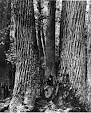
Sixty-plus years ago, my parents bought this property: two vacant lots later augmented by two more behind them, which had been logged over at some point leaving scrub trees and brush. My Father cleared it away with his brush hook and axe, but Mother made him spare this sapling, saying it would be a fine tree. Now in its full maturity, it dominates the yard, towering over the other trees in the half-acre at the back given over to woods and English ivy, perhaps a dozen or score of trees grown up over these six decades. I will miss it terribly, more than anything else connected with home. As a child, I used to talk to it and hug it -- in those days I could easily reach around it. Now its trunk is too large to encompass, and I have laid aside tree-hugging in any literal sense. But on this Lord's Day I pronounced a blessing on it, marking it with the sign of the cross. We are unlikely to meet again, this Q. palustris and I, unless it be in some forest beyond mortal ken.
Monday, October 19: the Feast of St. Luke
The days of our age are threescore years and ten; and though men be so strong that they come to fourscore years: yet is their strength then but labor and sorrow; so soon passeth it away, and we are gone. (Ps. 90:10)
I took the first shift. As soon as I saw her, it was clear that after fourscore years and fifteen, this was the end of days. Her lips were blue; her feet freezing cold even though her forehead was hot with fever (102 degrees); she struggled to breathe. Over the course of an hour, her respiration rate rose from the mid-thirties to nearly sixty; her pulse was rapid and increasingly irregular. The nurses let me call my sister from the nurses' station. On this day, we would not stray far from her side.
But the room remained cramped, too small for both my sister and I. When she arrived, we again took turns staying by Mother, a half-hour or forty-five minutes at a time. In between times, we went outside, sitting on the porch or walking on a path around a county park adjacent to the nursing home.
Thus it was that Kathy was with her when she died. I knew as soon as I walked in, from the way the nurses looked at me. One of them told me before I got to the room. Kathy was inside, crying. But Mother was at rest, pale and calm after this day of struggle.
For much of the day, her eyes were open, the first time in many days. I do not know if she was aware of us, but I cast aside all concern for her roommate (who they eventually moved somewhere else for the day), and read Scripture to her, and Psalms. It occurred to me finally that I could sing. Church musician that I am, I should have thought of this long before. I sang what I could remember of several hymns, and three plainsong settings of the Kyrie eleison, which seemed the most appropriate of all. Standing over her, stroking her hair, and singing to her, it was remarkably like singing a lullaby to a feverish child, as she probably did for me.
---
An Obituary
N.I.H. departed this life on the Feast of St. Luke, 2010, aged ninety-five.
A farm girl, she was the second of two sisters, "the one who was supposed to be a boy," as she related in later years. Tall, bookish, awkward, and fearsomely intelligent, she was no match for her sister, who married into the leading family of the district. In contrast, N. seemed destined for spinsterhood.
After graduating from high school at age sixteen, she attended Marshall University at the height of the Great Depression. She returned to her high school as a teacher of mathematics, living at home with her father and grandmother.
In the fateful year 1942, on a romantic whim she rode off with her handsome rascal of a boyfriend, a sometime coal miner five years her junior, to Bristol, Tennessee, the nearest place where they could be married without a waiting period. After a quickie wedding before a justice of a peace who specialized in such and a weekend in a hotel near the train station, it was off to war. They later managed a better honeymoon near the camp where he was stationed -- he had been in the Army since 1939, figuring it to be a better life than the mines, and was now a mess sergeant busy with feeding the flood of new recruits following Pearl Harbor. He eventually shipped out to North Africa, and was part of the fighting in Sicily and Italy. After their honeymoon, N. joined the Navy. She was part of a cryptography team that sought to break the code used by the Japanese Navy; they trained her in weather, and she (and others) compared the encoded weather reports broadcast to the fleet with the actual weather, looking for patterns. She said that in all those years, she had only one idea that was of any help.
After the war, her husband went to college on the G.I. Bill. They wanted to live "back home" near their families, but there was no work, so they moved to a larger town in the next county. They bought land on the edge of town, built a house (he, his brother, and their father, all of them skilled at carpentry and building trades), and had children.
N.'s husband died in 1975. She prospered as a widow, living a quiet and thrifty life at home, growing reclusive as family and friends passed away, one by one. She walked, gardened, canned, and read books, thoroughly content to be alone.
As the decades passed, she grew increasingly frail. At the age of ninety-three, she moved to an assisted-living facility. She made new friends and enjoyed her life, comparing it to being "with the girls back at Marshall."
N. lived a simple life, and accomplished little that anyone would consider special or outstanding. She did not work outside the home after her children came; she rarely travelled, hardly leaving her home town in her final decades. But through the long years, she maintained the values of thrift and industry that she knew were important, even when all around her was given over to waste and extravagance.
As a schoolteacher in the 1930's, she started a Girl Scout troop, the first in that part of the state. The values she lived and taught in Scouting were at one time widely held in society; they are no longer. She and others of her generation, the ones who knew the realities of Depression and World War, had much to teach us. Now they are gone, and it is up to us.
O Almighty God, the God of the spirits of all flesh, who by a voice from heaven didst proclaim, Blessed are the dead who die in the Lord: Multiply, we beseech thee, to those who rest in Jesus the manifold blessings of thy love, that the good work which thou didst begin in them may be made perfect unto the day of Jesus Christ. And of thy mercy, O heavenly Father, grant that we, who now serve thee on earth, may at last, together with them, be partakers of the inheritance of the saints in light; for the sake of thy Son Jesus Christ our Lord. Amen. (BCP p. 486)
I determined to observe the Lord's Day as would a normal Christian not in the employ of the church. I laid aside all work and cares, attended the Presbyterian church near our home, and sat with Mother for several shifts. She, too, seemed to rest quietly, though she seemed more distant than the previous day.
The Presbyterian service was solidly mainline Protestant, lasting precisely one hour from 11:00 to noon, with about seventy persons present. There was a children's handchime group and an adult choir of nine singers, including the minister. There was a decent electronic organ, a baby grand piano, and competent musicians to play them. It was a staid, genteel service, a far cry from the Baptist church I visited in August, and a reminder why I am not a Presbyterian. But it was good to worship with these people.
Through most of my fortnight in West Virginia, the weather was splendid: day after day of clear blue skies, sunshine, and shirtsleeve temperatures. I fell into the rhythm of singing Evensong in the back yard, in "choir" opposite the large oak tree (Q. palustris), glorious in the late afternoon sun in its fall colors.
Sixty-plus years ago, my parents bought this property: two vacant lots later augmented by two more behind them, which had been logged over at some point leaving scrub trees and brush. My Father cleared it away with his brush hook and axe, but Mother made him spare this sapling, saying it would be a fine tree. Now in its full maturity, it dominates the yard, towering over the other trees in the half-acre at the back given over to woods and English ivy, perhaps a dozen or score of trees grown up over these six decades. I will miss it terribly, more than anything else connected with home. As a child, I used to talk to it and hug it -- in those days I could easily reach around it. Now its trunk is too large to encompass, and I have laid aside tree-hugging in any literal sense. But on this Lord's Day I pronounced a blessing on it, marking it with the sign of the cross. We are unlikely to meet again, this Q. palustris and I, unless it be in some forest beyond mortal ken.
Monday, October 19: the Feast of St. Luke
The days of our age are threescore years and ten; and though men be so strong that they come to fourscore years: yet is their strength then but labor and sorrow; so soon passeth it away, and we are gone. (Ps. 90:10)
I took the first shift. As soon as I saw her, it was clear that after fourscore years and fifteen, this was the end of days. Her lips were blue; her feet freezing cold even though her forehead was hot with fever (102 degrees); she struggled to breathe. Over the course of an hour, her respiration rate rose from the mid-thirties to nearly sixty; her pulse was rapid and increasingly irregular. The nurses let me call my sister from the nurses' station. On this day, we would not stray far from her side.
But the room remained cramped, too small for both my sister and I. When she arrived, we again took turns staying by Mother, a half-hour or forty-five minutes at a time. In between times, we went outside, sitting on the porch or walking on a path around a county park adjacent to the nursing home.
Thus it was that Kathy was with her when she died. I knew as soon as I walked in, from the way the nurses looked at me. One of them told me before I got to the room. Kathy was inside, crying. But Mother was at rest, pale and calm after this day of struggle.
For much of the day, her eyes were open, the first time in many days. I do not know if she was aware of us, but I cast aside all concern for her roommate (who they eventually moved somewhere else for the day), and read Scripture to her, and Psalms. It occurred to me finally that I could sing. Church musician that I am, I should have thought of this long before. I sang what I could remember of several hymns, and three plainsong settings of the Kyrie eleison, which seemed the most appropriate of all. Standing over her, stroking her hair, and singing to her, it was remarkably like singing a lullaby to a feverish child, as she probably did for me.
---
An Obituary
N.I.H. departed this life on the Feast of St. Luke, 2010, aged ninety-five.
A farm girl, she was the second of two sisters, "the one who was supposed to be a boy," as she related in later years. Tall, bookish, awkward, and fearsomely intelligent, she was no match for her sister, who married into the leading family of the district. In contrast, N. seemed destined for spinsterhood.
After graduating from high school at age sixteen, she attended Marshall University at the height of the Great Depression. She returned to her high school as a teacher of mathematics, living at home with her father and grandmother.
In the fateful year 1942, on a romantic whim she rode off with her handsome rascal of a boyfriend, a sometime coal miner five years her junior, to Bristol, Tennessee, the nearest place where they could be married without a waiting period. After a quickie wedding before a justice of a peace who specialized in such and a weekend in a hotel near the train station, it was off to war. They later managed a better honeymoon near the camp where he was stationed -- he had been in the Army since 1939, figuring it to be a better life than the mines, and was now a mess sergeant busy with feeding the flood of new recruits following Pearl Harbor. He eventually shipped out to North Africa, and was part of the fighting in Sicily and Italy. After their honeymoon, N. joined the Navy. She was part of a cryptography team that sought to break the code used by the Japanese Navy; they trained her in weather, and she (and others) compared the encoded weather reports broadcast to the fleet with the actual weather, looking for patterns. She said that in all those years, she had only one idea that was of any help.
After the war, her husband went to college on the G.I. Bill. They wanted to live "back home" near their families, but there was no work, so they moved to a larger town in the next county. They bought land on the edge of town, built a house (he, his brother, and their father, all of them skilled at carpentry and building trades), and had children.
N.'s husband died in 1975. She prospered as a widow, living a quiet and thrifty life at home, growing reclusive as family and friends passed away, one by one. She walked, gardened, canned, and read books, thoroughly content to be alone.
As the decades passed, she grew increasingly frail. At the age of ninety-three, she moved to an assisted-living facility. She made new friends and enjoyed her life, comparing it to being "with the girls back at Marshall."
N. lived a simple life, and accomplished little that anyone would consider special or outstanding. She did not work outside the home after her children came; she rarely travelled, hardly leaving her home town in her final decades. But through the long years, she maintained the values of thrift and industry that she knew were important, even when all around her was given over to waste and extravagance.
As a schoolteacher in the 1930's, she started a Girl Scout troop, the first in that part of the state. The values she lived and taught in Scouting were at one time widely held in society; they are no longer. She and others of her generation, the ones who knew the realities of Depression and World War, had much to teach us. Now they are gone, and it is up to us.
O Almighty God, the God of the spirits of all flesh, who by a voice from heaven didst proclaim, Blessed are the dead who die in the Lord: Multiply, we beseech thee, to those who rest in Jesus the manifold blessings of thy love, that the good work which thou didst begin in them may be made perfect unto the day of Jesus Christ. And of thy mercy, O heavenly Father, grant that we, who now serve thee on earth, may at last, together with them, be partakers of the inheritance of the saints in light; for the sake of thy Son Jesus Christ our Lord. Amen. (BCP p. 486)
Tuesday, July 20, 2010
RSCM Report, Part Six: The Sabbath
(Friday evening, July 9)
I sit in the grape arbor at the south end of Todd Hall as evening falls, gentle and cool after a hot day. I have (quietly) sung Evensong here on my own, eaten a one-ounce piece of dark chocolate, and watched the sun set.
The older adults have gone out to an upscale restaurant; I ate pizza and leftover sandwiches with the choristers, sitting at table with the proctors and their friends. Two of them had brought in for their friends some "Polar Pops," a local treat which is a 42-oz. soft drink with lots of ice in a styrofoam cup, and the whole table was having a fine time. These young people are the best of friends, and they comfortably welcomed me into their fellowship for the dinner. I count myself blessed.
The Course always includes some free time on Friday evening and Saturday. This year, the dress rehearsal at the Basilica was on Friday rather than Saturday, so almost the entire Saturday is free. I used to chafe at this waste of time, as Judas chafed at the waste of expensive ointment. I would fill the free Saturday afternoon with activity, most often planning hymns for the next season back home. I brought a briefcase of materials for that very task, but earlier this evening I firmly packed it into the car, hardly touched, for this is, God be praised, the Sabbath.
On Saturday, there will be one last Matins with Judith and Brother Vincent, time perhaps for another visit to the grape arbor, where I have written most of these RSCM Reports, a brief rehearsal of an hour or so, a free afternoon, and the Holy Eucharist after that. Then, a dinner of pasta and the talent show. It is a full, relaxed day with these fellow-choristers, young and old, whom I love.
"O what their joy and their glory must be,
Those endless Sabbaths the blessed ones see. . . ."
I have had to learn that one need not wait for that joy, that glory. It is here, now, one day of every seven. By gracious commandment of the LORD our God, the gift is given. We need only receive it.
(Saturday midday)
At the morning rehearsal, the choristers had prepared a surprise for Mr. Lole. At the first downbeat after warmup, instead of the appointed piece, they launched into "You'll never walk alone," arms across one another's shoulders and swaying as if they were on the football terraces. That was well done. After much laughter, he tried to start again. They had another song, the football song for Arsenal, the rivals of Mr. Lole's beloved Liverpool. That really "got" him.
Afer that, the entire rehearsal was lighthearted. To duplicate the spacing issues at the Basilica, he had the Decani basses go out by the doorway of our little chapel,and the Cantoris basses behind the altar at the far end of the room. This was to synchronize an entrance in the Vierne. He did the same with the tenors for another entrance.
He "got" me with his imitation of the (imaginary) crabby old lady in the back row of the Basilica -- "there is always one of them in a big place like that." We were to sing big consonants so that she could hear them. We did some of this, with comments from the "crabby old lady." A bit later, precisely as we inhaled for a fortissimo chord, he said in his old lady voice "I'm listening." I lost it, doubled over with laughter.
It was a Good Day, a holy Sabbath.
I sit in the grape arbor at the south end of Todd Hall as evening falls, gentle and cool after a hot day. I have (quietly) sung Evensong here on my own, eaten a one-ounce piece of dark chocolate, and watched the sun set.
The older adults have gone out to an upscale restaurant; I ate pizza and leftover sandwiches with the choristers, sitting at table with the proctors and their friends. Two of them had brought in for their friends some "Polar Pops," a local treat which is a 42-oz. soft drink with lots of ice in a styrofoam cup, and the whole table was having a fine time. These young people are the best of friends, and they comfortably welcomed me into their fellowship for the dinner. I count myself blessed.
The Course always includes some free time on Friday evening and Saturday. This year, the dress rehearsal at the Basilica was on Friday rather than Saturday, so almost the entire Saturday is free. I used to chafe at this waste of time, as Judas chafed at the waste of expensive ointment. I would fill the free Saturday afternoon with activity, most often planning hymns for the next season back home. I brought a briefcase of materials for that very task, but earlier this evening I firmly packed it into the car, hardly touched, for this is, God be praised, the Sabbath.
On Saturday, there will be one last Matins with Judith and Brother Vincent, time perhaps for another visit to the grape arbor, where I have written most of these RSCM Reports, a brief rehearsal of an hour or so, a free afternoon, and the Holy Eucharist after that. Then, a dinner of pasta and the talent show. It is a full, relaxed day with these fellow-choristers, young and old, whom I love.
"O what their joy and their glory must be,
Those endless Sabbaths the blessed ones see. . . ."
I have had to learn that one need not wait for that joy, that glory. It is here, now, one day of every seven. By gracious commandment of the LORD our God, the gift is given. We need only receive it.
(Saturday midday)
At the morning rehearsal, the choristers had prepared a surprise for Mr. Lole. At the first downbeat after warmup, instead of the appointed piece, they launched into "You'll never walk alone," arms across one another's shoulders and swaying as if they were on the football terraces. That was well done. After much laughter, he tried to start again. They had another song, the football song for Arsenal, the rivals of Mr. Lole's beloved Liverpool. That really "got" him.
Afer that, the entire rehearsal was lighthearted. To duplicate the spacing issues at the Basilica, he had the Decani basses go out by the doorway of our little chapel,and the Cantoris basses behind the altar at the far end of the room. This was to synchronize an entrance in the Vierne. He did the same with the tenors for another entrance.
He "got" me with his imitation of the (imaginary) crabby old lady in the back row of the Basilica -- "there is always one of them in a big place like that." We were to sing big consonants so that she could hear them. We did some of this, with comments from the "crabby old lady." A bit later, precisely as we inhaled for a fortissimo chord, he said in his old lady voice "I'm listening." I lost it, doubled over with laughter.
It was a Good Day, a holy Sabbath.
Subscribe to:
Posts (Atom)

 Posts
Posts


