Wednesday, December 30, 2015

"Organ," by Arthur Wills (book review)

I write of this book primarily for its material on improvisation, for which read on.

The book has been on my shelf for fifteen or twenty years, since it was given to me (along with several bags of other musical books) by Mary Landrum, of blessed memory. I have finally read it, with delight; I wish that I had read it immediately, for it would have saved me some wrong turns along my path.

Wills was the Organist of Ely Cathedral from 1958 to 1990. In one volume, he sought to fulfill at least three purposes: a historical outline of the organ’s physical and tonal development, a historical survey of the music for the organ, and a course of study for learning to play the instrument.

It is this last which is of interest for today, though I recommend the book for its other contents as well, particularly for its emphasis on English music for the organ with suggested repertoire, a topic often neglected in books about organ music.

Wills begins this section (“Acquiring the Skills,” Part IV of the book) with an eight-page syllabus for three years of study, taking the beginner (granted, with the considerable piano fluency that he [and I] consider a prerequisite) from the easiest slow movements of the Mendelssohn sonatas to such works as the Messiaen Messe de la Pentecôte, the Bach Clavierübung Part III, the Liszt Ad nos (of which I wrote longingly a few weeks ago). I would add that it would be a student with unusual diligence and not insignificant talent who would attain this level (and learn all of this repertoire!) in three years. But the works that he lists are indeed the core repertoire that a student should learn, arranged in a good pedagogical order.

He devotes the rest of Part IV (pp. 186-242) to Organ Improvisation. And here, buried in the back of a volume where one might not expect such a topic, is a Treasure. Wills is the first author I have encountered who begins with what amounts to Species Counterpoint, leading to work modeled on French Classic examples such as the Titelouze hymn settings – which, one comes to realize, are not far removed from Species work, with the chant tune in long notes in the pedal, the other parts moving contrapuntally above it. From there, the student moves to chorale improvisation modeled on Buxtehude and Bach; then free improvisation, starting with two-part textures as one would find in the Voluntaries of John Stanley and his contemporaries, and on to binary and ternary forms, and the sonata form, using Haydn and Mozart as examples for all of this (minuets, slow movements, sonata-allegro movements). The final “exercise” in the book is the improvisation of a four-movement symphonic form using what has been studied: first movement in sonata form, slow movement in ternary form, scherzo in rondo form, finale consisting of introduction, fugue and toccata.

All this is to be accomplished in the three-year course of study, alongside all of that repertoire. And not to forget: choral accompaniment, to which he had earlier devoted a few pages, noting such works as the Stanford Magnificat in A major and the Duruflé Requiem as especially profitable for study.

I suspect that Wills expected this sort of discipline from his students at the Royal College of Music, and it is surely his work as a teacher that lies behind this volume. I conclude with a quotation from one of his students, Stephen Cleobury, the current Director of Music at Kings College, Cambridge:
Notwithstanding the possible disadvantages of ranging over too wide a field, many organists have displayed great versatility in carrying out many differing tasks assigned to them – solo performance, improvisation and accompaniment, choir-training and conducting, teaching and adjudicating, arranging and composing. Such is the daily round of the English cathedral organist, and there are many musicians now at work in all branches of the profession who have reason to be grateful to this tradition and its guardians for their early training. I shall always value the insights that I gained as a pupil of Dr. Wills… (from the Foreward: p. 9)

I see from Amazon that the most recent edition of the book is 2001. My copy is the 1985 edition; I suspect that any edition would be suitable, and that older copies may be found at minimal expense on used-book sites.

Organ, by Arthur Wills (Yehudi Menuhin Music Guides)
Schirmer Books, 1985
ISBN 0-02-872850-5
(paperback: 256 pages)

Sunday, December 27, 2015

Kenton Coe

For tonight, I have a new upload to YouTube: my prelude from the Midnight Mass [the link is further down this page]. It is a suite of six Christmas Carol settings by the Tennessee composer Kenton Coe. His website is here. I recommend that you visit it, if only to see the portrait of him and read his “random thoughts” on the homepage. Here is one:
I only trust a music that is a language between the composer and the listener: sharing an intellectual and spiritual experience. That music can be as simple as the simplest mountain carol, or as complicated as a piece by Elliot Carter. The only way to appreciate music is to listen to it, and listen to it, and listen to it. If it is in an unfamiliar style, keep listening. I had to play the recording of the Ives’ Concord Sonata fourteen times to begin to understand what it was about, and it was worth the effort!
This is something I am proud to put on the Net. It is about twenty-five minutes of music, and well worth the time to listen to it. I have played these pieces for twenty years and more, and they remain my favorite settings of these carols, by far.

Mr. Coe is one of the small number of Real Composers whom I have met. For many years, we lived in neighboring cities. He is very gracious, and has always encouraged me in my work with choirs and the organ.

I exchanged e-mails with Mr. Coe earlier this fall (our choir will be doing one of his anthems in 2016), and I told him that upon reflection, he is one of the main influences on my musical style. I can offer a composer no higher compliment, other than to perform his music.

Kenton Coe: Six Organ Preludes, Book II (Christmas Carols)
(composed in 1988)

Joy to the world
Puer nobis nascitur
Venite adoremus
Rosa mystica
Silent night
God rest ye merry, gentlemen

Artwork:
Angels appearing before the Shepherds (Henry Ossawa Tanner, 1911)
The Nativity (Lucas Cranach the Elder, c. 1520)
The Adoration of the Kings (Peter Breughel the Elder, c. 1556)
Virgin and Child (Madonna of Humility) – Andrea Mantegna, 1490

Saturday, December 26, 2015

Boxing Day

I almost did not practice the hymns for tomorrow.

Preparations for Christmas Eve dominated the week. Somehow, the idea lodged in my head that there were two days to prepare for Sunday.

Well, yes, if one counts Christmas Day. But that morning was devoted to the Mass for the day, wherein Ting Davidson played violin. I wrote of this last year; it was a delight to work with her again in similar manner. Someday soon, her collegiate studies will end and it is unknowable whether she will make it home for Christmas after that, or at least not with enough time or energy to play for a church service. That makes a day like yesterday all the more precious to me. She is a terrific musician.

I could have stayed through the afternoon and practiced. But my wife was at home, with a day off after too many days of “big box” retail work, too much overtime.

It was not until this morning that I realized that this day is Saturday, not Friday, and this day is all that I have.

Our service tomorrow is Christmas Lessons and Carols, “so that no one has to work very hard,” as one of the clergy said. Right: prelude, ten hymns, postlude. Not much work for anyone.

I had the church to myself all day except for the noontime Al-Anon group; it is Boxing Day, and no one is working unless they must. I was feeling more than a little resentful at the clergy, taking a day off and spending time with their families. “No one has to work very hard.” I worked about three hours on the voluntaries, glad that I had spent two hours on them Thursday morning when that evening’s services were more pressing.

I looked at the hymnal, bristling with the tape flags for tomorrow’s hymns. “Just leave it. You have some time tomorrow morning. If you can’t play 'While shepherds watched' and ‘Joy to the world’ by now, you might as well hang up your shoes.”

It was that close. Yes, I could play these hymns and carols without practice. The service would probably go just fine with what I call “plain vanilla” hymnody – straight-up hymn playing without creativity, without thought or any more than a minimum of preparation.

And, by just a tiny amount, the Kingdom of God would be degraded. The people would go home and go on with their lives. When next year rolls around, they might stay at home rather than coming out for the First Sunday after Christmas Day.

What it boils down to is that by not practicing, not doing my best, I would be Bearing False Witness. I would be acting as if the Nativity of Our Lord were not important. I wrote of this in another connection here:
In the morning, I woke and prayed and knew what had to be done. Yes, I could have decided not to do it. Who would have known? Would it have made a difference to anyone in the world that I had felt a sense of incompleteness about a painting? ...

But it would have made me a whore to leave it incomplete. It would have made it easier to leave future work incomplete. It would have made it more and more difficult to draw upon that additional aching surge of effort that is always the difference between integrity and deceit in a created work. (Chaim Potok, “My Name is Asher Lev,” p. 328, quoted in the linked Music Box essay.)
I sighed, opened the hymnal, and started in on the first hymn, “Once in royal David’s city.” And, what do you know, once I got going, it was Good Work. It was clear whose voice that had been, telling me to “just leave it.” It was clear, also, what manner of spirit lay behind my resentment against the clergy for taking a day off. They have worked hard this week too, often dealing with thorny interpersonal issues that drain the life out of one's soul. That is the bread and butter of parish pastoral ministry, and it is much harder than sitting in a quiet church at the organ, practicing hymns. We must work together, and the Adversary (Hebrew: "ha-Satan") ever seeks to sow discord and resentment between us.

And if I think even for a moment that I have a tough job, I could trade places with my wife, who had an eight-hour shift at Customer Service and Returns on the day after Christmas.

Two and a half hours sufficed to work through the ten hymns. I am not doing anything new or dramatic, but I am using the stanza layouts that I have prepared in the past, and I could not have done so in tomorrow’s service without this day’s work.

The final hymn is one that summarizes the story: “The first Nowell.” I saw my notes that the Willcocks harmonization from the green “Carols for Choirs” is good for the final stanza, so I went downstairs and got it out of the stack from the other night’s music. It is good indeed, and needed about fifteen minutes of work to get the cobwebs brushed off, for I have not used it for several years. It will be a better ending for tomorrow’s service than a plain vanilla play-through, much better.
Then let us all with one accord
Sing praises to our heavenly Lord;
that hath made heaven and earth of nought,
and with his blood mankind hath bought.
Nowell, Nowell!
Born is the King of Israel.

Tuesday, December 22, 2015

Three for Advent

Most of the world has moved on to Christmas – they got there the day after Halloween, for the most part. But we are not there yet.

Here are three pieces from the Fourth Sunday of Advent, all based in various ways on the Visitation of the Blessed Virgin Mary to her cousin Elizabeth:

Improvisation on “Veni Emmanuel” and “Picardy”

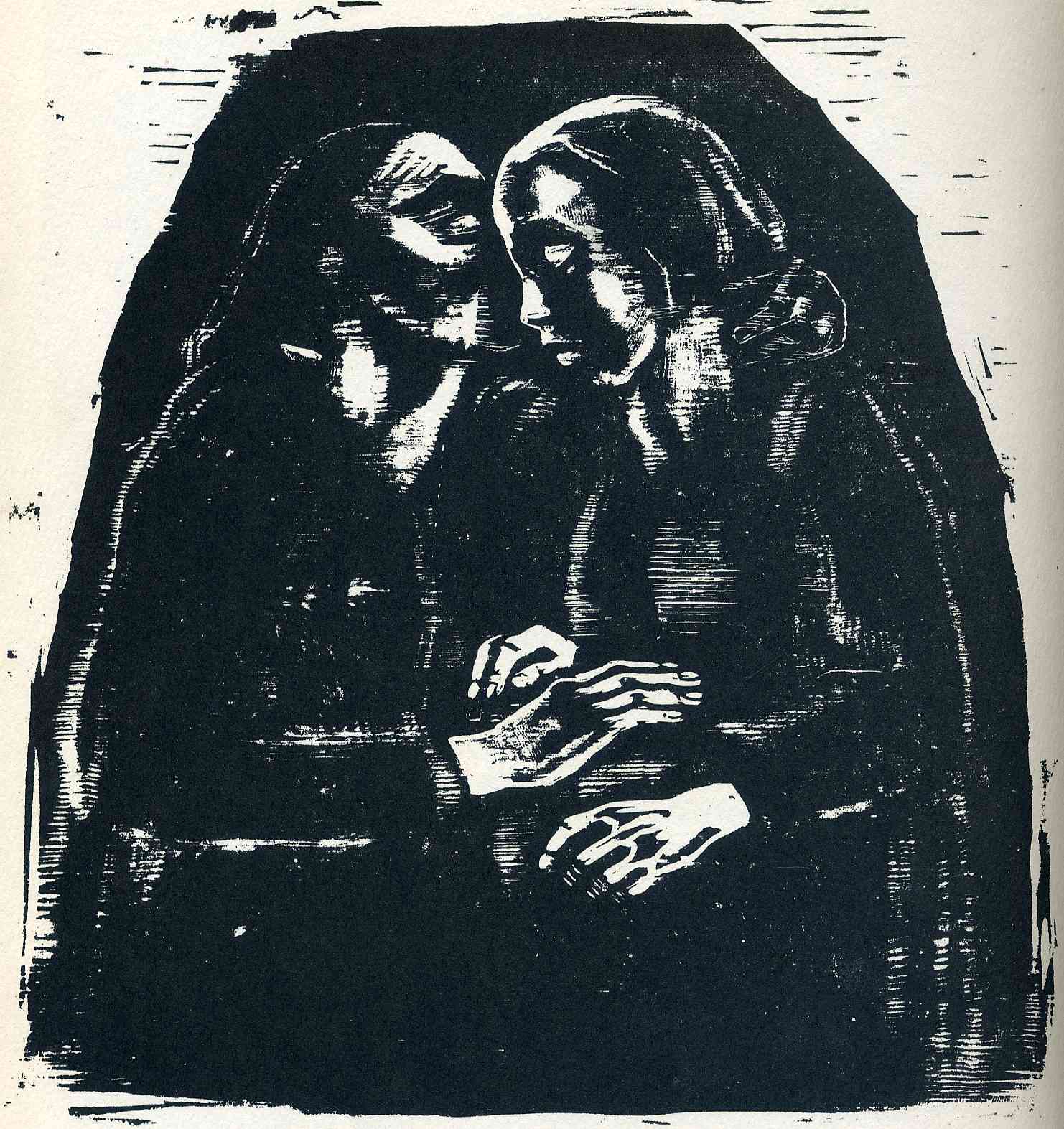
Artwork: “Mary and Elizabeth” by Kathe Kollwitz (1867-1945)

This improvisation came out rather dark in tone, and I hope that the Kollwitz print is a good match to it. I made another attempt at Sonata Form, with the exposition of the two tunes in A minor and C minor, a development mixing the two, and a rather abrupt return to the tonic for recapitulation. I remind myself that the only way I can become thoroughly comfortable with a form is by frequent use of it.

Kollwitz was born in East Prussia, and worked in Germany through two wars. The younger of her two sons died in World War I, greatly influencing the direction of her art for the rest of her life. A committed pacifist and socialist, the Nazi government forced her to resign her teaching position in 1933. All of her work was removed from German museums and she and her husband were threatened by the Gestapo. She continued to work through the later 1930’s, creating a major cycle of lithographs on “Death.” Her Berlin house was destroyed in a bombing raid in 1943, along with much of her work. Two hundred and seventy five etchings, woodcuts, and lithographs survive, enough to secure her reputation as one of the leading artists of twentieth century Germany.

************

J. S. Bach: Two settings of Meine Seele erhebt den Herren (My soul doth magnify the Lord)
from the Schübler Chorales (BWV 648)
Fugue on the Magnificat (BWV 733)

These settings are a textbook for working with minimal material, for the tune is essentially no more than a psalm tone, two phrases. From this, Bach creates masterpieces.

In the first, Bach weaves an ostinato (first presented as a solo in the pedals) around the tune, creating a quiet, intense setting. The artwork is by Rembrandt; I love the quiet grace of the two women in the center of the painting, the light radiating from them.

Artwork: “The Visitation” by Rembrandt (1640)

For the second setting, Bach takes the first phrase of the psalm tone and makes it the subject for a fugue on full organ, organo pleno and bursting with energy. It is for manuals only until the tune finally appears in the pedals at a most profound climax of intensity.

Here, I have included a painting by Henry Ossawa Tanner, who has become one of my favorite twentieth-century American artists. Mary walks in the door, and Elizabeth, sitting at her kitchen table, recognizes that the world has changed forever: “He hath put down the mighty from their seat, and hath exalted the humble and meek.”

Artwork: “The Visitation” by Henry Ossawa Tanner (1910)

*******************
I will not post again before the Twelve Days; thus, I wish for all of you a most joyful and holy Christmas. The world has indeed changed forever.

The Lord be with you

I do not intend to see the new Star Wars movie.
But I saw the first one many years ago. In those days (and often since then), people would use a movie line as a good wish: "May the Force be with you." I have heard it several times in the last week.

I have grown increasingly uncomfortable with the worldview behind that: an impersonal Force, complete with a Dark Side. The Force enables one to perform superhuman exploits, for good or ill - in essence, Magical Thinking, the notion that we can somehow influence Hidden Powers to bend the universe for our personal benefit. But that is ill-tempered on my part. It is just a movie, though its influence on popular culture has been considerable. I have many young friends who love the Star Wars movies and characters, so I will say no more.

Except for this: We have something greater than any Force -- a Person. So when we say something as common as "The Lord be with you" and respond "And with thy spirit," this is not a trivial wish.

The Lord is not going to bend the universe for our personal benefit, and he is not to be manipulated into anything. But he is our Friend, and he will be with you (and me) in life and death. That is good enough for me, and I wish it for you:

The Lord be with you.

Wednesday, December 9, 2015

Ad nos ad salutarem

Someday I would like to play this:
Fantasy and Fugue on the Chorale “Ad Nos, ad salutarem undam” (Franz Liszt)


One of the perverse ways in which my mind has always worked is that when I am the busiest, that is when I have ideas about Big Projects, especially recitals. I am committed to play in the Lenten series for 2016 across town on the Casavant at the Congregational Church, and I must come up with something to do. There are easier things that I could do than this, but it is what this day I would love to attempt. I was thinking of it all night and on the bus ride into town this morning.

Among the organ music of Liszt, three pieces tower above the rest. The third (Variations on “Weinen, Klagen, Sorgen, Zagen”) I have played. The second (Prelude and Fugue on B.A.C.H.) is probably the best-known, and for that reason I am not much interested in attempting it. The first, written in 1850, is the “Ad Nos,” based on a chorale from the opera “The Prophets” by Louis Meyerbeer, one of the most noted composers of that era (and now almost forgotten). I have the score – it is in the same volume as the other two works, comprising 48 pages, some of it visually intimidating – I have looked at it and "read" parts of it mentally, but I have never heard this piece in performance, or even on a recording.

The modern musician in such a state does what I did this morning: I went to YouTube. There one may find a number of recordings. The one I linked at the beginning of this page is by Daniel Roth, in live performance on the masterpiece of Cavaille-Coll, the five-manual instrument at St. Sulpice in Paris.

Being a mechanical action (with Barker levers) instrument, Roth here employs two stop assistants, one on each side, each with multiple-page lists of stop changes, which Roth calls out to them as he plays. It is fascinating to watch them negotiate this long, complex work. It is a task that would be much easier on an instrument with electric stop action (at the least, if not some form of electric key action). But Liszt had no such action at his disposal. When he played it at the organ, he probably had stop assistants as one sees here.

There are two gaps in the recording, which is from the video archives of St. Sulpice, and there are doubtless many YouTube versions with better sound quality – I have sampled one by Dame Gillian Weir which is quite good, played at the Royal Albert Hall, and that recording includes the score so one can read the music as it plays. But the “behind the scenes” nature of this recording at St. Sulpice makes it especially interesting, at least to me. And it is a live recording. And, amazingly, it is a part of the Liturgy, a postlude. As the recording begins (and as Roth and his assistants busily prepare the stops), one hears the priests off somewhere down front, chanting the ending of the Mass. I marvel at the sort of Liturgy and Place that would support a major thirty-minute work as a postlude. Blessings be upon them!

It is enjoyable to watch Roth squinting through his glasses at the score, singing along with some of the melodies, most of all playing in the Grand Manner that such music (and such an instrument) require. At the end, he asks one of the assistants about the time, and he holds his wristwatch where Roth can read it – even as he is playing the final majestic chords. I wonder if they had to clear out for another Mass, and the long postlude was pushing the available time? Or perhaps he had to clear his mind and play the next Mass himself? That sort of thing is part of being an Organist – one always must have the external circumstances in a part of one’s mind, much more so than other classical performers.

As for my undertaking of the Ad Nos, it may come to naught like most of my Big Projects. I have other responsibilities between now and Lent, and I have pencilled in one of the large movements from the Livre du Saint-Sacrement of Messiaen for the April Evensong, which would be new to me and require quite a bit of work – I may not be up to doing both it and the Liszt. But I am growing old, and will not have many more opportunities to play such works as these; if not now, when?

Sunday, December 6, 2015

Hanukkah: Cause us, O Lord

On this first Night of Hanukkah and Second Sunday of Advent, I have posted our anthem from Choral Evensong here.
Cause us, O Lord our God, to lie down each night in peace
and to awaken to renewed life and strength.
Lord, help us to order our lives by thy counsel,
lead us in the paths of righteousness.
Lord, be thou a shield about us, protect us,
save our world from sorrow, from hate, and from war.
Curb thou within us the will to do evil;
shelter us beneath the shadow of thy wings. Amen.

(text: a Jewish prayer)


As I mentioned a fortnight ago, I played the Prière of César Franck as the prelude. It turned out well enough, but there are plenty of good recordings on YouTube so I will not post mine. I did not select this anthem with the idea that it would be sung during Hanukkah; I chose it to fit the Lessons for tonight’s Evensong – Amos 6 and II Thessalonians 1. But it is a Jewish text, and far more timely than I had imagined. “Save our world from sorrow, from hate, and from war…”

We are Christians, of the household of God only by adoption, whom St. Paul describes as wild olive branches grafted to the rootstock. But Hanukkah was our deliverance, too. If the name of Israel had been erased from the earth in those days, there would have been no Messiah.

Thus, I selected Jewish images for the YouTube clip; a photo of a Menorah from a college Hillel center’s blog, and what I find to be an evocative Cubist painting from a modern artist (1970).

There is much more that I would like to say, but it must wait for another time. For tonight, for this Feast of the Dedication when the Lord granted his people deliverance when all seemed to be lost, it is enough to pray together.

Friday, November 27, 2015

Wedding Day

Today was the wedding of two young parishioners, Will and Stacy. It was simple, beautiful, and elegant. I am happy for them; I enjoyed working with them on the musical aspects, and I wish them well this day, and all the days of their life together.

When I contemplate retirement, one of the thoughts uppermost in my mind is “No more weddings!” I may be willing to play a few Sunday services as a substitute, and I have entertained the thought of becoming a Funeral Home Organist, if such positions still exist (they are being replaced by canned music, for the most part) -- but No Weddings. Not for any amount of money.

In the planning process, I have been screamed at and cursed by mothers, once by a father (who was an ordained minister; that one was over the question as to whether his other daughter, the vocal soloist, could use a microphone and a portable sound system. I said “No,” and stood my ground). I have mediated between the family and the trumpet player who would not open his case without $200 cash money in hand – all this some thirty minutes before the wedding, for which I was being paid $50. I have had to preludize for ten extra minutes, twenty, thirty… I have started a five-minute piece to fill the extra time and within the first four bars been told “They are ready to roll; cut it short.” I have wondered whether the two-year old flower girl would make it down the aisle or sit down in the middle and start counting flower petals (as I vamped on Pachelbel’s Canon, playing the last page three times).

Any organist has stories. Clergy doubtless have stories to match, some of them about their organists. Some of the worst days of my professional life have been Wedding Days. And yet… some of the best days of my professional life have been Wedding Days.

I was in high school when I played my first wedding, and it was the first time I played an organ – a little electric thing with one octave of stubby pedals, in an Assembly of God church. The groom had been my neighbor and best friend when we were quite small, preschool and the early grades. Our paths diverged as I gravitated to music and he to sports (he is now well respected as a small-college basketball coach); the bride was likewise a close friend. She alone of the friends of my childhood and youth attended my mother’s funeral; she told me that day of something I had not known – through the early years while they were in town and I was off at college, my mother was the only adult who believed in them, that they would make it as a married couple (they have: forty-plus years so far).

And there was a day when the young woman who was probably my best friend in college – and is the only friend I still have from those days – was married in the living room of her home. She and I had gone to the music store and selected a rental piano for the event, a spinet. I played Mozart and Bach and Chopin and Beethoven and it was a Good Day, one that remains in my heart as a landmark.

I was at the Presbyterian church in Tennessee long enough for a generation of choristers to grow into adults, and played quite a few weddings for them. There was the one where the girl whom I had known since she was a toddler married a farmer, and the reception was out in the country, complete with bluegrass band and old-style flatfoot dancing. There was another where the bride decided that the place she wanted to wait before the wedding was upstairs in the organ/choir gallery because that was the place in the church where she felt most at home after all her years in choir – she sat on a stool beside the organ console, her bridesmaids around her – all of them former choirgirls – as I played the preservice music. I felt as if I were playing for the Bride of Christ, the holy Marriage Supper of the Lamb for which we long.

Every wedding, every marriage, is a glimpse of that eternal Day, when sorrow and pain shall be no more.

But in this life, there is plenty of sorrow and pain, and marriage is one of the places where it is most acute, for the pain comes to those whom we love the most, and the path is often very hard. One of the women I have described is now a widow; another cares for her husband who is disabled, while working a demanding full-time job and parenting teenagers.

Marriage is one of the Seven Sacraments, and like the others, much about it is a mystery. It is in the providence of God that He has set us in families, with the union of man and woman as the foundation. One finds that it is in the times of sickness, of pain and bereavement and anguish, when God is most present, and that Presence is manifested very often in the patient daily care of husband and wife for one another through the darkest of times. Or parent for child, or child for parent.

One ought not to think too much on these things on Wedding Days – but it is right there in the marriage vows, and a good thing it is; I have needed the remembrance of these vows many times over the years:
In the Name of God, I, N. take you, N. to be my wife, to have and to hold from this day forward, for better for worse, for richer for poorer, in sickness and in health, to love and to cherish, until we are parted by death. This is my solemn vow.
***************
Some might be interested in what I play for weddings. It depends, of course, on what the Bride and Groom desire, within the limits of what is acceptable for Christian worship. Here is today’s music list, with some commentary:

Two short movements by Felix Mendelssohn: Adagio from the First Organ Sonata, and the Andante tranquillo from the Third Sonata. This latter Sonata he wrote for the marriage of his beloved sister Fanny – and then he was unable to play it, being injured in a carriage accident shortly before the day. I have used the majestic opening to the first movement, the Con moto maestoso, as a bridal procession, but the fugue that makes up the rest of the movement, based on the chorale Aus tiefer Not, is a bit much.

Vaughan Williams: “Wedding Tune for Ann,” from “A Vaughan Williams Organ Album” (Oxford Univ. Press) – a fine three-minute piece which is thoroughly suitable to the occasion. It is hard to find music by Real Composers that they intended for weddings and that still work in current practice. The only other that I can think of offhand is the Siciliano for a High Ceremony (Herbert Howells), a fine eight-minute piece composed for a 1953 wedding – but it is not for everyone; it has to be someone that would appreciate Howells’ musical style.

Chorale setting: Schmücke dich, O liebe Seele (J. S. Bach, from the Leipzig Chorales) – this was a favorite of Mendelssohn’s, and of many other organists since. It is a communion text, but the spirit befits a wedding – “deck thyself, my soul, with gladness.”

Canon in D (J. Pachelbel, arranged for organ by S. Drummond Wolff, Concordia Publishing House). For today’s service, the couple wanted “Pachelbel’s Canon,” but not as the processional, a purpose for which I have played it scores of times. Many serious musicians turn up their nose at this – there was a time when we had three excellent violinists in our parish, and I tried to get them to play the Canon for church – they looked at me as if I had committed an Unpardonable Sin and absolutely would not do it. But it is a terrific piece of music, and the mood of it is exactly right. Further, it can be cut short or stretched out to fit a procession – my poor copy is marked with so many cuts that I can hardly make out what I am doing. And today, I played the whole thing for the first time in quite a few years – I had to work on the middle parts, which I most often have cut.

More Bach: Wachet auf, ruft uns die Stimme, from the Schübler Chorales. This is the one piece that I always play, because of the connection of the chorale text with the Bridegroom. And for a wedding two days before Advent, it is essential.

At this point, the procession begins:

Bach: “Jesu, joy of man’s desiring,” from “The Biggs Book of Organ Music” (ed. E. Power Biggs, H. W. Gray Publications). This is a useful volume for the church organist, not least for this arrangement of “Jesu, joy.” Like the Canon in D, it is a wedding staple, and very practical – it can be cut or extended to some degree, though not so readily as the Pachelbel.

On this day, the brother of the bride played a piano piece of his own composition for the brides’ procession. I worried about this, especially after he launched into the Darth Vader theme from Star Wars as the people gathered for the wedding rehearsal. But he was just poking fun at his sister; in the event, the piece was thoroughly appropriate, and far more meaningful than anything I could have done.

When it is up to me to play the procession, one of my staples is the Jeremiah Clarke Trumpet Voluntary (The Prince of Denmark). I play this from "Incidental Music for Weddings and Other Occasions, As played at the Royal Wedding at St. Paul's Cathedral, 29 July 1981," edited by Christopher Dearnley (the organist for that Occasion)- Basil Ramsey, publisher. It is a lovely little volume, complete with the stoplist for the very large instrument in that Place, and photos of various parts of the instrument.

And I am not above "Here comes the bride," or more properly, the Wedding March from Lohengrin (R. Wagner). Like the Pachelbel, it is a piece that can be trimmed or expanded to fit the time needed. I always include it in my suggestions to the couple; some laugh at me, for others it is precisely what is suitable. There are some clergy (and some organists) who forbid this piece; I am not one of them.

The recessional:
Trumpet Tune (Henry Purcell) – another wedding standard. At this point, I very often play the Wedding March from Midsummer Night’s Dream (Mendelssohn) which is my favorite. Or the piece that on this day followed the Purcell:

Overture and The Rejoicing, from “Firework Music” (G. F. Handel) – this is from the Biggs Book, which contains many other arrangements from Bach and Handel.

I used to play the Widor Toccata (Final, from the Fifth Organ Symphony), but that was on an instrument with electric action. On our mechanical-action Pilcher, my hand starts to fall off after about three pages, so I refuse to play it. But it is very effective if the instrument and organist are up to it. The Final from the First Symphony of Louis Vierne is another good choice if the circumstances are fitting.

*********
I was pleased this day to play my first wedding with our current rector. She does a splendidly dignified wedding, by far the best of any clergy with whom I have worked; it was indeed a delight to work with her this day. And she used the long form of the Blessing, which I have not heard since my own wedding, many years ago:
Most gracious God, we give you thanks for your tender love in sending Jesus Christ to come among us, to be born of a human mother, and to make the way of the cross to be the way of life. We thank you, also, for consecrating the union of man and woman in his Name. By the power of your Holy Spirit, pour out the abundance of your blessing upon this man and this woman. Defend them from every enemy. Lead them into all peace. Let their love for each other be a seal upon their hearts, a mantle about their shoulders, and a crown upon their foreheads. Bless them in their work and in their companionship; in their sleeping and in their waking; in their joys and in their sorrows; in their life and in their death. Finally, in your mercy, bring them to that table where your saints feast for ever in your heavenly home; through Jesus Christ our Lord, who with you and the Holy Spirit lives and reigns, one God, for ever and ever. Amen.

Saturday, November 14, 2015

Rest in peace.

Music by two Parisians:

Tierce en taille, and Cromorne en Taille, from the Messe de Paroisse (François Couperin)

Priere (César Franck)

******
This morning, in the process of considering what music I might post here in response to the attacks in Paris last night, it struck me most suddenly that I have a responsibility tomorrow morning, akin to what those who will be preaching and leading prayers will have. Mine is but a small responsibility, but it did not until now occur to me. I am cancelling the postlude that I had planned and will play the Tierce en Taille which is linked above as a memorial prayer.

I would love to play the Franck instead, but it is well beyond anything I could prepare in one day. [Edited to add: I think that I can play it for the next choral evensong, December 6.] I do encourage you to listen to the Franck, or the Couperin. Perhaps light a candle. Certainly, pray for those who have died, and those who are bereaved, and those who are injured. And all of us, around the world, who must live this day and the next and the next after that, trusting only in the mercies and providence of God.

There have been other terrorist killings, some of them worse than this. Upon hearing the news last night, I thought immediately of the 2004 Madrid bombings, and the schoolchildren of Beslan, in the Ossetia region of Russia, also in 2004. And the Israeli athletes at the Munich Olympics in 1972.

This one, last night in Paris, feels like 9/11/01. As with that event, I fear that the consequences will be profound, and not for the best.

Friday, November 13, 2015

Open my eyes

Here is a recording of our choir singing the Gilbert Martin arrangement of an old gospel hymn: "Open my eyes that I may see." It is taken from our liturgy on October 25, and I am just now getting around to posting it.

We also sang the Howells Te Deum and Jubilate at that service, and it went pretty well. But I am not going to post the recordings; there are many versions on YouTube that are much better than we could ever hope to do.

But this one, "Open my eyes," has only one other YouTube version, a good rendition in Chinese, so ours is worth posting.

While working with the YouTube video manager, I noticed that several of my Bach organ recordings have had copyright claims placed on them. I suppose that I should be flattered that the computer who does these things for YouTube thinks that my versions are sufficiently close to their Property to warrant a claim. I am not.

But I do not see a good way to dispute the claim. The YouTube dispute form gives several options that could be checked off and none of them apply completely. On the one hand, the video is not entirely of my creation - J. S. Bach wrote the music, and the artwork is from WikiArt, by some of the Masters of old time. These things are in the public domain, but they are most decidedly not my work.

And on the other hand, I am not willing to claim that the YouTube clips are entirely in the public domain; they are not, for I have a performance right in them. That is to say: I am very pleased for anyone to listen to this music. But I am not pleased for some rights organization to come and make money on what is not theirs.

And, most of all, there is the danger that by disputing the claim, the publisher who claims rights can summarily shut down my YouTube channel and this MusicBox. I know of one blog that disappeared in just this fashion, without notice or recourse. Or I could find myself embroiled in litigation.

So I am going to let it go.

[Edited 11/20/15 to add this news story}
YouTube owner Google says it will help fund up to $1m (£650,000) in legal fees for some content creators who have received copyright takedown notices. It will step in if it feels their material is considered to be fair use. However the firm admitted that only a handful of people have been chosen to benefit from this support. Copyright holders are able to make requests to Google - or other sites - to take down content under the Digital Millennium Copyright Act (DMCA).....

"We are offering legal support to a handful of videos that we believe represent clear fair uses which have been subject to DMCA takedowns," wrote Fred von Lohmann, Google's copyright legal director, in a blog post....

"We're doing this because we recognise that creators can be intimidated by the DMCA's counter-notification process and the potential for litigation that comes with it.

"While we can't offer legal protection to every video creator - or even every video that has a strong fair use defence - we'll continue to resist legally unsupported DMCA takedowns as part of our normal processes."