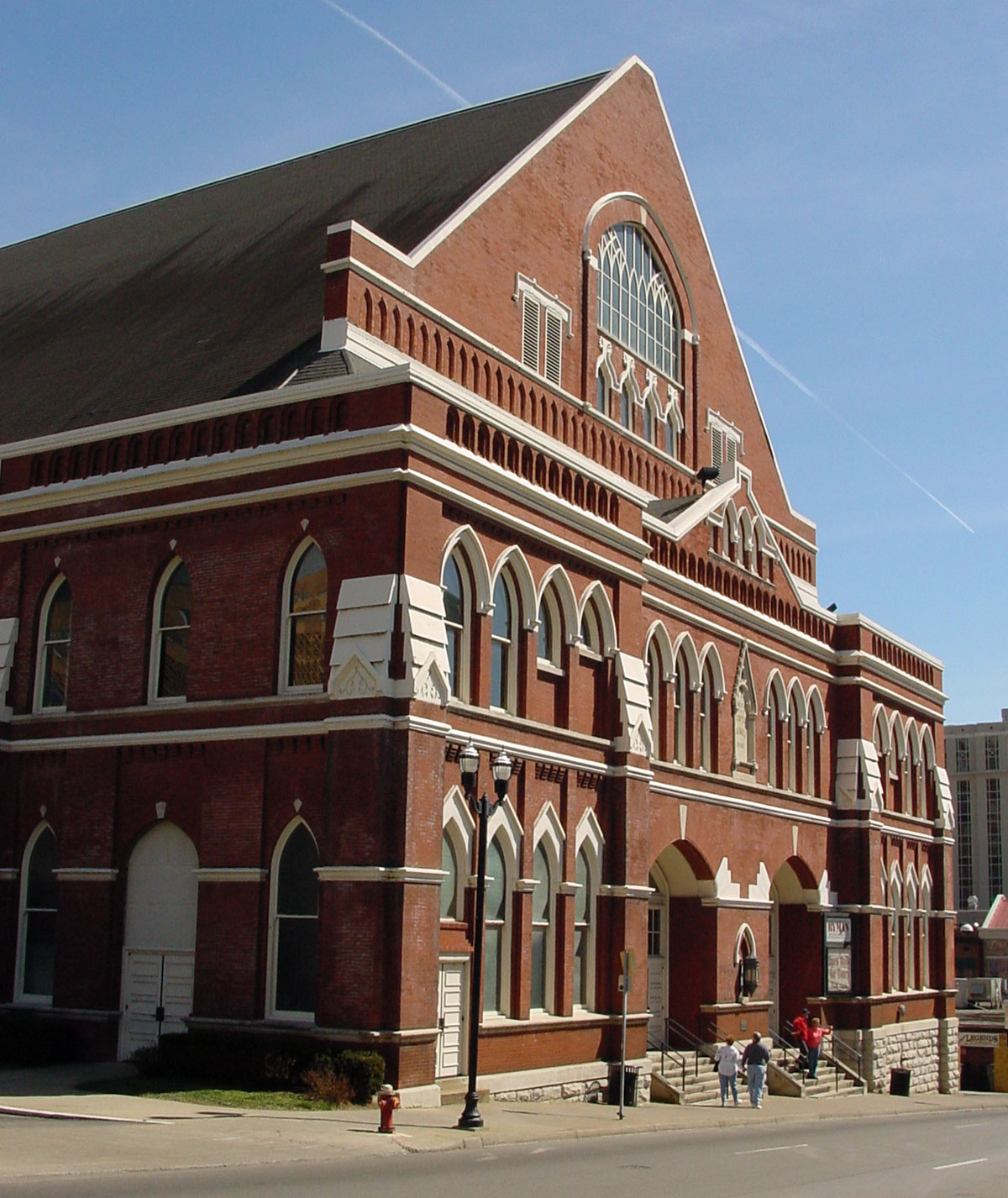
August 13: Friday
The Doubletree Hotel in downtown Nashville was a different world than the one I inhabit. Walking through the rotating door thrust me into the world of those who spend their life rushing from airport to hotel to meeting to airport to holiday and more hotels, all of them fine and expensive. An army of porters and bellhops awaited guests at the entrance, all arrayed in white shirts and dark trousers and all expecting their tips. The lobby was full of busy folk, most of them glued to their phones, either texting or voicing. Large sums of money were being exchanged at the front desk, but I saw not so much as a dime of genuine cash. It was all polite, plastic, and invisible; a mere swipe through the card reader and 'twas done. I did not belong in that place. It felt dangerous, fraught with the peril of the Big City for simpletons like me, and far too expensive.
I found my sister and followed her to her suite, an opulent ninth-floor multi-room affair larger than our apartment at home. As parents of the bride, such a place was necessary: "command central" for the wedding. They got the suite for the price of a regular room, which in turn was deeply discounted, as the wedding was responsible for about a hundred guests at the hotel.
The rehearsal dinner in one of the hotel ballrooms was lavish, with steak, salmon, asparagus (I wondered where on earth that was in season: Chile? New Zealand? South Africa? It was not very good after its long journey) and much more. I stayed away from the meats and loaded up on mashed potatoes and shredded cheddar, with three or four rolls.
I was taken aback by being seated at table with the bride, groom, and their parents. Was there not someone else more important who should have been there? Worthy or not, I was glad to be with them. I am glad that my niece has found someone with whom she wants to spend her life.
After the dinner, I escaped the hotel into the hot summer night. I could not let the evening pass without a visit to the Ryman Auditorium, just a few blocks away. It was Friday night, time for the Grand Ol' Opry, there in its historic and proper venue because of the spring floods at Opryland.
I reverently walked all the way around the building, thinking of Bill Monroe, of Lester Flatt and Earl Scruggs, of Hank Williams and Roy Acuff and Minnie Pearl and Tennessee Ernie Ford and Loretta Lynn and Johnny Cash and Ernest Tubbs and all the rest.
There has been a lot of fine music on that stage over the years. Touching the walls as I walked around, I could almost feel the echoes. I was brought back to the present by the music pouring out of the clubs across the alley from the Ryman and on down hill a half-block on Broadway. They were thronged with people: tourists young and old, couples, individuals, and groups seeking the night life of the city, strange characters like derelicts washed ashore, bouncers at the door of every club, all in cowboy hats, and loud music everywhere, none of it good. I was surprised by how bad it was; Nashville calls itself "Music City U.S.A.," and I expected better.
Across the corner, the marquee at the civic auditorium where the big concerts are held, those too big for the Ryman, advertised, in bright lights, a Carrie Underwood concert.
Ah, the dream! To be on American Idol like she was, and become famous; to see your name in lights, the crowd in their thousands there to hear your music. . . . I have known a few young people who have harbored such dreams. One of my sister's old friends, herself a talented country musician and songwriter on the West Coast, had put it in perspective earlier that evening: "You become a slave to one of the production companies, if they will have you. And they suck the life out of you." And, all too easily, you could end up like one of those derelicts on Broadway or Printers' Alley on a Friday night, outside of the clubs looking in, the dreams turned to ashes.
August 14: Saturday
My little cabin at the RV park north of town proved to be splendid, a far cry from the Doubletree; a quiet and rustic little room with pine-plank walls and ceiling, a quilt on the bed, a porch out front, and a porch swing with a view of the tree-covered hills. I spent the morning there on the porch swing, translating Psalm 124. Being outdoors in the oppressive heat seemed to make me feel closer to the old Psalmists, who knew nothing of air conditioning but a great deal about hot days:
"The LORD is your shade at your right hand
so that the sun shall not strike you by day. . . ." (Psalm 121)
Psalm 124 is one of many which begin with trouble, but end with consolation and blessing. In my limited experience, the contrast in such a psalm is more striking in Hebrew than in English. The darkness is darker; the light and blessing are brighter. When one gets to verse six: "Blessed be the LORD! He has not given us over to be a prey for their teeth," it is like life coming forth from the tomb. "The snare is broken, and we are free." And finally, the summation, a verse which has become a part of Compline:
"Our help is in the Name of the LORD,
the maker of heaven and earth."
It was good, very good, to read this as I looked at the high blue sky and the tree-covered hills, basking in the hot summer sun. One can have confidence in a God who makes such things.
By then, it was time to clean up for the wedding.
It has been years since I have attended a wedding in any other capacity than that of Organist. This time, I was a mere guest, though I had the duty of escorting my sister, the Mother of the Bride, down the aisle. That got me a front-row seat. It was an outdoor wedding, conducted with haste because of an approaching thunderstorm. Throughout the ceremony, lightning flashed in the distance; from the spacing between lightning and thunder, it was less than a mile away by the time we were done. It never did rain; the storm passed us by. The music was canned: a rendition of Pachelbel's Canon by string ensemble, much doctored up from the perfectly good original version, and Wagner's Wedding March, likewise for string ensemble. Both were faded out in mid-measure when the action they were covering was complete. I try to at least make it to a cadence when I am at the organ, and this made me appreciate the value of live music at a wedding.
But it was a fine wedding, the marriage of a young woman whom I love. It was a delight to sit afterwards with my cousins in the large tent for the reception watching her and her bridesmaids dance the night away. It is a transition for her, an end as well as a beginning. With all my heart, I wish her the best.
Wednesday, August 25, 2010

Tuesday, August 24, 2010
St. Bartholomew's Day: Matins
from the Daily Office lessons for Matins on the Feast of St. Bartholomew, Apostle:
Genesis 28:10-17
St. John 1:43-51
"And he dreamed, and behold a ladder set up on the earth, and the top of it reached to heaven: and behold the angels of God ascending and descending upon it. And behold, the LORD stood above it, and said, I am the LORD God of Abraham thy father, and the God of Isaac. . . ."
"Nathanael [normally considered to be the same person as the Son of Tolmai, or Bar-tholomew] answered and saith unto him, Rabbi, thou art the Son of God; thou art the King of Israel. . . . [Jesus] saith unto him, Verily, verily, I say unto you, Hereafter ye shall see heaven open, and the angels of God ascending and descending upon the Son of man."
------------
It was not a ladder that Jacob saw.
It was a cross.
Genesis 28:10-17
St. John 1:43-51
"And he dreamed, and behold a ladder set up on the earth, and the top of it reached to heaven: and behold the angels of God ascending and descending upon it. And behold, the LORD stood above it, and said, I am the LORD God of Abraham thy father, and the God of Isaac. . . ."
"Nathanael [normally considered to be the same person as the Son of Tolmai, or Bar-tholomew] answered and saith unto him, Rabbi, thou art the Son of God; thou art the King of Israel. . . . [Jesus] saith unto him, Verily, verily, I say unto you, Hereafter ye shall see heaven open, and the angels of God ascending and descending upon the Son of man."
------------
It was not a ladder that Jacob saw.
It was a cross.
Sunday, August 22, 2010
The Book of Judges: God's presence in history
The latter part of Judges, the five chapters from Chapter 17 to the end, is one of the grimmest passages in all of Scripture, containing tales of rape, dismemberment, idolatry, and genocide, and with no visible Hand of God at work.
And that, I think, is the point.
"In those days, there was no king in Israel: every man did that which was right in his own eyes." (Judges 21:25)
The implication is that by the time these tales were committed to writing in the form in which we have them, there was a king in Israel. Perhaps they were placed here at the end of the book, out of chronological order [chapters 19-21 are dated by 20:28, when "Phineas, the son of Eleazar, the son of Aaron" was high priest, thus very early in the period], as cautionary tales, describing how bad it can get when, in absence of a king, orderly teaching and enforcement of the law is lacking. The children of Israel in those days had the Law. But they did not follow it. As one learns in the books of the Kings and in the Prophets, the situation did not improve under the monarchy. Someone like Hezekiah would make reforms, and others, like Manasseh, would undo them, leading to ruin.
So, why are these stories here, a part of the larger Story, and (in their way) an important part?
The children of Israel learned that the Hand of God was manifest in history, in the life of families and nations -- in, ultimately, the little decisions, moment by moment, of every person for good or ill, and the ramifications thereof. Sometimes the work of God is blindingly obvious, as in the deliverance from Egypt. But very often, as in these final chapters of Judges, God seems to be absent. Where was God when the children of Dan put the city of Laish to the sword and took it as their own (Chapter 18)? Where was God when the concubine out of Bethlehem-Judah was shoved out the door into a night of horror, and when, as day dawned, she crawled with her last strength to the threshold of the door and died (Chapter 19)?
Where was God during the Armenian Massacre? Or the Holocaust? Or the Soviet Union in the days of Josef Stalin? Or the killing fields of Cambodia? Or Rwanda? Or the Congo and the Sudan? The definitive answer came on a day when it seemed, even to the Son of Man, that God was absent:
"And when they were come unto a place called Golgotha, that is to say, a place of a skull, they gave him vinegar to drink mingled with gall: and when he had tasted thereof, he would not drink. And they crucified him. . . ." (St. Luke 27:33-35a)
In the distant age when "there was no king in Israel," God was manifest in the likes of Ehud, and Deborah, and Jael, and Gideon, and Jephthah, and Samson, and many others, who "through faith subdued kingdoms, wrought righteousness, obtained promises, stopped the mouths of lions, quenched the violence of fire, escaped the edge of the sword, out of weakness were made strong, waxed valiant in fight, turned to flight the armies of the aliens . . . . They were stoned, they were sawn asunder, were tempted, were slain with the sword: they wandered about in sheepskins and goatskins: being destitute, afflicted, tormented. . . ." (Hebrews 11:33-34, 37)
It was in the context of chapters 17 through 21 that these women and men of faith lived their lives and did what was right in the sight of the LORD. They were joined by Naomi and Ruth and Boaz, and by Hannah and Samuel, and (perhaps) by righteous Job and his friends. It was a time of anarchy and much violence, but that did not prevent them from living as lights of the world in their generations. It did not prevent God, through them, from influencing the course of history.
Where is God in this Year of Our Lord 2010, when it seems that God is absent from the affairs of men and nations?
"Christ has no body now but yours
No hands, no feet on earth but yours
Yours are the eyes through which He looks compassion on this world.
Christ has no body now but yours."
(St. Teresa of Avila)
And that, I think, is the point.
"In those days, there was no king in Israel: every man did that which was right in his own eyes." (Judges 21:25)
The implication is that by the time these tales were committed to writing in the form in which we have them, there was a king in Israel. Perhaps they were placed here at the end of the book, out of chronological order [chapters 19-21 are dated by 20:28, when "Phineas, the son of Eleazar, the son of Aaron" was high priest, thus very early in the period], as cautionary tales, describing how bad it can get when, in absence of a king, orderly teaching and enforcement of the law is lacking. The children of Israel in those days had the Law. But they did not follow it. As one learns in the books of the Kings and in the Prophets, the situation did not improve under the monarchy. Someone like Hezekiah would make reforms, and others, like Manasseh, would undo them, leading to ruin.
So, why are these stories here, a part of the larger Story, and (in their way) an important part?
The children of Israel learned that the Hand of God was manifest in history, in the life of families and nations -- in, ultimately, the little decisions, moment by moment, of every person for good or ill, and the ramifications thereof. Sometimes the work of God is blindingly obvious, as in the deliverance from Egypt. But very often, as in these final chapters of Judges, God seems to be absent. Where was God when the children of Dan put the city of Laish to the sword and took it as their own (Chapter 18)? Where was God when the concubine out of Bethlehem-Judah was shoved out the door into a night of horror, and when, as day dawned, she crawled with her last strength to the threshold of the door and died (Chapter 19)?
Where was God during the Armenian Massacre? Or the Holocaust? Or the Soviet Union in the days of Josef Stalin? Or the killing fields of Cambodia? Or Rwanda? Or the Congo and the Sudan? The definitive answer came on a day when it seemed, even to the Son of Man, that God was absent:
"And when they were come unto a place called Golgotha, that is to say, a place of a skull, they gave him vinegar to drink mingled with gall: and when he had tasted thereof, he would not drink. And they crucified him. . . ." (St. Luke 27:33-35a)
In the distant age when "there was no king in Israel," God was manifest in the likes of Ehud, and Deborah, and Jael, and Gideon, and Jephthah, and Samson, and many others, who "through faith subdued kingdoms, wrought righteousness, obtained promises, stopped the mouths of lions, quenched the violence of fire, escaped the edge of the sword, out of weakness were made strong, waxed valiant in fight, turned to flight the armies of the aliens . . . . They were stoned, they were sawn asunder, were tempted, were slain with the sword: they wandered about in sheepskins and goatskins: being destitute, afflicted, tormented. . . ." (Hebrews 11:33-34, 37)
It was in the context of chapters 17 through 21 that these women and men of faith lived their lives and did what was right in the sight of the LORD. They were joined by Naomi and Ruth and Boaz, and by Hannah and Samuel, and (perhaps) by righteous Job and his friends. It was a time of anarchy and much violence, but that did not prevent them from living as lights of the world in their generations. It did not prevent God, through them, from influencing the course of history.
Where is God in this Year of Our Lord 2010, when it seems that God is absent from the affairs of men and nations?
"Christ has no body now but yours
No hands, no feet on earth but yours
Yours are the eyes through which He looks compassion on this world.
Christ has no body now but yours."
(St. Teresa of Avila)
Tuesday, August 10, 2010
a visit to Hogwarts
Our parish Vacation Bible School is this week. Through the efforts of Meg W., our director of Christian Formation, the church has been transformed into Hogwarts for the week. She had lots of help with the setup, including Mike, Tom, Zoe, and Kim. Now that the week has arrived, what seems like the whole parish is involved, with dozens of adults appearing in cameo roles.
*** we interrupt this essay for a Shameless Commercial Message ***
Wizards and Wonders -- a curriculum for Vacation Bible School
If one reads the reviews from Virginia Theological Seminary, it lists the strengths and weaknesses of this and other curricula which they recommend. For this one:
"Weakness: requires free-spirited leaders"
Fortunately, we have them around here.
*** and now, we return to The Music Box ***
Meg has also done a VBS based on the Chronicles of Narnia, "Aslan is on the move," and yet another based on "A Wrinkle in Time." These, too, require "free-spirited leaders," and the transformation of one's church into places of magic and wonder. I am fuzzy on the details, but I think that Meg wrote one or two of these curricula, all of them now published. Vacation Bible School in this parish is extraordinary, and Meg is extraordinary. It is a privilege to work with her.
I have been involved in some of these events, but not this year. I will be gone the latter part of the week, so I am on the sidelines. Nonetheless, I have been wearing a black cassock around the church so that I look like one of the miscellaneous wizards (or ghosts thereof) roaming the hallways of Hogwarts. I have done some of my work in the Potions Classroom (formerly the choir room), suitably located in the lowest recess of the church dungeons. I regularly walk down Diagon Alley (formerly a hallway in the educational wing) to the Great Hall (the parish hall). Yesterday, I spent much of the morning at the organ, dressed in my cassock. As the various classes passed through (they took a different route every time to get from place to place, easily possible in our maze of a building), I stopped and glared at them to provide some atmosphere.
I will miss it when it is over.
*** we interrupt this essay for a Shameless Commercial Message ***
Wizards and Wonders -- a curriculum for Vacation Bible School
If one reads the reviews from Virginia Theological Seminary, it lists the strengths and weaknesses of this and other curricula which they recommend. For this one:
"Weakness: requires free-spirited leaders"
Fortunately, we have them around here.
*** and now, we return to The Music Box ***
Meg has also done a VBS based on the Chronicles of Narnia, "Aslan is on the move," and yet another based on "A Wrinkle in Time." These, too, require "free-spirited leaders," and the transformation of one's church into places of magic and wonder. I am fuzzy on the details, but I think that Meg wrote one or two of these curricula, all of them now published. Vacation Bible School in this parish is extraordinary, and Meg is extraordinary. It is a privilege to work with her.
I have been involved in some of these events, but not this year. I will be gone the latter part of the week, so I am on the sidelines. Nonetheless, I have been wearing a black cassock around the church so that I look like one of the miscellaneous wizards (or ghosts thereof) roaming the hallways of Hogwarts. I have done some of my work in the Potions Classroom (formerly the choir room), suitably located in the lowest recess of the church dungeons. I regularly walk down Diagon Alley (formerly a hallway in the educational wing) to the Great Hall (the parish hall). Yesterday, I spent much of the morning at the organ, dressed in my cassock. As the various classes passed through (they took a different route every time to get from place to place, easily possible in our maze of a building), I stopped and glared at them to provide some atmosphere.
I will miss it when it is over.
Sunday, August 8, 2010
Savior, again to thy dear Name we raise . . .
One of my organist colleagues, nowadays the director of music at a major Roman Catholic cathedral in the eastern U.S., told me years ago that "playing the hymns is easy. You just learn a few formulas."
I wish.
I have never found playing the hymns to be easy. It is a constant challenge, demanding one's best efforts. It demands attentive and responsive listening to the congregation; it calls for careful pondering of the hymn texts, their music, and their relationship to one another and to the congregation.
Even at the most basic level, it is not easy. One must play the right notes at the right time, with proper articulations. A suitable tempo must be chosen, proper for the text and tune, and equally appropriate to the nature of the congregation that will sing it, and even to the time of day and the weather. One must maintain tempo and rhythmic accuracy, come what may -- yet remain responsive to the ebb and flow of the congregation's voice.
And then, one must eventually get beyond what is printed on the page. I learned much about this from a study course produced by the American Guild of Organists: "A Mini-Course in Creative Hymn Playing" by John Ferguson, the organist at St. Olaf College, and I have learned much by listening to other organists play the hymns, not least some who have played for RSCM courses. I have a couple of old CD's from the Girls' Courses at St. Philip's, Atlanta, with Bruce Neswick at the organ; I listened to the hymns (and his prelude and postlude improvisations) dozens of times, seeking to learn from him. One lesson was this: Don't play the tune!
This contradicts all that one is taught in the beginning stages. But, in a situation where one has a very strong choir, or a congregation that is absolutely confident of the tune, one can indeed let them carry it, and devote the organ to elaborating around it. I did this with our opening hymn this morning, "Come, thou Fount of every blessing" to the tune "Nettleton." I gave them the tune in the introduction and first stanza, and from there on I played arpeggios and chords around it, seeking to capture the sense of outdoorsy joyful abandon that is at the heart of this Early American tune.
But there are other times when one must certainly play the tune, and possibly little more than that. Our fourth hymn, "O God of Bethel, by whose hand" to the tune "Dundee," was somewhat unfamiliar to the congregation, especially in its text. The Hymnal 1982 gives a seventeenth century fauxbourdon accompaniment for it, with the tune in the tenor. I wanted to play it, but felt that it was too much for the congregation to handle; they would not find the tune and would falter. Thus, I began by playing only the tune, in the pedals (where I would leave it throughout), complete with a howler of a wrong note the first time through. In later stanzas, I added the bass line with the left hand (the tune still in the tenor, on the pedals with 8' and 4' and the manual couplers in order to be louder than the rest), then the soprano. It took more work to prepare this hymn than anything else that I played today, including the voluntaries; the coordination of playing the tenor in the pedals and other parts in the hands remains a challenge for me, always requiring a lot of practice. But it went nicely, and fit the tune and text extremely well.
And there are times when one ought not play at all. The closing hymn provides the title to this essay: "Savior, again to thy dear name we raise / with one accord our parting hymn of praise" (Hymn 345, to the tune "Ellers"). It is a fine old nineteenth century text and tune, not often sung these days. Like many nineteenth century tunes, it depends largely on its harmony, in four vocal parts. I love to let the congregation sing such tunes with unaccompanied harmony, but I had doubts about this one. Each phrase ends on a whole note, providing opportunity for the rhythm to come apart; the harmonic progressions are sufficiently chromatic as to be a challenge. But when the time came, I gave them the opportunity on the third stanza:
Grant us thy peace throughout our earthly life;
peace to thy Church from error and from strife;
peace to our land, the fruit of truth and love;
peace in each heart, thy Spirit from above.
They took about two measures to come to terms with it, and come to the collective understanding that "yes, we can do this." From then on, it was the finest music of the day: quiet, steady, prayerful.
I followed this with a quiet registration on the final stanza, and (taking another chance), a very quiet postlude on the tune, a setting by Emma Lou Diemer. It started soft, on 8's and 4's in the Swell with box closed, and got softer still. Were people to get up and mill about, it would be overwhelmed and lost. But people stayed and listened. I hope it gave them a gentle and graceful end to the liturgy.
Postludes are much like their equivalent at the movies, the music for the closing credits. I should write more about this sometime, but for now I will note that sometimes such music needs to be full of energy, but there are other times when something quiet is more fitting.
-------
I will share a memory from one of the aforementioned Atlanta RSCM Courses. We had finished our final rehearsal, and the director was thanking Mr. Neswick for his work at the organ, which was spectacular -- he is, in my opinion, probably the finest service organist in the Episcopal Church. "It is an uncommon privilege," the director said, "to have such an organist for a week. You will rarely hear someone play so well." I was in complete agreement with this -- but three of my choristers, across the way in the other side of the choir, were not. They looked at me and smiled, and it was clear that they were thinking "We hear someone who is as good as this every Sunday."
I will carry that with me as a treasure for the rest of my days.
I wish.
I have never found playing the hymns to be easy. It is a constant challenge, demanding one's best efforts. It demands attentive and responsive listening to the congregation; it calls for careful pondering of the hymn texts, their music, and their relationship to one another and to the congregation.
Even at the most basic level, it is not easy. One must play the right notes at the right time, with proper articulations. A suitable tempo must be chosen, proper for the text and tune, and equally appropriate to the nature of the congregation that will sing it, and even to the time of day and the weather. One must maintain tempo and rhythmic accuracy, come what may -- yet remain responsive to the ebb and flow of the congregation's voice.
And then, one must eventually get beyond what is printed on the page. I learned much about this from a study course produced by the American Guild of Organists: "A Mini-Course in Creative Hymn Playing" by John Ferguson, the organist at St. Olaf College, and I have learned much by listening to other organists play the hymns, not least some who have played for RSCM courses. I have a couple of old CD's from the Girls' Courses at St. Philip's, Atlanta, with Bruce Neswick at the organ; I listened to the hymns (and his prelude and postlude improvisations) dozens of times, seeking to learn from him. One lesson was this: Don't play the tune!
This contradicts all that one is taught in the beginning stages. But, in a situation where one has a very strong choir, or a congregation that is absolutely confident of the tune, one can indeed let them carry it, and devote the organ to elaborating around it. I did this with our opening hymn this morning, "Come, thou Fount of every blessing" to the tune "Nettleton." I gave them the tune in the introduction and first stanza, and from there on I played arpeggios and chords around it, seeking to capture the sense of outdoorsy joyful abandon that is at the heart of this Early American tune.
But there are other times when one must certainly play the tune, and possibly little more than that. Our fourth hymn, "O God of Bethel, by whose hand" to the tune "Dundee," was somewhat unfamiliar to the congregation, especially in its text. The Hymnal 1982 gives a seventeenth century fauxbourdon accompaniment for it, with the tune in the tenor. I wanted to play it, but felt that it was too much for the congregation to handle; they would not find the tune and would falter. Thus, I began by playing only the tune, in the pedals (where I would leave it throughout), complete with a howler of a wrong note the first time through. In later stanzas, I added the bass line with the left hand (the tune still in the tenor, on the pedals with 8' and 4' and the manual couplers in order to be louder than the rest), then the soprano. It took more work to prepare this hymn than anything else that I played today, including the voluntaries; the coordination of playing the tenor in the pedals and other parts in the hands remains a challenge for me, always requiring a lot of practice. But it went nicely, and fit the tune and text extremely well.
And there are times when one ought not play at all. The closing hymn provides the title to this essay: "Savior, again to thy dear name we raise / with one accord our parting hymn of praise" (Hymn 345, to the tune "Ellers"). It is a fine old nineteenth century text and tune, not often sung these days. Like many nineteenth century tunes, it depends largely on its harmony, in four vocal parts. I love to let the congregation sing such tunes with unaccompanied harmony, but I had doubts about this one. Each phrase ends on a whole note, providing opportunity for the rhythm to come apart; the harmonic progressions are sufficiently chromatic as to be a challenge. But when the time came, I gave them the opportunity on the third stanza:
Grant us thy peace throughout our earthly life;
peace to thy Church from error and from strife;
peace to our land, the fruit of truth and love;
peace in each heart, thy Spirit from above.
They took about two measures to come to terms with it, and come to the collective understanding that "yes, we can do this." From then on, it was the finest music of the day: quiet, steady, prayerful.
I followed this with a quiet registration on the final stanza, and (taking another chance), a very quiet postlude on the tune, a setting by Emma Lou Diemer. It started soft, on 8's and 4's in the Swell with box closed, and got softer still. Were people to get up and mill about, it would be overwhelmed and lost. But people stayed and listened. I hope it gave them a gentle and graceful end to the liturgy.
Postludes are much like their equivalent at the movies, the music for the closing credits. I should write more about this sometime, but for now I will note that sometimes such music needs to be full of energy, but there are other times when something quiet is more fitting.
-------
I will share a memory from one of the aforementioned Atlanta RSCM Courses. We had finished our final rehearsal, and the director was thanking Mr. Neswick for his work at the organ, which was spectacular -- he is, in my opinion, probably the finest service organist in the Episcopal Church. "It is an uncommon privilege," the director said, "to have such an organist for a week. You will rarely hear someone play so well." I was in complete agreement with this -- but three of my choristers, across the way in the other side of the choir, were not. They looked at me and smiled, and it was clear that they were thinking "We hear someone who is as good as this every Sunday."
I will carry that with me as a treasure for the rest of my days.
Sunday, August 1, 2010
August
August 1. Although it is a fine summer day, it is a day of dread, metaphorically a day of clouds and thick darkness. In June, it seems as if there will be enough time to get the necessary tasks done before fall. July comes, and my anxiety grows. It races by, and I make almost no progress. And now, August. There are twenty-four days until the first rehearsals, and I will be out of town for nine of them.
I was involved in the diocesan ministries retreat last weekend as pianist and director of the "diocesan youth choir," a first-time experiment. We ended up with nine young people plus two adult singers/chaperones (and one other chaperone, our most excellent Director of Christian Formation who does many things, but not choral singing). They sang very well and had a good time. They provided solid choral leadership for the "big" services involving the entire ministries retreat, which is mostly an adult activity, culminating in Sunday Eucharist with the Bishop. We worked, played, and slept separately from the adults, across the highway in the local parish church.
It is an old country church, white, wood-frame, with tall clear windows, the glass wavy with age. Some years ago, the Episcopal parish moved it to town on a truck and made it their own, the original congregation long since disbanded. It was perfect for our purposes, among which were choral services on our own, apart from the adults: Compline the two nights we were there, and Sunday Matins before going across for the big Eucharist.
The first night was stormy. One of the younger girls was afraid of the weather -- a sensible attitude in this tornado-prone region. I said a few words to them about Compline, how Christians have prayed it before bedtime for centuries, sometimes in very dangerous circumstances. Then, we sang the service, the lightning and thunder outside in the darkness.
"Be our light in the darkness, O Lord, and in your great mercy defend us from all perils and dangers of this night. . . ."
The second night was calmer. By that time, we had quite a bit of music under our belts. We sang the anthem setting of Psalm 23 we had learned, and a setting of the Nunc Dimittis we had sung for the Evensong earlier that evening. Both were splendid in the little church, the candles bright on the altar.
Sunday morning was beautiful, bright and clear. The sun shone through the tall windows; the grass and trees and blue sky outside were glorious. We sang Rite One Choral Matins, probably the first time most of the choristers had encountered this service, with the Anglican Chant psalm we had prepared for the Eucharist a bit later, and a fine metrical setting of the Benedictus Dominus Deus. It was a good service.
The ministries retreat concluded, I had hopes of progress this week, but a funeral intervened. That likewise was good and fitting, a proper farewell to a grand lady. But I managed no more than the minimum needed for the funeral and this morning's services; no progress whatsoever on my preparations for the fall.
So here I am, facing the beginning of August. After church, I managed about eight hours of work this afternoon and evening, selecting organ voluntaries for the fall and starting to assemble materials for the youth choir folders. It is a start; if I had about thirty or forty days like this, I might be ready for rehearsals, and ready to play the organ voluntaries that are now piled high on my clavichord. But I don't. Twenty-four days, with nine of them out of town.
Lord God of hosts, our guide through every perplexity: I commit these my duties into thy hands. Grant that, through the grace of thy Holy Spirit, I might serve thee faithfully in these things, so that thy Name might be glorified and thy people strengthened: through Jesus Christ our Lord. Amen.
I was involved in the diocesan ministries retreat last weekend as pianist and director of the "diocesan youth choir," a first-time experiment. We ended up with nine young people plus two adult singers/chaperones (and one other chaperone, our most excellent Director of Christian Formation who does many things, but not choral singing). They sang very well and had a good time. They provided solid choral leadership for the "big" services involving the entire ministries retreat, which is mostly an adult activity, culminating in Sunday Eucharist with the Bishop. We worked, played, and slept separately from the adults, across the highway in the local parish church.
It is an old country church, white, wood-frame, with tall clear windows, the glass wavy with age. Some years ago, the Episcopal parish moved it to town on a truck and made it their own, the original congregation long since disbanded. It was perfect for our purposes, among which were choral services on our own, apart from the adults: Compline the two nights we were there, and Sunday Matins before going across for the big Eucharist.
The first night was stormy. One of the younger girls was afraid of the weather -- a sensible attitude in this tornado-prone region. I said a few words to them about Compline, how Christians have prayed it before bedtime for centuries, sometimes in very dangerous circumstances. Then, we sang the service, the lightning and thunder outside in the darkness.
"Be our light in the darkness, O Lord, and in your great mercy defend us from all perils and dangers of this night. . . ."
The second night was calmer. By that time, we had quite a bit of music under our belts. We sang the anthem setting of Psalm 23 we had learned, and a setting of the Nunc Dimittis we had sung for the Evensong earlier that evening. Both were splendid in the little church, the candles bright on the altar.
Sunday morning was beautiful, bright and clear. The sun shone through the tall windows; the grass and trees and blue sky outside were glorious. We sang Rite One Choral Matins, probably the first time most of the choristers had encountered this service, with the Anglican Chant psalm we had prepared for the Eucharist a bit later, and a fine metrical setting of the Benedictus Dominus Deus. It was a good service.
The ministries retreat concluded, I had hopes of progress this week, but a funeral intervened. That likewise was good and fitting, a proper farewell to a grand lady. But I managed no more than the minimum needed for the funeral and this morning's services; no progress whatsoever on my preparations for the fall.
So here I am, facing the beginning of August. After church, I managed about eight hours of work this afternoon and evening, selecting organ voluntaries for the fall and starting to assemble materials for the youth choir folders. It is a start; if I had about thirty or forty days like this, I might be ready for rehearsals, and ready to play the organ voluntaries that are now piled high on my clavichord. But I don't. Twenty-four days, with nine of them out of town.
Lord God of hosts, our guide through every perplexity: I commit these my duties into thy hands. Grant that, through the grace of thy Holy Spirit, I might serve thee faithfully in these things, so that thy Name might be glorified and thy people strengthened: through Jesus Christ our Lord. Amen.
Friday, July 23, 2010
RSCM Report: Final Thoughts
It should be clear that the RSCM Course is important to me. In these pages, I have sought to explain why. But other things are important too, and I must turn my attention to them. For a while, I will be stepping away from the Music Box. If the Lord permits, I will be back.
As St. Cecilia might say, "Whatever happens, keep on singing."
--------
Among the young people (and sometimes those not so young), there are always many tears at the final Evensong on Sunday, and the ensuing farewells, the Course completed. It is right that it be so, for we do not know when or if we will meet again in this mortal life. Every year, some old friends are missing. The day will eventually come when we will be the ones missing, or when the Course is no more.
It occurs to me that I have probably attended more Courses than any but a handful of people. I began taking boys to Belmont Abbey and girls to Atlanta back in the mid-80's, and have been either there or at the St. Louis course almost every year since. The Belmont Abbey and Atlanta Courses no longer exist, though some of the principals from those days are active in other Courses. The boys and girls from those days are now adults, many of them with children of their own. I very much doubt that I will see any of them again in this life.
But one never knows. This year, Tom O. was with us in the bass section, attending the Course with his wife. Back in the 90's, he and his son, a fine young treble, were regulars at the Belmont Abbey Course. Tom and I were perched almost every year in the very back of the choir gallery at Christ Church, Charlotte for the Sunday Eucharist, standing on the stairs behind the organ case with no view whatsoever of the conductor because the gallery was filled with choristers. We had to sing by sensing when everyone else was singing, and every cutoff was an adventure. Ah, those were the days! Seeing Tom again after all these years made them seem as yesterday when it is past (Ps. 90:4).
As I have said several times in these pages, there is a special bond between those of us who have sung at these Courses, all the more so when we have sung together for a number of years. I believe that such bonds, and the similar bonds one has with others in this life, sometimes people we encounter only for a brief time, are a manifestation of the Communion of Saints which we affirm in the Creed. I can easily think of a score of choristers and directors with whom I have sung who have since passed out of this life, and I miss them, sometimes very much. Once, they were young; they learned to sing in the company of those of the generation before them and in turn they taught us, directly or by example. We are bound as choristers into a seamless web across the generations.
We will see one another again, in this life or the next. We will sing again with one another, and the years apart shall be as yesterday when it is past.
As St. Cecilia might say, "Whatever happens, keep on singing."
--------
Among the young people (and sometimes those not so young), there are always many tears at the final Evensong on Sunday, and the ensuing farewells, the Course completed. It is right that it be so, for we do not know when or if we will meet again in this mortal life. Every year, some old friends are missing. The day will eventually come when we will be the ones missing, or when the Course is no more.
It occurs to me that I have probably attended more Courses than any but a handful of people. I began taking boys to Belmont Abbey and girls to Atlanta back in the mid-80's, and have been either there or at the St. Louis course almost every year since. The Belmont Abbey and Atlanta Courses no longer exist, though some of the principals from those days are active in other Courses. The boys and girls from those days are now adults, many of them with children of their own. I very much doubt that I will see any of them again in this life.
But one never knows. This year, Tom O. was with us in the bass section, attending the Course with his wife. Back in the 90's, he and his son, a fine young treble, were regulars at the Belmont Abbey Course. Tom and I were perched almost every year in the very back of the choir gallery at Christ Church, Charlotte for the Sunday Eucharist, standing on the stairs behind the organ case with no view whatsoever of the conductor because the gallery was filled with choristers. We had to sing by sensing when everyone else was singing, and every cutoff was an adventure. Ah, those were the days! Seeing Tom again after all these years made them seem as yesterday when it is past (Ps. 90:4).
As I have said several times in these pages, there is a special bond between those of us who have sung at these Courses, all the more so when we have sung together for a number of years. I believe that such bonds, and the similar bonds one has with others in this life, sometimes people we encounter only for a brief time, are a manifestation of the Communion of Saints which we affirm in the Creed. I can easily think of a score of choristers and directors with whom I have sung who have since passed out of this life, and I miss them, sometimes very much. Once, they were young; they learned to sing in the company of those of the generation before them and in turn they taught us, directly or by example. We are bound as choristers into a seamless web across the generations.
We will see one another again, in this life or the next. We will sing again with one another, and the years apart shall be as yesterday when it is past.
Wednesday, July 21, 2010
RSCM Report, Part Seven: a Sermon
A Sermon by Castanea dentata, visiting Chorister, for the Cathedral Basilica of Saint Louis on the Fifteenth Sunday of Ordinary Time: July 11, 2010 AD
This is, obviously, imaginary. But it is what I wish I could have said to the people that day. I probably would have offended everyone in the room.
Deuteronomy 30:10-14
Psalm 69:1-4
Colossians 1:15-20
St. Luke 10:25-37 [the Good Samaritan]
-----
"But he, willing to justify himself, said unto Jesus, And who is my neighbor?"
We sit before you, your neighbors. For the most part, we choristers are Episcopalians and Methodists. We are baptized. We have been sealed as Christ's own forever. And you bar us from the Table of the Lord. Even the dogs gather up the crumbs under the table. Dogs, yes; Protestants, no.
I warn you: by doing this thing, you eat and drink unworthily, eating and drinking damnation to yourselves, for you fail to discern the Lord's body [I Cor. 11:29] of which we are part.
We forgive you, and seek your forgiveness. We pray that the Divine Judge may have mercy on us all, for all our manifold and grievous offenses toward one another, from the Forty Martyrs of England and Wales, the Inquisition, and the Thirty Years' War, to the widespread prejudice against Roman Catholics in this country through much of the nineteenth and twentieth centuries, a prejudice that has not even now altogether disappeared. With all our hearts we pray for mercy, joining our hearts and voices to the prayer of Holy Mother Church throughout all the world; you will hear it shortly:
Agnus Dei, qui tollis peccata mundi, miserere nobis.
Agnus Dei, qui tollis peccata mundi, miserere nobis.
Agnus Dei, qui tollis peccata mundi, dona nobis pacem.
We will not eat from the Table, but we are here nonetheless; it is granted us to be servants at this heavenly Banquet. We are in the divine Presence, witnessing the Mysteries, and assisting in their due celebration in accordance with our office as Choristers. And that is enough: "For one day in thy courts is better than a thousand. I had rather be a door-keeper in the house of my God, than to dwell in the tents of ungodliness." [Psalm 84:10-11, traditional BCP text]
Because we are barred from this Table, we celebrated the Eucharist at camp yesterday, according to the usage of the Episcopal Church. Our Lectionary differs in many of the Old Testament lessons from yours, so instead of Deuteronomy, we heard from the Prophet Amos:
"And the LORD said unto me, Amos, what seest thou? And I said, A plumbline. Then said the LORD, Behold, I will set a plumbline in the midst of my people Israel: I will not again pass by them any more. . . ." [Amos 7:8]
We, your neighbors, are that plumbline, as the Samaritans were for the Jews. What will you do about us?
You are our plumbline as well. The dignity and splendor with which the Divine Liturgy is conducted in this place, with liturgical texts and ceremonial in faithful continuity with Scripture and the Apostolic Tradition, stand in judgment on modern Episcopal liturgy. There was a time not so long ago when our liturgy was good too, often better than yours in these respects; it is less often so, these days. Instead of dignity, we embrace casual informality. Instead of stable liturgical texts firmly rooted in the Tradition, we offer a cafeteria of options, celebrating our own creativity and increasingly distant from both Scripture and Tradition.
This morning, we sang the Gloria from the Messe Solennelle of Louis Vierne in its proper place in the liturgy. We will shortly sing the Agnus Dei very nearly in its proper place. Such music invites the actual and complete participation of the faithful with their ears, minds, and hearts. This, too, is a plumbline. Do we have such music in the liturgy, or do we sing settings of the Ordinary of the Mass that, in their banal predictability, invite us to go through the motions without any genuine connection to the liturgical action? Simply moving our lips and making vocal sounds does not mean that we, in our hearts, are participating in the spiritual realities; bad music makes it almost impossible to do so. There is some music of this sort even here in today's liturgy. I will not name it, but I can describe it, a description that applies to vast quantities of music published for the "Catholic market":
-- Rising five-note scale at the beginning? Check.
-- Two-bar phrases, so as to demand no physical effort from the singers? Check.
-- Hint of modality, but not enough to be uncomfortable? Check.
-- Descending figure at the end? Check.
-- Copyright notice included and licensing fees paid? Check.
I know and respect musicians who write music of this sort, including two of the musicians represented in today's service booklet. They are devout Catholic musicians of high calibre, doing the best they can in the circumstances in which they find themselves. They are writing what the Church appears to want and is willing to sing. They can do no better until you ask it of them, and should you do so, they will.
In your tradition, you have Palestrina, Byrd, and Victoria; Mozart, Haydn, and Schubert; Bruckner, Duruflé, and many others, to say nothing of the Gregorian Chant that lies behind much of their work. You and we should sing their music in the liturgy, where it belongs. We Protestants have great composers in our tradition as well, from Orlando Gibbons and Henry Purcell and Heinrich Schütz to J. S. Bach, Ralph Vaughan Williams, Herbert Howells and Hugo Distler. We rarely sing them in our liturgies. Every time we offer some inane pseudo-religious pop song to the Lord, they are a plumbline, reminding us that we could do better.
I could say more. I could speak of my profound respect for your Catechism and its clear ethical teaching, something lacking in Episcopal circles. On the other hand, I could ask why, in direct contradiction to the plain teaching of Scripture, you do not permit your priests to marry [I Tim. 3:2, 8-11, 12]. Or I could ask why there are no women at your Altar. And you could ask why we are so casual about divorce. And then there are the issues which inflame passions so much that civil discussion becomes difficult; issues such as abortion and homosexuality. In these matters, we are again plumblines to one another. So long as we differ, we ought to keep listening, in case we might prove to be mistaken. "Be not highminded, but fear" (Rom. 11:20).
But I will finish by expressing my affection and esteem for your Holy Father, Benedict XVI. Papal authority has long been an obstacle in attempts at reconciliation between Catholics and Protestants. It is a thorny issue, and I have little to add to what has been said many times by both sides. But I believe that the Successor of Peter has at the least a moral leadership in the Western Church, both Catholic and Protestant, and that all of us should listen carefully to what he says. I consider him the leading contemporary voice in Christianity. We Anglicans have no one comparable, as much as I like our Archbishop of Canterbury, unless it is someone like the Archbishop of the Sudan, the Most Rev'd Daniel Deng Bul.
He, along with his four million fellow Anglicans in that war-torn country -- and your Roman Catholic bishops, priest, deacons, religious, and lay people alongside them, and Methodists, and many other Christians of all sorts -- regularly face danger, poverty, hardships of every sort, and the possibility of martyrdom. They do not back down from any of these things.
Their unity in witness is a reminder that there is much more that unites us than those few things that divide us. I do not know when it will happen, but there will come a day when our descendants will share the one bread, the one cup, at this Table. If nothing else, it will be on that Day when all things are made new [Rev. 21:1-6].
St. Paul writes in the Letter to the Colossians:
"For it pleased the Father that in [Christ] should all fullness dwell; and, having made peace through the blood of his cross, by him to reconcile all things unto himself; by him, I say, whether they be things in earth, or things in heaven. And you, that were sometimes alienated and enemies in your mind by wicked works, yet now hath he reconciled in the body of his flesh through death, to present you holy and unblameable and unreprovable in his sight." (Col. 1:19-22)
----
"Now unto him that is able to keep you from falling, and to present you faultless before the presence of his glory with exceeding joy, to the only wise God our Saviour, be glory and majesty, dominion and power, both now and ever. Amen." (St. Jude, v. 24-25)
-----
As if in answer to my thoughts, Judith and I spoke with a devout Roman Catholic gentleman in the parking lot after the Mass. We spoke of our mutual love for the Body and Blood of Christ in the Blessed Sacrament. We spoke of our unity in Christ, and we parted with handshakes and goodwill.
This is, obviously, imaginary. But it is what I wish I could have said to the people that day. I probably would have offended everyone in the room.
Deuteronomy 30:10-14
Psalm 69:1-4
Colossians 1:15-20
St. Luke 10:25-37 [the Good Samaritan]
-----
"But he, willing to justify himself, said unto Jesus, And who is my neighbor?"
We sit before you, your neighbors. For the most part, we choristers are Episcopalians and Methodists. We are baptized. We have been sealed as Christ's own forever. And you bar us from the Table of the Lord. Even the dogs gather up the crumbs under the table. Dogs, yes; Protestants, no.
I warn you: by doing this thing, you eat and drink unworthily, eating and drinking damnation to yourselves, for you fail to discern the Lord's body [I Cor. 11:29] of which we are part.
We forgive you, and seek your forgiveness. We pray that the Divine Judge may have mercy on us all, for all our manifold and grievous offenses toward one another, from the Forty Martyrs of England and Wales, the Inquisition, and the Thirty Years' War, to the widespread prejudice against Roman Catholics in this country through much of the nineteenth and twentieth centuries, a prejudice that has not even now altogether disappeared. With all our hearts we pray for mercy, joining our hearts and voices to the prayer of Holy Mother Church throughout all the world; you will hear it shortly:
Agnus Dei, qui tollis peccata mundi, miserere nobis.
Agnus Dei, qui tollis peccata mundi, miserere nobis.
Agnus Dei, qui tollis peccata mundi, dona nobis pacem.
We will not eat from the Table, but we are here nonetheless; it is granted us to be servants at this heavenly Banquet. We are in the divine Presence, witnessing the Mysteries, and assisting in their due celebration in accordance with our office as Choristers. And that is enough: "For one day in thy courts is better than a thousand. I had rather be a door-keeper in the house of my God, than to dwell in the tents of ungodliness." [Psalm 84:10-11, traditional BCP text]
Because we are barred from this Table, we celebrated the Eucharist at camp yesterday, according to the usage of the Episcopal Church. Our Lectionary differs in many of the Old Testament lessons from yours, so instead of Deuteronomy, we heard from the Prophet Amos:
"And the LORD said unto me, Amos, what seest thou? And I said, A plumbline. Then said the LORD, Behold, I will set a plumbline in the midst of my people Israel: I will not again pass by them any more. . . ." [Amos 7:8]
We, your neighbors, are that plumbline, as the Samaritans were for the Jews. What will you do about us?
You are our plumbline as well. The dignity and splendor with which the Divine Liturgy is conducted in this place, with liturgical texts and ceremonial in faithful continuity with Scripture and the Apostolic Tradition, stand in judgment on modern Episcopal liturgy. There was a time not so long ago when our liturgy was good too, often better than yours in these respects; it is less often so, these days. Instead of dignity, we embrace casual informality. Instead of stable liturgical texts firmly rooted in the Tradition, we offer a cafeteria of options, celebrating our own creativity and increasingly distant from both Scripture and Tradition.
This morning, we sang the Gloria from the Messe Solennelle of Louis Vierne in its proper place in the liturgy. We will shortly sing the Agnus Dei very nearly in its proper place. Such music invites the actual and complete participation of the faithful with their ears, minds, and hearts. This, too, is a plumbline. Do we have such music in the liturgy, or do we sing settings of the Ordinary of the Mass that, in their banal predictability, invite us to go through the motions without any genuine connection to the liturgical action? Simply moving our lips and making vocal sounds does not mean that we, in our hearts, are participating in the spiritual realities; bad music makes it almost impossible to do so. There is some music of this sort even here in today's liturgy. I will not name it, but I can describe it, a description that applies to vast quantities of music published for the "Catholic market":
-- Rising five-note scale at the beginning? Check.
-- Two-bar phrases, so as to demand no physical effort from the singers? Check.
-- Hint of modality, but not enough to be uncomfortable? Check.
-- Descending figure at the end? Check.
-- Copyright notice included and licensing fees paid? Check.
I know and respect musicians who write music of this sort, including two of the musicians represented in today's service booklet. They are devout Catholic musicians of high calibre, doing the best they can in the circumstances in which they find themselves. They are writing what the Church appears to want and is willing to sing. They can do no better until you ask it of them, and should you do so, they will.
In your tradition, you have Palestrina, Byrd, and Victoria; Mozart, Haydn, and Schubert; Bruckner, Duruflé, and many others, to say nothing of the Gregorian Chant that lies behind much of their work. You and we should sing their music in the liturgy, where it belongs. We Protestants have great composers in our tradition as well, from Orlando Gibbons and Henry Purcell and Heinrich Schütz to J. S. Bach, Ralph Vaughan Williams, Herbert Howells and Hugo Distler. We rarely sing them in our liturgies. Every time we offer some inane pseudo-religious pop song to the Lord, they are a plumbline, reminding us that we could do better.
I could say more. I could speak of my profound respect for your Catechism and its clear ethical teaching, something lacking in Episcopal circles. On the other hand, I could ask why, in direct contradiction to the plain teaching of Scripture, you do not permit your priests to marry [I Tim. 3:2, 8-11, 12]. Or I could ask why there are no women at your Altar. And you could ask why we are so casual about divorce. And then there are the issues which inflame passions so much that civil discussion becomes difficult; issues such as abortion and homosexuality. In these matters, we are again plumblines to one another. So long as we differ, we ought to keep listening, in case we might prove to be mistaken. "Be not highminded, but fear" (Rom. 11:20).
But I will finish by expressing my affection and esteem for your Holy Father, Benedict XVI. Papal authority has long been an obstacle in attempts at reconciliation between Catholics and Protestants. It is a thorny issue, and I have little to add to what has been said many times by both sides. But I believe that the Successor of Peter has at the least a moral leadership in the Western Church, both Catholic and Protestant, and that all of us should listen carefully to what he says. I consider him the leading contemporary voice in Christianity. We Anglicans have no one comparable, as much as I like our Archbishop of Canterbury, unless it is someone like the Archbishop of the Sudan, the Most Rev'd Daniel Deng Bul.
He, along with his four million fellow Anglicans in that war-torn country -- and your Roman Catholic bishops, priest, deacons, religious, and lay people alongside them, and Methodists, and many other Christians of all sorts -- regularly face danger, poverty, hardships of every sort, and the possibility of martyrdom. They do not back down from any of these things.
Their unity in witness is a reminder that there is much more that unites us than those few things that divide us. I do not know when it will happen, but there will come a day when our descendants will share the one bread, the one cup, at this Table. If nothing else, it will be on that Day when all things are made new [Rev. 21:1-6].
St. Paul writes in the Letter to the Colossians:
"For it pleased the Father that in [Christ] should all fullness dwell; and, having made peace through the blood of his cross, by him to reconcile all things unto himself; by him, I say, whether they be things in earth, or things in heaven. And you, that were sometimes alienated and enemies in your mind by wicked works, yet now hath he reconciled in the body of his flesh through death, to present you holy and unblameable and unreprovable in his sight." (Col. 1:19-22)
----
"Now unto him that is able to keep you from falling, and to present you faultless before the presence of his glory with exceeding joy, to the only wise God our Saviour, be glory and majesty, dominion and power, both now and ever. Amen." (St. Jude, v. 24-25)
-----
As if in answer to my thoughts, Judith and I spoke with a devout Roman Catholic gentleman in the parking lot after the Mass. We spoke of our mutual love for the Body and Blood of Christ in the Blessed Sacrament. We spoke of our unity in Christ, and we parted with handshakes and goodwill.
Tuesday, July 20, 2010
RSCM Report, Part Six: The Sabbath
(Friday evening, July 9)
I sit in the grape arbor at the south end of Todd Hall as evening falls, gentle and cool after a hot day. I have (quietly) sung Evensong here on my own, eaten a one-ounce piece of dark chocolate, and watched the sun set.
The older adults have gone out to an upscale restaurant; I ate pizza and leftover sandwiches with the choristers, sitting at table with the proctors and their friends. Two of them had brought in for their friends some "Polar Pops," a local treat which is a 42-oz. soft drink with lots of ice in a styrofoam cup, and the whole table was having a fine time. These young people are the best of friends, and they comfortably welcomed me into their fellowship for the dinner. I count myself blessed.
The Course always includes some free time on Friday evening and Saturday. This year, the dress rehearsal at the Basilica was on Friday rather than Saturday, so almost the entire Saturday is free. I used to chafe at this waste of time, as Judas chafed at the waste of expensive ointment. I would fill the free Saturday afternoon with activity, most often planning hymns for the next season back home. I brought a briefcase of materials for that very task, but earlier this evening I firmly packed it into the car, hardly touched, for this is, God be praised, the Sabbath.
On Saturday, there will be one last Matins with Judith and Brother Vincent, time perhaps for another visit to the grape arbor, where I have written most of these RSCM Reports, a brief rehearsal of an hour or so, a free afternoon, and the Holy Eucharist after that. Then, a dinner of pasta and the talent show. It is a full, relaxed day with these fellow-choristers, young and old, whom I love.
"O what their joy and their glory must be,
Those endless Sabbaths the blessed ones see. . . ."
I have had to learn that one need not wait for that joy, that glory. It is here, now, one day of every seven. By gracious commandment of the LORD our God, the gift is given. We need only receive it.
(Saturday midday)
At the morning rehearsal, the choristers had prepared a surprise for Mr. Lole. At the first downbeat after warmup, instead of the appointed piece, they launched into "You'll never walk alone," arms across one another's shoulders and swaying as if they were on the football terraces. That was well done. After much laughter, he tried to start again. They had another song, the football song for Arsenal, the rivals of Mr. Lole's beloved Liverpool. That really "got" him.
Afer that, the entire rehearsal was lighthearted. To duplicate the spacing issues at the Basilica, he had the Decani basses go out by the doorway of our little chapel,and the Cantoris basses behind the altar at the far end of the room. This was to synchronize an entrance in the Vierne. He did the same with the tenors for another entrance.
He "got" me with his imitation of the (imaginary) crabby old lady in the back row of the Basilica -- "there is always one of them in a big place like that." We were to sing big consonants so that she could hear them. We did some of this, with comments from the "crabby old lady." A bit later, precisely as we inhaled for a fortissimo chord, he said in his old lady voice "I'm listening." I lost it, doubled over with laughter.
It was a Good Day, a holy Sabbath.
I sit in the grape arbor at the south end of Todd Hall as evening falls, gentle and cool after a hot day. I have (quietly) sung Evensong here on my own, eaten a one-ounce piece of dark chocolate, and watched the sun set.
The older adults have gone out to an upscale restaurant; I ate pizza and leftover sandwiches with the choristers, sitting at table with the proctors and their friends. Two of them had brought in for their friends some "Polar Pops," a local treat which is a 42-oz. soft drink with lots of ice in a styrofoam cup, and the whole table was having a fine time. These young people are the best of friends, and they comfortably welcomed me into their fellowship for the dinner. I count myself blessed.
The Course always includes some free time on Friday evening and Saturday. This year, the dress rehearsal at the Basilica was on Friday rather than Saturday, so almost the entire Saturday is free. I used to chafe at this waste of time, as Judas chafed at the waste of expensive ointment. I would fill the free Saturday afternoon with activity, most often planning hymns for the next season back home. I brought a briefcase of materials for that very task, but earlier this evening I firmly packed it into the car, hardly touched, for this is, God be praised, the Sabbath.
On Saturday, there will be one last Matins with Judith and Brother Vincent, time perhaps for another visit to the grape arbor, where I have written most of these RSCM Reports, a brief rehearsal of an hour or so, a free afternoon, and the Holy Eucharist after that. Then, a dinner of pasta and the talent show. It is a full, relaxed day with these fellow-choristers, young and old, whom I love.
"O what their joy and their glory must be,
Those endless Sabbaths the blessed ones see. . . ."
I have had to learn that one need not wait for that joy, that glory. It is here, now, one day of every seven. By gracious commandment of the LORD our God, the gift is given. We need only receive it.
(Saturday midday)
At the morning rehearsal, the choristers had prepared a surprise for Mr. Lole. At the first downbeat after warmup, instead of the appointed piece, they launched into "You'll never walk alone," arms across one another's shoulders and swaying as if they were on the football terraces. That was well done. After much laughter, he tried to start again. They had another song, the football song for Arsenal, the rivals of Mr. Lole's beloved Liverpool. That really "got" him.
Afer that, the entire rehearsal was lighthearted. To duplicate the spacing issues at the Basilica, he had the Decani basses go out by the doorway of our little chapel,and the Cantoris basses behind the altar at the far end of the room. This was to synchronize an entrance in the Vierne. He did the same with the tenors for another entrance.
He "got" me with his imitation of the (imaginary) crabby old lady in the back row of the Basilica -- "there is always one of them in a big place like that." We were to sing big consonants so that she could hear them. We did some of this, with comments from the "crabby old lady." A bit later, precisely as we inhaled for a fortissimo chord, he said in his old lady voice "I'm listening." I lost it, doubled over with laughter.
It was a Good Day, a holy Sabbath.
RSCM Report, Part Five: Alto, Tenor, or Bass?
As mentioned elsewhere, I was granted the grace of singing alto this year at the Course. Of the three parts that I can sing, it is my favorite, but there are usually plenty of women to cover the part, for adult women are not permitted to sing soprano at the Course; alto is their only option. Unless one is in a Choir of Men and Boys, one rarely encounters male altos, and they are generally considered to be eccentric relics.
There is some truth to this; most of the male altos I have known are indeed eccentric, comparable to their equivalents in the string orchestra, the violists. Female altos tend to be the most intelligent of adult female singers; that does not seem to apply to the men.
Perhaps with practice I could easily switch among the three parts, or have a beautiful seamless voice from top to bottom. Without regular practice, or no more than I get, my register shift is problematic, and more so in "alto mode" than when I am singing tenor or bass.
The alto sound spins in the forehead. At its best, it feels free, high, and pure, almost disembodied -- though in fact it is as firmly rooted in posture, inside space, and breath as tenor or bass. At the end of the Dyson Magnificat in D, the Amen is on the fourth-line high D, fortissimo. To sing it is, for a moment, to have the voice of an angel.
The challenges of alto: maintaining tall vocal space and support whatever the vowels, consonants, and dynamics; keeping the tone rich and warm, not fussy and contrived, which is especially challenging around the register shift; blending seamlessly into chest register at the bottom of the range. This last is more difficult when I am vocally tired; the notes become unreliable, crack, or fail to sound. As mentioned the other day, I inflicted quite a bit of this on the trebles in front of me at Sunday evensong, along with many faulty pitches on the higher notes.
The bass sound feels as if it is in the chest, earthy, masculine, and strong. To sing a bass line with energy is to be, for a moment, a mighty hero of old, striding across the pages of history. As a bass, one feels the responsibility of supporting the others, making it possible for them to soar. Men who sing bass tend to be solid, responsible citizens, the sort of men upon whom a community is built.
The challenges of bass: bringing some of the bright clarity of head voice all the way down to the bottom of the bass staff and below to keep the sound from becoming dull and "woofy"; staying agile and flexible, because bass lines frequently leap from low to high, and the nature of the bass vocal production tends toward less flexibility than the others; lightening up on the sound as it rises above the staff and incorporating falsetto and head register for the high notes; secure intonation, for if the bass fails in this, the choir fails.
Tenor lives at the junction of the two worlds, spirit and earth. For me, most of the tenor tessiatura is right at the register shift. The challenge is to cross back and forth with effortless fluency, and when I am vocally in "tenor mode," I can do this pretty well -- the very same part of the voice where I struggled this week while in "alto mode." Singing tenor demands a flamboyance which I lack. The tenor is always the star and routinely gets the girl; the bass occasionally gets the girl; the alto, never.
Lest I feel any pride in the ability to sing three voice parts, there are at least five of the young men, plus Lindsey Gray, the director of the RSCM who was visiting the Course for a couple of days, who could do the same, and probably better than I can.
I was disappointed with my singing this year. I peaked at the Wednesday Evensong, giving it my all for the Howells, the Vierne Kyrie (both of which I have mentioned repeatedly, for they were the finest music of the week), and the Dyson in D. Thursday showed the results, and I never really recovered. By the Sunday services, I was not singing very well; my tone was flat and lifeless, with lots of cracking on low notes, and insecure pitches on high notes, with most of the high D's and above entirely lacking.
Next year, if I am permitted to sing alto, I hope to do better. To that end, I have switched my voice for daily Matins at the church to alto. This, plus about fifteen minutes of warmup every morning, are about all of the singing I do outside of the leadership of choir rehearsals and Sunday services. If I sing in the alto range every day at Matins and use it more in choral rehearsals, that may be enough to make me more dependable next summer. At this writing, I have been home for over a week and can already see some progress, after a rocky start.
But when next summer arrives, I will probably have to sing bass.
There is some truth to this; most of the male altos I have known are indeed eccentric, comparable to their equivalents in the string orchestra, the violists. Female altos tend to be the most intelligent of adult female singers; that does not seem to apply to the men.
Perhaps with practice I could easily switch among the three parts, or have a beautiful seamless voice from top to bottom. Without regular practice, or no more than I get, my register shift is problematic, and more so in "alto mode" than when I am singing tenor or bass.
The alto sound spins in the forehead. At its best, it feels free, high, and pure, almost disembodied -- though in fact it is as firmly rooted in posture, inside space, and breath as tenor or bass. At the end of the Dyson Magnificat in D, the Amen is on the fourth-line high D, fortissimo. To sing it is, for a moment, to have the voice of an angel.
The challenges of alto: maintaining tall vocal space and support whatever the vowels, consonants, and dynamics; keeping the tone rich and warm, not fussy and contrived, which is especially challenging around the register shift; blending seamlessly into chest register at the bottom of the range. This last is more difficult when I am vocally tired; the notes become unreliable, crack, or fail to sound. As mentioned the other day, I inflicted quite a bit of this on the trebles in front of me at Sunday evensong, along with many faulty pitches on the higher notes.
The bass sound feels as if it is in the chest, earthy, masculine, and strong. To sing a bass line with energy is to be, for a moment, a mighty hero of old, striding across the pages of history. As a bass, one feels the responsibility of supporting the others, making it possible for them to soar. Men who sing bass tend to be solid, responsible citizens, the sort of men upon whom a community is built.
The challenges of bass: bringing some of the bright clarity of head voice all the way down to the bottom of the bass staff and below to keep the sound from becoming dull and "woofy"; staying agile and flexible, because bass lines frequently leap from low to high, and the nature of the bass vocal production tends toward less flexibility than the others; lightening up on the sound as it rises above the staff and incorporating falsetto and head register for the high notes; secure intonation, for if the bass fails in this, the choir fails.
Tenor lives at the junction of the two worlds, spirit and earth. For me, most of the tenor tessiatura is right at the register shift. The challenge is to cross back and forth with effortless fluency, and when I am vocally in "tenor mode," I can do this pretty well -- the very same part of the voice where I struggled this week while in "alto mode." Singing tenor demands a flamboyance which I lack. The tenor is always the star and routinely gets the girl; the bass occasionally gets the girl; the alto, never.
Lest I feel any pride in the ability to sing three voice parts, there are at least five of the young men, plus Lindsey Gray, the director of the RSCM who was visiting the Course for a couple of days, who could do the same, and probably better than I can.
I was disappointed with my singing this year. I peaked at the Wednesday Evensong, giving it my all for the Howells, the Vierne Kyrie (both of which I have mentioned repeatedly, for they were the finest music of the week), and the Dyson in D. Thursday showed the results, and I never really recovered. By the Sunday services, I was not singing very well; my tone was flat and lifeless, with lots of cracking on low notes, and insecure pitches on high notes, with most of the high D's and above entirely lacking.
Next year, if I am permitted to sing alto, I hope to do better. To that end, I have switched my voice for daily Matins at the church to alto. This, plus about fifteen minutes of warmup every morning, are about all of the singing I do outside of the leadership of choir rehearsals and Sunday services. If I sing in the alto range every day at Matins and use it more in choral rehearsals, that may be enough to make me more dependable next summer. At this writing, I have been home for over a week and can already see some progress, after a rocky start.
But when next summer arrives, I will probably have to sing bass.
Subscribe to:
Posts (Atom)


 Posts
Posts