Tomorrow, I am sending an old friend to the recycling bin at the landfill. It is a Hewlett-Packard Vectra HM Computer, approximately fifteen years old. It has a Pentium I processor running at 75 MHz, and was a fine machine for its day.
I had two of them, purchased at the local university surplus shop for $5 each; I got the second one for spare parts. I combined the memory SIMMs from the two machines, adding yet more from an older Dell that I had been using (an Intel 486 machine, which had also been an old friend) and putting the two hard drives in the one case. Thus customized, it had 96 MB of memory, one 500 Mbyte drive and one 4 Gbyte drive, plus drives for CD-ROM and 3.5” floppy disks. There are no USB ports. I ran it with the Windows 95 operating system, and Lotus SmartSuite office software. It did everything a computer should do, though it took its sweet time about it. The boot routine was especially slow because it checked all 96 MB of memory, taking three or four minutes. I would start it up, go fix a cup of tea, and come back.
In some ways it was better than the modern computers. The case is solid, well-constructed, made to last. None of the internal components were made in China, so far as I can tell; most of them are from Japan with a few from the U.S.A., as hard as that is to believe. I used it for about six years and it never gave me the slightest trouble.
But time marches on. The Official Music Office Computer, a Dell Dimension with Pentium IV processor, was the oldest and slowest on the church network. Recently, they upgraded to Windows 7, and discovered that the network would no longer work with my lonely Windows XP machine attached – and my machine would not handle Windows 7. (We skipped over Windows Vista, thank goodness.) So, while I was out in West Virginia last month, my computer was replaced by the second-oldest machine, the one that used to be in the secretary's office, a Dell Optiplex 755. Chris, the wonderful computer person who handles such things for the church, told me I could have the old machine for my very own.
My “new” Pentium IV has moved across to my desk and is now offline, not hooked up to anything but the electrical outlet. But unlike the old HP Vectra, it has its problems. There are two optical drives, a CD-RW and a DVD. Neither of them work nowadays, and haven't for some time. Nor do they respond to cleaning, or any other troubleshooting that I have been able to attempt.
Thus, I took it apart this afternoon to fix it up a bit. I had purchased a shiny new DVD-RW drive to install, but once I got into it, I learned that the perfectly good method of connecting drives which has been used for years is now obsolete; the new drive has a different connector, and if I am going to use it, I must purchase an adapter board. I will look into this tomorrow at the retailer. Mind you, this “obsolete” computer is only six years old, built in 2004.
So, I took the CD drive (read-only) from the HP Vectra and put it in the Pentium IV. It is fifteen years old, has seen heavy use, and works like a charm, albeit slowly. “Made in Japan,” the label on the drive says. I am also using the HP keyboard, which is heavy and solid. I have three of these, again from the surplus shop – free when purchasing a computer or $3 otherwise, back in those days; serial keyboards, all.
I am hard on keyboards because I eat while I write. I get bread crumbs and peanut butter in them, spill tea on them, and much more. I have gone through several Dell keyboards over the years, but have never yet managed to kill one of these HP beauties. One of them has the letters worn off the keys, but it still works.
Or it would if they still made computers with a port for a serial keyboard. The New Official Music Office Machine does not have one: USB only. It comes with a miserable little black keyboard which I hate. The keys are too small, they have the light and insubstantial feel of a laptop, and my hands cramp after only a few minutes of work, to say nothing of everything feeling wrong. And I bet that the first time I spill a cup of tea on it, it will be history. “Made in China,” the label on the bottom says.
Nonetheless, I have to admit that (a) the New Official Machine is fast, (b) all the drives work (though it does not have a floppy drive; I pulled the one out of the HP Vectra, and may install it if I can get permission – and if they haven't gone and “improved” the connectors on those like they have on the DVDs), and (c ) Windows 7 is not too bad as operating systems go. It seems to work, which cannot always be said for Microsoft products.
So my Very Own Dell Dimension Pentium 4 is on my desk, and I will use it for everything that matters to me, such as my databases of anthems and journal articles. Its predecessor, a Pentium III Dell (another surplus shop computer, $35 this time – prices for new computers go down, but surplus prices seem to go up) is going on the floor as a backup. And the old backup, the HP Vectra, has to go out the door.
I will miss it. I booted it one last time today to confirm that I had no data on it. It still works perfectly, or it did until I started pulling drives out of it.
At least I have a few bits remaining from the Old Days – the Vectra CD drive, in light tan, contrasts very nicely with the dark grey of the Pentium 4. The HP keyboard (also in light tan) is hooked up to it, along with an Epson dot matrix printer – it, likewise, works like a charm after what must be twenty-five years of use and is cheaper per page than the inkjet printers. I still use a genuine original equipment IBM PS-2 mouse. It has never needed a bit of attention beyond cleaning (and not much of that; it is layered with years of grime).
And I have a lifetime supply of 3.5” floppy disks.
Sunday, November 21, 2010

Wednesday, November 3, 2010
odds and ends
I carried off several things from my mother's house. Most are of a practical nature, such as her Tupperware kitchen storage containers, two pounds of pinto beans, three pounds of white rice, and a five-pound bag of Martha White Corn Meal. A few have more of a lasting connection:
- A treadle sewing machine that had been my great-grandmother's; this was the only significant item. Mrs. C. was bemused when I arrived home with it, observing that "it needs a lot of work," but she put it in our bedroom beside her grandmother's sewing cabinet.
- A long-handled scythe that my grandfather used to mow hay. It, too, would need a lot of work, being rusty and dull, and the century-old handle (hickory? ash?) might not be up to regular use. But there it is, sitting in our storage unit. I have absolutely no practical use for it.
- A walking stick. On the last full day that I was there, I undertook a little task that had nagged at me for a couple of years; a sapling (Juglans nigra) had grown up through the branches of the apple tree, and with neglect was now some twelve or fourteen feet tall. I sawed it down, and decided that the bottom part of it would make a fine walking stick, straight for five feet with a nice crook at the top where I trimmed off the branches. Being black walnut, it will be sturdy. It has character, reminding me of Gandalf's staff and, much more than that, reminding me of the soil from which it grew. It, too, sits in our storage unit.
Several books:
- A Bible, in the Authorized King James Version, large print with the words of Jesus in red. It is fairly new; I gave it to Mother perhaps ten or fifteen years ago and it is not heavily used (though neither is it un-used). She wrote what she could recall of our family tree in the front pages of it. I am reaching the age where a large-print Bible will be welcome, so I have made this my principal Bible for home use, adding her death to the list of dates and names. Someday mine will join them.
- A Girl Scout Handbook from the 1930's, which she used in starting and leading a Scout troop; I alluded to this in the previous entry. In those days, the Girl Scout and Boy Scout handbooks were considerably more useful than their modern equivalents, where safety and political correctness rule.
- A book of poetry. When I visited her in August, she wanted her "old book of poems." She described it, but I could not find it in the house, nor could my sister. Mother had forgotten to add that it was no longer a "book," but a collection of loose pages in a plain manila envelope. We found it while cleaning out the house, too late for Mother to have for a final visit with these verses as she had desired. Many carry handwritten dates from her early teens, probably memorization assignments. It tends toward eighteenth and nineteenth century authors now out of fashion, such as Whittier, Emerson, Riley, and Longfellow, plus many whose names are entirely unknown to me. Of nineteenth century American poets whose popularity has remained, there is but little: one by Poe, one by Whitman ("O Captain, my Captain") and nothing by Emily Dickinson. There is a fair amount of Burns, a handful of snippets from Shakespeare such as the Soliloquy from "Hamlet," and a selection of political documents at the end: the Gettysburg Address, the Declaration of Independence, Patrick Henry's "Give me liberty or give me death" speech, and the Ten Commandments (which, in those days, were considered as foundational of American thought as these other documents). The book is, as mentioned, entirely fallen to pieces.
So should every worthwhile book be, by the time it has accompanied us through a lifetime.
Sunday, October 31, 2010
a Sabbath, and the end of days
Sunday, October 17: a Sabbath
I determined to observe the Lord's Day as would a normal Christian not in the employ of the church. I laid aside all work and cares, attended the Presbyterian church near our home, and sat with Mother for several shifts. She, too, seemed to rest quietly, though she seemed more distant than the previous day.
The Presbyterian service was solidly mainline Protestant, lasting precisely one hour from 11:00 to noon, with about seventy persons present. There was a children's handchime group and an adult choir of nine singers, including the minister. There was a decent electronic organ, a baby grand piano, and competent musicians to play them. It was a staid, genteel service, a far cry from the Baptist church I visited in August, and a reminder why I am not a Presbyterian. But it was good to worship with these people.
Through most of my fortnight in West Virginia, the weather was splendid: day after day of clear blue skies, sunshine, and shirtsleeve temperatures. I fell into the rhythm of singing Evensong in the back yard, in "choir" opposite the large oak tree (Q. palustris), glorious in the late afternoon sun in its fall colors.
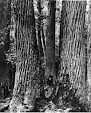
Sixty-plus years ago, my parents bought this property: two vacant lots later augmented by two more behind them, which had been logged over at some point leaving scrub trees and brush. My Father cleared it away with his brush hook and axe, but Mother made him spare this sapling, saying it would be a fine tree. Now in its full maturity, it dominates the yard, towering over the other trees in the half-acre at the back given over to woods and English ivy, perhaps a dozen or score of trees grown up over these six decades. I will miss it terribly, more than anything else connected with home. As a child, I used to talk to it and hug it -- in those days I could easily reach around it. Now its trunk is too large to encompass, and I have laid aside tree-hugging in any literal sense. But on this Lord's Day I pronounced a blessing on it, marking it with the sign of the cross. We are unlikely to meet again, this Q. palustris and I, unless it be in some forest beyond mortal ken.
Monday, October 19: the Feast of St. Luke
The days of our age are threescore years and ten; and though men be so strong that they come to fourscore years: yet is their strength then but labor and sorrow; so soon passeth it away, and we are gone. (Ps. 90:10)
I took the first shift. As soon as I saw her, it was clear that after fourscore years and fifteen, this was the end of days. Her lips were blue; her feet freezing cold even though her forehead was hot with fever (102 degrees); she struggled to breathe. Over the course of an hour, her respiration rate rose from the mid-thirties to nearly sixty; her pulse was rapid and increasingly irregular. The nurses let me call my sister from the nurses' station. On this day, we would not stray far from her side.
But the room remained cramped, too small for both my sister and I. When she arrived, we again took turns staying by Mother, a half-hour or forty-five minutes at a time. In between times, we went outside, sitting on the porch or walking on a path around a county park adjacent to the nursing home.
Thus it was that Kathy was with her when she died. I knew as soon as I walked in, from the way the nurses looked at me. One of them told me before I got to the room. Kathy was inside, crying. But Mother was at rest, pale and calm after this day of struggle.
For much of the day, her eyes were open, the first time in many days. I do not know if she was aware of us, but I cast aside all concern for her roommate (who they eventually moved somewhere else for the day), and read Scripture to her, and Psalms. It occurred to me finally that I could sing. Church musician that I am, I should have thought of this long before. I sang what I could remember of several hymns, and three plainsong settings of the Kyrie eleison, which seemed the most appropriate of all. Standing over her, stroking her hair, and singing to her, it was remarkably like singing a lullaby to a feverish child, as she probably did for me.
---
An Obituary
N.I.H. departed this life on the Feast of St. Luke, 2010, aged ninety-five.
A farm girl, she was the second of two sisters, "the one who was supposed to be a boy," as she related in later years. Tall, bookish, awkward, and fearsomely intelligent, she was no match for her sister, who married into the leading family of the district. In contrast, N. seemed destined for spinsterhood.
After graduating from high school at age sixteen, she attended Marshall University at the height of the Great Depression. She returned to her high school as a teacher of mathematics, living at home with her father and grandmother.
In the fateful year 1942, on a romantic whim she rode off with her handsome rascal of a boyfriend, a sometime coal miner five years her junior, to Bristol, Tennessee, the nearest place where they could be married without a waiting period. After a quickie wedding before a justice of a peace who specialized in such and a weekend in a hotel near the train station, it was off to war. They later managed a better honeymoon near the camp where he was stationed -- he had been in the Army since 1939, figuring it to be a better life than the mines, and was now a mess sergeant busy with feeding the flood of new recruits following Pearl Harbor. He eventually shipped out to North Africa, and was part of the fighting in Sicily and Italy. After their honeymoon, N. joined the Navy. She was part of a cryptography team that sought to break the code used by the Japanese Navy; they trained her in weather, and she (and others) compared the encoded weather reports broadcast to the fleet with the actual weather, looking for patterns. She said that in all those years, she had only one idea that was of any help.
After the war, her husband went to college on the G.I. Bill. They wanted to live "back home" near their families, but there was no work, so they moved to a larger town in the next county. They bought land on the edge of town, built a house (he, his brother, and their father, all of them skilled at carpentry and building trades), and had children.
N.'s husband died in 1975. She prospered as a widow, living a quiet and thrifty life at home, growing reclusive as family and friends passed away, one by one. She walked, gardened, canned, and read books, thoroughly content to be alone.
As the decades passed, she grew increasingly frail. At the age of ninety-three, she moved to an assisted-living facility. She made new friends and enjoyed her life, comparing it to being "with the girls back at Marshall."
N. lived a simple life, and accomplished little that anyone would consider special or outstanding. She did not work outside the home after her children came; she rarely travelled, hardly leaving her home town in her final decades. But through the long years, she maintained the values of thrift and industry that she knew were important, even when all around her was given over to waste and extravagance.
As a schoolteacher in the 1930's, she started a Girl Scout troop, the first in that part of the state. The values she lived and taught in Scouting were at one time widely held in society; they are no longer. She and others of her generation, the ones who knew the realities of Depression and World War, had much to teach us. Now they are gone, and it is up to us.
O Almighty God, the God of the spirits of all flesh, who by a voice from heaven didst proclaim, Blessed are the dead who die in the Lord: Multiply, we beseech thee, to those who rest in Jesus the manifold blessings of thy love, that the good work which thou didst begin in them may be made perfect unto the day of Jesus Christ. And of thy mercy, O heavenly Father, grant that we, who now serve thee on earth, may at last, together with them, be partakers of the inheritance of the saints in light; for the sake of thy Son Jesus Christ our Lord. Amen. (BCP p. 486)
Wednesday, October 27, 2010
"In the midst of life..."
In the midst of life we are in death;
of whom then may we seek for succor,
but of thee, O Lord,
who for our sins art justly displeased?
Yet, O Lord God most holy, O Lord most mighty,
O holy and most merciful Savior,
deliver us not into the bitter pains of eternal death.
Thou knowest, Lord, the secrets of our hearts;
shut not thy merciful ears to our prayer;
but spare us, Lord most holy, O God most mighty,
O holy and merciful Savior,
thou most worthy Judge eternal.
Suffer us not at our last hour,
through any pains of death, to fall from thee.
(BCP p. 484)
Sunday and Monday: October 10 and 11
“You'd better come right away,” my sister said. “I don't think she'll last more than another day or two.” Kathy, my sister, had been trying for several hours to contact me. I was at the church, Sunday services complete, tying up loose ends. Our mother had suffered a stroke several days previous, and I had already planned to leave for home Monday morning, to arrive midday Tuesday. Mother had been stable as late as Saturday, but her condition deteriorated overnight, leading to my sister's anxious efforts to contact me. Now I would have to leave immediately. But I had not packed, and our apartment was a quarter-hour's drive in the wrong direction. By the time I got home, my wife had done most of my packing. She loaded the Honda as I ate some lentils and rice. It was 4:30 before I was rolling.
Haste or not, I stopped for Evensong, singing it at a deserted roadside park in northern Missouri. The sun was behind thickening clouds, but the thin crescent of the new moon peeked through the clouds during the Magnificat. I munched on a chunk of bread and an apple as I drove on, traversing St. Louis and the Mississippi crossing well into the night and rolling on into Illinois. I slept for a few hours at a rest area and pressed on, stopping for Matins and fuel, eating the rest of my bread and cheese as Indiana and Kentucky rolled by.
Hardly twenty miles from home, the traffic slowed to a crawl, then a full stop. There was a truck accident ahead, blocking the highway. Eventually they got one lane open, and we all crawled forward in stop-and-go fashion. At last I was home, in twenty-five hours' time, a record time for a trip I have made many times. My sister was waiting, impatient for my arrival. But there was, after all, no need for haste; Mother's condition had stabilized. We headed out for the hospital.
Monday evening and Tuesday: October 11 and 12
“Mother, I'm here. It's me.” She opened her eyes and perhaps was aware of me. Or perhaps not.
On Wednesday, I had again been unavailable when Kathy wanted me; my wife tracked me down in adult choir rehearsal by calling J.'s cell phone. My sister, who had the medical rights,was being pressed to have a feeding tube installed to see if Mother might improve. In accordance with the promises Mother had extracted from both of us, Kathy at first refused, the doctor responding with “How can you do this, and watch your mother starve to death?” At this, Kathy started trying to reach me for my opinion. The idea was to install the tube “just for a few days” in hopes that she would improve enough to go to a nursing home and, my sister thought, perhaps begin rehabilitation and regain the ability to swallow. I agreed with Kathy's decision to go ahead with the feeding tube; we both regretted it later, and we bear the guilt of betraying our Mother.
Perhaps because of the food and the IV fluids, Mother was now in a stable condition, her vital signs strong and steady – though paralyzed and unconscious, living in her worst nightmare. And it was clear that she could survive indefinitely in this state. The physician had gotten his way.
Through the entire process, we rarely encountered any physicians. One of them stuck his head in Mother's room once while I was there and spoke with me for a total of five seconds. Kathy interacted with him hardly any more than that except for the time when he was laying guilt on her about the feeding tube, long enough to pressure her into agreement. Despite his lack of interest in the patient and her family, I have no doubt that he will collect the lion's share of payments from Medicare and private insurance.
Physicians roam the hospital corridors like demigods, demanding complete subservience from the nurses and other staff. Despite appearances, I believe that many of them mean well. I think that they would like to have more time to interact with patients and families, or at least evaluate and treat patients without Medicare and the insurance companies watching over their shoulder and the specter of malpractice suits always in the background. To be fair to our specific physician, he was of Indian descent, living in a prejudiced small town -- one of the "foreign doctors" about whom Mother frequently complained. It must be a difficult existence, and he can be forgiven for his haughty demeanor; I suspect that he despises the community and all of the unwashed and ignorant hicks who are his patients as thoroughly as they despise him.
Thank heavens for Nurses, and their assistants. They were the ones who cared for Mother, and they were unfailingly excellent, except for the Hospice personnel.
Much of Tuesday was devoted to waiting for them. The Hospice case manager made an appointment with us for 11:00; she appeared about noon. The nurse who performed the admittance evaluation said she'd show up about 2:00; it was 5:30 when she arrived. Neither of these ladies had the courtesy to call Kathy's cell phone to tell her that they were running late.
In my innocence, I thought that Hospice was a work of mercy, involving volunteers and supported by donations. Not so; they are simply another corporate vulture gnawing at the carcass of the American medical system, having found a niche by living on the 100% Medicare reimbursements for Hospice care. When I finally returned to the Midwest, my wife said that her parents wanted to make a memorial donation to Hospice. I said “Not Hospice. They can give a donation anywhere else, but not to them.”
But for all my griping, I am grateful to these gatekeepers of death for admitting our Mother to Hospice, which stopped the feedings and IV's and provided morphine for pain. That was well worth the day of waiting. [Edited to add: After reading this, M.W., whose mother died not long ago, told me that Hospice was wonderful in caring for her. I am glad that my family's experience with Hospice was not the way it is everywhere.]
Wednesday through Saturday: October 13 through 16
They moved her to a nursing home on Thursday. At the hospital, I had read poetry to her for hours, and quietly sung Evensong in her room, on the chance that she might hear it. At the nursing home, she was in a double room and I did not wish to disturb her roommate. In any event, Mother grew increasingly more distant and was probably beyond hearing anything I said.
My father died suddenly. For various reasons, I was far away and absent when my other relatives of that generation died. This was my first experience of sitting with someone, day after day, as they shed all earthly bonds. The nursing home room was cramped, so my sister and I took turns, an hour or so at a time through the day, leaving her alone for hours at a stretch as we ate meals at home and worked at the task of clearing the house of sixty years of Mother's life therein.
Aside from the Psalter, the Episcopal Book of Common Prayer was less helpful than I expected, at least in any obvious way. There are prayers for the sick, but they presume a recovery. There is a “Ministration at the Time of Death,” but it is in cheesy Rite Two language, mostly dumbed down from the Great Litany. This latter in its proper form (page 147) was better. Several of the Additional Prayers at the end of the Rite One burial service (page 487) are excellent, as is the Anthem “In the midst of life we are in death”(page 484, quoted at the beginning of this post). Silence, with only my breath-prayer (“Deo gratias”) was good. Best of all was the Ave Maria; I wished for a Rosary.
Ora pro nobis peccatoribus
nunc et in hora mortis nostrae. Amen.
I thought much about the intercessions of Our Lady for her children at the hour of their death, beginning with her own Son. On that day when the universe hung in the balance, it may be that her prayers were heard by the Father, as well as the Son.
Sunday, October 3, 2010
St. Francis, and the End of the World
Today was "St. Francis Sunday" in our parish (and, I suspect, many others), complete with the blessing of animals. This rankles me, for Sunday is a Feast of Our Lord, not of any of his servants [c.f. BCP p. 16]. I am further rankled by the romantic caricature of Francis that we encounter on such a day -- a sweet and gentle little friar who preaches to birds, wrote a beautiful little prayer, is Environmentally Conscious, and loves puppies and kittens. We hear little of Lady Poverty, and nothing of the Stigmata.
Despite all this, I was moved by one of the hymns, in the context of a service emphasizing environmental issues:
Were the world to end tomorrow,
would we plant a tree today?
Would we till the soil of loving,
kneel to work and rise to pray?
....
Born into the brittle morning
of that final earthy day,
would we be intent on seeing
Christ in others on our way?
(from "A hymn on not giving up," by Fred Kaan. Copyright 1989, Hope Publishing Company)
I believe that we have run out of Last Chances. Even if we were to somehow magically all begin living responsible and energy-efficient lives tomorrow, I think that we have already pushed the environment over the edge. As a result, the collapse of civilization seems likely at some point in this century, with a significant decline in world population through plague, pestilence, famine, and war. At the end of one of the services where we sang this hymn and in light of such thoughts, I improvised a little postlude on it, a prayer.
Today's preacher, quoting a book by Thomas Berry pretty much blamed the whole mess on Christianity, especially the "pie in the sky" version of it which I espouse, involving some form of eternal life with God. This, we are told, devalues the natural world in which we live and makes us more likely to pillage it. I will say only that there is no lack of blame to go around, and it is more the fruit of the atheistic materialism which has too often been espoused by those of us who call ourselves Christians, as well as those whose God is their belly.
The "pie in the sky" (or better, the Hope of Glory) is precisely how we can continue the struggle. No matter how bad it gets, even if we succeed in killing everything on earth (ourselves included), we are not in the end tied to this world.
"Grant us, O Lord, not to mind earthly things, but to love things heavenly; and even now, while we are placed among things that are passing away, to cleave to those that shall abide..." (the Collect for the Sunday closest to September 21: BCP p. 182)
This is not a cop-out. Rather than giving us license to continue in our profligate ways, it should cause us to fear God. We shall certainly stand before him and give account, an account which must include what we have done to this green Earth and all that dwells therein. "It is a fearful thing to fall into the hands of an angry God."
-----------
A week ago, we admitted six new Choristers to the youth choir, most of them seven or eight years of age. They took it seriously, as they ought:
Minister: As a member of the choir, will you do your best to help the people worship God?
New Chorister: I will.
For some of them, this is a Life Vocation. It is my task to help them in it, a ministry that will likely take many of them down paths I cannot imagine, and (if they keep on singing and helping people worship God, and believe and act upon the things they sing and learn) do as much as anything to help preserve this Earth and the people and other creatures who inhabit it.
In doing this, I am "planting trees."
Friday, October 1, 2010
Further thoughts on the nature of Holy Scripture
While the Bible is a Story, we must not press the analogy too far. That path leads to the Liberals, who seem to consider the whole thing a collection of pious fables, no different than any other of a score of "sacred books" -- inspiring, with moral teachings from which we can choose at our pleasure, but with no basis in reality. But the Bible is different from the Koran, the Bhagavad Gita, the Book of Mormon, and all the rest; it is based in sober, factual history.
One cannot take this too far, either. It would be too much to presume that the Creation took place in six literal twenty-four hour days, precisely as described in Genesis 1 (and ignoring the differing account in Genesis 2).
I think that Genesis 12 is a key transition between the distant past, based on oral transmission through many generations and brought into its current form by Moses or some other writer(s), and a more recent time wherein the stories have not passed through so many generations. I have no doubt that the succeeding chapters provide a faithful portrait of Abraham, Isaac, and Jacob, and the God who called them to be his own people, through whom all the families of the earth would be blessed.
Some bits of the Story, old and more recent, are more important to the "plot" than others. For example, I would not bet my life on the factuality of Joshua 10:12-14. But I would, and have, on I Corinthians 15:1-8.
This Story, as Tolkien said in the passage quoted last time, has entered the primary reality in which we live. The Word was made flesh, and dwelt among us, full of grace and truth. Many details are uncertain, because the stories as we have them are attempts to convey in words the inexpressible. It is difficult to harmonize the accounts of the Four Gospels; at the least, they differ in detail, often drastically so. But behind these stories, as well as the other stories of the Old and New Testaments, is plain sober reality. There was a day, a genuine historical day every bit as real as this day in which I sit at my computer and write this essay, wherein the children of Israel "saw the Egyptians dead upon the sea shore" (Exodus 14:30). There was another day not long after when Moses came down from Mt. Sinai, a real place that is still with us, bearing two tables of stone written by the hand of God.
And, preeminently, there was a day, a Sunday, when Mary Magdalene and others saw the risen Lord Jesus Christ, whom they knew to be dead. They had seen him die, and there was no doubt. And now, there was no doubt that he was alive, in plain fact.
Christ has died. Christ is risen. Christ will come again.
---------
From The Two Towers; Samwise Gamgee is speaking:
"The brave things in the old tales and songs, Mr. Frodo: adventures, as I used to call them. I used to think that they were things the wonderful folk of the stories went out and looked for, because they wanted them, because they were exciting and life was a bit dull, a kind of a sport, as you might say. But that's not the way of it with the tales that really mattered, or the ones that stay in the mind. Folk seem to have been just landed in them, usually – their paths were laid that way, as you put it. But I expect they had lots of chances, like us, of turning back, only they didn't. And if they had, we shouldn't know, because they'd have been forgotten. We hear about those as just went on – and not all to a good end, mind you; at least not to what folk inside a story and not outside it call a good end. You know, coming home, and finding things all right, though not quite the same – like old Mr. Bilbo. But those aren't always the best tales to hear, though they may be the best tales to get landed in! I wonder what sort of a tale we've fallen into?"
"I wonder," said Frodo. "But I don't know. And that's the way of a real tale. Take any one that you're fond of. You may know, or guess, what kind of a tale it is, happy-ending or sad-ending, but the people in it don't know. And you don't want them to."
"No sir, of course not. . . [Sam recounts part of the tale of Beren and the Silmaril as an example] "Why, to think of it, we're in the same tale still! Don't the great tales never end?"
"No, they never end as tales," said Frodo. "But the people in them come, and go when their part's ended."
The Holy Father, Benedict XVI, has for some time been using his weekly General Audience in the square of St. Peter's Basilica in Rome to speak about some of the saints of the church. He began the series, as one might expect, with St. Peter, and then the other Apostles, and other New Testament figures. From there, he continued with Clement of Rome and other post-Apostolic Christians, and has moved onward through the centuries to (at present) the late Middle Ages. The series continues.
The saints are the bridge between the New Testament and our own time. In every generation, there have been those who have served the Lord, known to us and unknown. And in them, the Story has continued.
Now, after all these thousands of years, it is our turn. What will they say of us when our time is done? More to the point, what will the Author say?
The Holy Bible, in the Authorized Version (KJV)
I will attempt to list some books that have meant much to me in the sidebar of the Music Box, and describe them here; as they are added, they may be found by the label "books" in the sidebar. I have already written of the Book of Common Prayer; now, the Bible.
--------
"Oh, how I love your law!
all the day long it is in my mind." (Psalm 119:97)
Psalm 119 is, if anything, too short. One hundred and seventy-six verses, from Aleph to Taw, cannot begin to tell the wonders of the law, or more broadly speaking, the word of God. I say one of the eight-verse stanzas each day with the Midday Office, besides its appearance in the normal round of Matins and Evensong. I always delight in this Psalm, all the more with each passing month. This delight is a microcosm of my delight in the larger story, the Old and New Testaments (and the Apocrypha) in their grand sweep from the Beginning to the End. The Bible is an untidy collection of writings, contradicting itself repeatedly. It is full of bizarre and seemingly trivial detail, as I recounted in my essay on Leviticus. It has moments of the most profound beauty, and the utmost darkness and terror. There are stories of heroic deeds, of military victories (and defeats). There are tales of abject failure, of apostasy, of betrayal. There are moments when in the darkness, light shines, a light which cannot be quenched. There is poetry, songs that have endured for millennia. It contains the wisdom of the ages, the holy Law of the LORD, the words and teachings of our Lord Jesus Christ.
And it is, from beginning to end, true. These words have been tried in the fire and have not been found wanting.
I must quote at length from J.R.R. Tolkien's essay "On Fairy-Stories," wherein he alludes to the Biblical record as a special kind of Story:
"I would venture to say that approaching the Christian Story from this direction . . . the Gospels [and I would add, all of Scripture] contain a fairystory, or a story of a larger kind which embraces all the essence of fairy-stories. They contain many marvels— artistic, beautiful, and moving: "mythical" in their perfect, self-contained significance; and among the marvels is the greatest and most complete conceivable eucatastrophe [a "happy ending," though the word conveys more than that, as Tolkien explains in the essay]. But this story has entered History and the primary world. . . . The Birth of Christ is the eucatastrophe of Man's history. The Resurrection is the eucatastrophe of the story of the Incarnation. This story begins and ends in joy. It has pre-eminently the "inner consistency of reality." There is no tale ever told that men would rather find was true, and none which so many sceptical men have accepted as true on its own merits. For the Art of it has the supremely convincing tone of Primary Art, that is, of Creation. To reject it leads either to sadness or to wrath.
"It is not difficult to imagine the peculiar excitement and joy that one would feel, if any specially beautiful fairy-story were found to be "primarily" true, its narrative to be history, without thereby necessarily losing the mythical or allegorical significance that it had possessed. It is not difficult, for one is not called upon to try and conceive anything of a quality unknown. The joy would have exactly the same quality, if not the same degree, as the joy which the "turn" in a fairy-story gives: such joy has the very taste of primary truth. (Otherwise its name would not be joy.) It looks forward (or backward: the direction in this regard is unimportant) to the Great Eucatastrophe. The Christian joy, the Gloria, is of the same kind; but it is preeminently (infinitely, if our capacity were not finite) high and joyous. But this story is supreme; and it is true. Art has been verified. God is the Lord, of angels, and of men— of elves. Legend and History have met and fused."
----------
Biblical translation requires at least two skills. It requires knowledge of the original languages: Hebrew and Aramaic, Greek. And it require knowledge of the target language. It is in this latter skill that the modern translations -- anything later than the "old" Revised Standard Version -- fall short. The scholars who composed the NRSV, the NIV, the NEB, the Jerusalem Bible, and similar versions probably know the old languages at least as well as the seventeenth century scholars of the AV. They certainly have better source documents, though I am not aware of any differences of content between the AV and the new versions that amount to more than trivialities. But they do not know English as well as William Tyndale, Lancelot Andrewes, and the others whose work is in the pages of the AV. The modern translators may have a clear idea of what the original language says, but too often they cannot find the English words and grammar to express it precisely and poetically.
Samuel Johnson, from the Preface to his Dictionary:
"I have studiously endeavored to collect examples and authorities from the writers before the restoration, whose works I regard as the wells of English undefiled, as the pure sources of genuine diction. . . . From the authors which rose in the time of Elizabeth, a speech might be formed adequate to all the purposes of use and elegance."
I would submit that Johnson remains correct: the English from the time of Elizabeth I to the Restoration is better than that of any period since. The English of our current age, from about 1960 onward, is perhaps the most depraved of all.
Precision of language and poetics is not a small thing. It is only through language that the Scriptures communicate anything at all to us. If the language is clumsy, communication is hindered. If the language is careful and precise, and at the same time beautiful, what is read is more likely to be understood and remembered. Because it is Story, the manner of its telling is significant. The precision with which the Biblical authors tell their stories, down to the individual words, is astounding. There is hardly a detail that does not, in some way, contribute to the telling. Some of this will necessarily be lost in translation, but as much as possible of the sense of the original must be conveyed in the target language. I believe that the Authorized Version succeeds in this better than any other English translation.
Nonetheless, one can learn from the variety of approaches to the text found in the many English translations. My one study Bible is an Oxford Annotated NRSV, and it is of great value to me. I consult the New English Bible from time to time, and the "old" RSV. The Jerusalem Bible is good, too; I am less fond of the NIV, but many people prefer it. I rather like the old Phillips translation at times as something of a paraphrase.
The RSV and NRSV share one characteristic that I like very much: footnotes. When there are alternative readings for a word in various manuscripts, or alternative ways of translating a word, it often gives them in the footnote. Or one might find something like this: "Meaning of Heb. uncertain," which is indeed the case for a number of passages. I appreciate them saying so. When there are names which are meaningful for the passage, it gives their meaning: an example is at Hosea 1:4-8 and 2:22-23, where the names Jezreel, Lo-ruhamah, and Lo-ammi are the point of the passage. The KJV gives the names in chapter one when Hosea names his children, but at 2:22-23, it gives the English translation, not the names, and one misses part of the connection between these two passages. The NRSV gives the names in both places, with their translation in footnotes; this is superior.
The KJV does something that, in turn, I wish other translations would do: when there are words or short phrases which are the translators' suggestions for filling in what is implied in the original, they put them in italics. This is especially valuable in the O.T., when the Hebrew is often elliptic in comparison to English. Sometimes the translators supplied entire phrases, and one can question whether they did rightly or not; by rendering the supplied text in italics, the reader can figure it out for himself. An example of this is at I John 2:23: "Whosoever denieth the Son, the same hath not the Father: but he that acknowledgeth the Son hath the Father also."
The Bible in any translation is better than any other book under the sun. It does us no good if we do not read it. But if we do, it is an unfailing guide, a "light upon [our] path" (Ps. 119:105). It is open to the simplest person; it is a fount of wisdom to the wisest and most subtle of scholars. But it remains a closed book to any who do not approach it in faith.
"Blessed Lord, who hast caused all holy Scriptures to be written for our learning: Grant that we may in such wise hear them, read, mark, learn, and inwardly digest them; that, by patience and comfort of thy holy Word, we may embrace and ever hold fast the blessed hope of everlasting lift, which thou hast given us in our Savior Jesus Christ; who liveth and reigneth with thee and the Holy Spirit, one God, for ever and ever. Amen." [Collect for the Sunday closest to November 16: BCP p. 184]
Sunday, September 19, 2010
Archbishop and Pope
In the upstairs hall of our church, there is a photograph of the Most Reverend and Right Honorable Dr. Rowan Williams, Archbishop of Canterbury, with a handwritten note of greeting to our parish inscribed on it. This photograph from the Archbishop gives me hope, especially on bad days in the parish. It reminds me that my little bit of work in this place is in communion with the much larger work of Anglicans in places of infinite variety around the world, large and small.
I am glad that Rowan and Benedict, the Bishop of Rome, have become, to all appearances, personal friends, with a shared recognition of their task of Christian witness in an unbelieving world. I hold both of them in high regard, and wish them God's grace and blessings in all that they undertake.
In this light, the Pope's recent visit to Great Britain was for me a source of unalloyed joy, culminating in the Choral Evensong at Westminster Abbey on Friday. Here is the Order of Service; it is worthy of examination as a window into what must have been a splendid occasion.
Some impressions:
- One does not often have an Order of Procession like this (page 8), including the sixth-century illuminated Gospel book brought to Canterbury by its first Archbishop, and concluding with the Pope and Archbishop and their chaplains, all entering to "Christ is made the sure foundation" to the tune Westminster Abbey, in the building for which it was named and where its composer was Organist.
- I am glad that we Anglicans presented ourselves at our best: Choral Evensong in one of the great churches of the world. The service of Choral Evensong, with the musical repertoire that has developed for it, is the unique gift of the Anglican Communion to Christendom.
- The musical selections could not have been better, from the list of organ voluntaries before the service (page 4) and the anthems by Byrd, Stanford and Tallis (page 6-7) to the hymns and Psalm, and Stanford in A for the Magnificat and Nunc Dimittis, and Duruflé's Ubi caritas as the Anthem, topped off with Bach's Komm, heiliger Geist as the first of two concluding voluntaries. We have sung some of this music in our parish choir, and I have played some of the voluntaries; this music is thoroughly representative of our tradition.
- The Service was a reminder that the Choral Office is ecumenical in a way that the Holy Eucharist cannot be. We differ on many things, but we can pray together, and sing together.
- The address given by the Holy Father was an inspiration to me. Using the processional hymn as a springboard, he spoke of Christ as the source of all Christian unity:
"Our commitment to Christian unity is born of nothing less than our faith in Christ, in this Christ, risen from the dead and seated at the right hand of the Father, who will come again in glory to judge the living and the dead. It is the reality of Christ's person, his saving work and above all the historical fact of his resurrection, which is the content of the apostolic kerygma and those credal formulas which, beginning in the New Testament itself, have guaranteed the integrity of its transmission. The Church's unity, in a word, can never be other than a unity in the apostolic faith, in the faith entrusted to each new member of the Body of Christ during the rite of Baptism. It is this faith which unites us to the Lord, makes us sharers in his Holy Spirit, and thus, even now, sharers in the life of the Blessed Trinity, the model of the Church's koinonia here below. . . ."
"Fidelity to the word of God, precisely because it is a true word, demands of us an obedience which leads us together to a deeper understanding of the Lord's will, an obedience which must be free of intellectual conformism or facile accommodation to the spirit of the age. This is the word of encouragement which I wish to leave with you this evening, and I do so in fidelity to my ministry as the Bishop of Rome and the Successor of Saint Peter, charged with a particular care for the unity of Christ's flock."
--------
In perusing the Holy Father's other speeches during his visit, I found this, in his address to the people of St. Peter's Residence, a home for the elderly in London:
"Those of us who live many years are given a marvellous chance to deepen our awareness of the mystery of Christ, who humbled himself to share in our humanity. . . . [O]ur physical capacities are often diminished; and yet these times may well be among the most spiritually fruitful years of our lives. These years are an opportunity to remember in affectionate prayer all those whom we have cherished in this life, and to place all that we have personally been and done before the mercy and tenderness of God. This will surely be a great spiritual comfort and enable us to discover anew his love and goodness all the days of our life."
--------
In our little parish church, far removed from Westminster Abbey in almost every possible respect, we had a good choral service this morning. The choir sang verses from Psalm 79 to Tone IV, capturing the dark intensity of these words:
O God, the heathen have come into your inheritance;
they have profaned your holy temple *
they have made Jerusalem a heap of rubble.
They have given the bodies of your servants as food for the birds of the air, *
and the flesh of your faithful ones to the beast of the field. . . .
They later sang "There is a balm in Gilead" in the fine arrangement by William Dawson, in a manner that was fully committed to this great Spiritual, communicating that being a Christian is something that demands everything from us, and is in turn our only refuge and help, the "balm in Gilead to make the wounded whole." In our own way, we gave testimony this morning to "our faith in Christ, in this Christ, risen from the dead and seated at the right hand of the Father, who will come again in glory to judge the living and the dead."
It is as we worship and serve this our Lord Jesus Christ, looking to Him alone, that we are one. We must hold on to this.
Tuesday, September 14, 2010
"Ha! Ha!" among the trumpets
[from a sermon by Martin H. Franzmann, preached at Zion Lutheran Church, St. Louis, June 4, 1956. A more complete text can be found in the book Come to the Feast, the collected hymns of Martin Franzmann, edited by Robin A. Leaver: MorningStar Music Publishers, 1994. It is an excellent little book, not least for the four sermons appended to the main text, from which the following quotation is drawn:]
-------
"Nowhere in that jubilant and exuberant book, the Old Testament, is there such an expression of joyful wonder at the creation of God as in the latter chapters of the Book of Job . . . . And in all these chapters, in all these pictures of beings fearfully and wonderfully made, there is nothing quite like the picture of the horse in his strength [Job 39:19-15], the horse whose neck is clothed with thunder, the glory of whose nostrils is terrible, who paweth in the valley and rejoiceth in his strength, who mocketh at fear, who swalloweth the ground with fear and rage -- 'He saith among the trumpets, 'Ha! Ha!''
"God has made him a horse, a steed of war. He delights in being a horse; he is glad to work like a horse and to fight like a steed of war. He hears the trumpets of war, and he cannot stand still at the sound of the trumpet; that trumpet is God's call to him to be what God has made him. And he greets that call with an equine Alleluia! He snuffs the air, and stamps the ground, and 'saith among the trumpets, 'Ha! Ha!'"
----------------------------
For several weeks at Matins, we have been reading the Book of Job. I have written of it elsewhere: Some thoughts on the Book of Job. Like Dr. Franzmann, I delight in the latter chapters of the Book, wherein the LORD answers Job "out of the whirlwind" (Job 38:1).
The whirlwind, or tornado as we would call it, is a Force of Nature of the most immense power. That is, possibly, why the author depicted the LORD as speaking from it, calling his listeners (which include us, all these thousands of years later) to account. "Gird up now thy loins like a man: for I will demand of thee, and answer thou me. Where wast thou when I laid the foundations of the earth? declare, if thou hast understanding." (Job 38:3-4)
When we are tempted to make God into a cosmic teddy bear, all love, cuddly warmth, and forgiveness, which we can set on a shelf to gather dust, bringing Him out when we are feeling lonely or sad, we should remember the LORD speaking out of the whirlwind. "The wind bloweth where it listeth, and thou hearest the sound thereof, but canst not tell whence it cometh, and whither it goeth: so is every one that is born of the Spirit" (St. John 3:8).
No hand can thwart the Spirit's intention. That divine intention has, from the foundation of the world, had at its center a Cross, and we are part of it, we who are of the Body of Christ. In our participation in His death upon the Cross, we find the gate of life. "I am crucified with Christ: nevertheless I live, yet not I, but Christ liveth in me: and the life which I now live in the flesh I live by the faith of the Son of God, who loved me, and gave himself for me." (Gal. 2:20).
Franzmann again:
"Perhaps you have decided to work like a horse in your ministry. Do so by all means. But do not work like a drudging nag under the lash, or a weary bag of bones under the yoke. We are not under the yoke in our ministry. The necessity which is laid upon us is not that of the yoke and the lash but that of the irresistible call of God's own trumpet."
The Collect for Holy Cross Day, September 14:
Almighty God, whose Son our Savior Jesus Christ was lifted high upon the cross that he might draw the whole world unto himself: Mercifully grant that we, who glory in the mystery of our redemption, may have grace to take up our cross and follow him; who liveth and reigneth with thee and the Holy Spirit, one God, in glory everlasting. Amen.
Sunday, September 5, 2010
Red Beans and Rice, Music Office Style
This has been a busy week, so I cannot write anything profound. Thus, a recipe:
Needed:
- small Rice Cooker
- Rice, either Brown or White: 1 "cup"(see note below)
- Dried Soup Vegetables: ½ cup
- Can of Red or Pinto Beans, or similar amount of leftover "home-cooked" beans
- Cajun Seasoning to taste (I use one or two Teaspoons)
- Water
- Cooking Oil: about 1 Tablespoon
By one "cup" of rice, I mean one Rice Cooker "cup," which is 6 ounces, or three-quarters of a standard U.S. measuring cup -- and, very conveniently, one good-sized serving. Such a measuring cup supposedly comes with a rice cooker when you purchase it; the three cookers I have owned are all from thrift stores, and did not have the cups. I take a regular measuring cup and fill it about three-quarters full. One need not be exact.
Dried Soup Vegetables are handy to keep around. They can be purchased in the bulk food section of our local natural foods cooperative. If not available where you live, you can order them from Frontier Natural Products, which is the source from which our cooperative gets them.
----------
Put the rice and dried vegetables in the rice cooker. Add the cooking oil. Add water as appropriate for your rice cooker, probably an inch or so above the level of the rice/vegetable mixture, a bit more if you are using brown rice. If you have time, you can let the rice and vegetables soak for a while before cooking; I prepared it to here before Matins this morning and left it to soak until after the late Eucharist.
Plug in the cooker, and cook the rice. Have ready the can of beans. When the rice cooker clicks off from "cook" to "warm," stir in the beans and cajun seasoning, stirring to the bottom of the cooker pan (with a wooden spoon to avoid scratching the cooker). Put the lid back on and let it set on "warm" for fifteen minutes or more. Unplug the cooker and serve.
Serves one hungry person (me, on a Sunday after church. I fixed it today in my office as I worked on next Sunday's bulletins).
Subscribe to:
Posts (Atom)

 Posts

